The data says Pump.fun’s top KOLs lost $3.5M trading their own calls last month, while earning $1.3M for making them.
I don’t buy it. Public wallets only show what a caller wants you to see, and the selling happens in the ones nobody’s linked.
For the record, I don’t touch memes. But the lesson holds anywhere: you can’t assume to have full picture by just looking at public wallets. There are a lot of insider games going on.
Here’s what we got today:
SEC greenlighted buybacks. Here are five top tokens with buybacks.
Note Systems Deep Dive. Autocallables are coming onchain.
Around the web. Ondo introduced Intelligent Portfolios, Priority gas auctions from Arbitrum, and more.
Today’s email is brought to you by Note Systems — the onchain autocallable protocol.
Here’s your Edge 🗡️!
News & updates
Top Five Tokens With Buybacks
A token buyback is no longer, by itself, a promise of managerial effort.
That’s the SEC staff’s current position.
Aka, a protocol that makes real money can send it back to holders without the buyback alone making its token look like a security.
That’s a big deal for every crypto project with revenue. But lets read the fine print first.
What the SEC actually said
What happened? The SEC’s Division of Corporation Finance answered the question directly in its crypto asset FAQ (Question 2.5):
“Where a crypto system is functional and has no central party, an issuer’s announcement of a non-security crypto asset buyback program would not constitute a representation or promise to undertake essential managerial efforts.”
Quick 80/20 on the fine print:
It only covers tokens that are already non-securities. A buyback doesn’t make your token a security. It doesn’t make it a non-security either.
There are two conditions. The network has to be functional, and it can’t have a “central party.” The SEC defines that as anyone “having operational, economic, or voting control of a crypto system.”
Networks that aren’t functional yet get no free pass. If they pitch a buyback as yield for holders, the same answer says it could count as a promise.
It’s staff guidance, not law. No legal force, and a future SEC can rewrite it.
So who’s actually sending revenue back to holders? I ran the numbers.
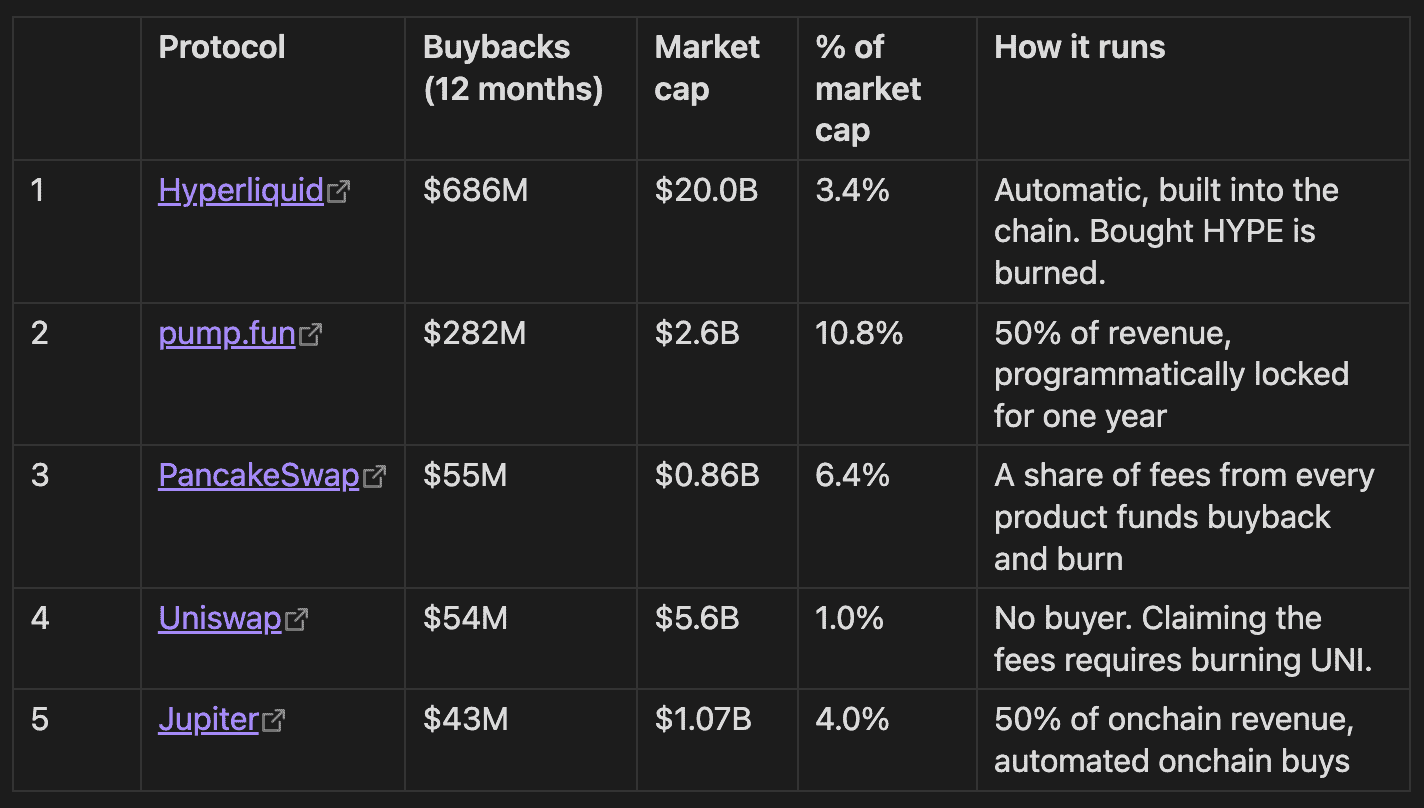
The 5 biggest buyback programs in crypto
How I picked them: I pulled DefiLlama’s Holders Revenue data and kept only protocols that use revenue to buy their own token on the open market (or, in Uniswap’s case, force someone else to). Then I ranked them by the last 12 months and divided by circulating market cap to see how much each buyback actually moves the needle.
Buybacks from DefiLlama, market caps from CoinGecko, both as of Oct 1, 2026.
A few things jump out.
Hyperliquid is in a league of its own. $686M of HYPE bought back in a year. That’s 2.4x pump.fun and more than the other four combined.
pump.fun returns the most relative to its size: 10.8% of its market cap a year.
Uniswap looks smallest, but it’s early. Its fee switch only went live in late December 2025 and rolled out to more chains through July. Annualize the last 30 days and it’s at 3.4%, level with Hyperliquid.
Size is one thing. But the buyback mechanism is built is another, and now that matters more.
Code beats discretion
Here’s the principle I take from the SEC’s wording: the less any person can change, pause or redirect a buyback, the closer it sits to what the SEC described.
By that measure, Uniswap has the most defensible setup on this list. Technically, it isn’t even a buyback.
How it works: Uniswap’s protocol fees flow into an immutable onchain contract called TokenJar. The only way to withdraw them is to burn UNI in a second contract called Firepit. Nobody at Uniswap buys anything. Whoever wants the fees has to get UNI and destroy it to claim them.
The rest of the list sits on the same spectrum:
Hyperliquid: fees convert to HYPE “in a fully automated manner as part of the L1 execution,” and that HYPE is burned (Hyperliquid docs). The buyback lives inside the chain itself.
Jupiter: 50% of onchain revenue buys JUP “through automated, programmatic onchain transactions” (Jupiter docs). About 134M JUP burned so far.
pump.fun: 50% of revenue is “programmatically locked” for buybacks and burns for one year from April 28, 2026 (pump.fun). After that, it’s the company’s call again.
PancakeSwap: 15 to 23% of spot trading fees, 20% of perps profits and cuts from other products fund the burns (PancakeSwap docs).
To be clear: I’m not a lawyer, and the SEC hasn’t applied this test to any of these protocols. This is how I read the wording, not a legal opinion. Just a take from random anon.
Sponsored Deep Dive
Note Systems: Building the DeFi Primitive for a $538B-a-Year TradFi Market
Banks issued $538bn worth of autocallable and callable notes in 2025. It’s one of the biggest products in TradFi. But DeFi has nothing of the sort.
We’ve built spot, perps, lending, and options. New DeFi primitives have big upside potential. See Uniswap, Aave, Pendle, etc.
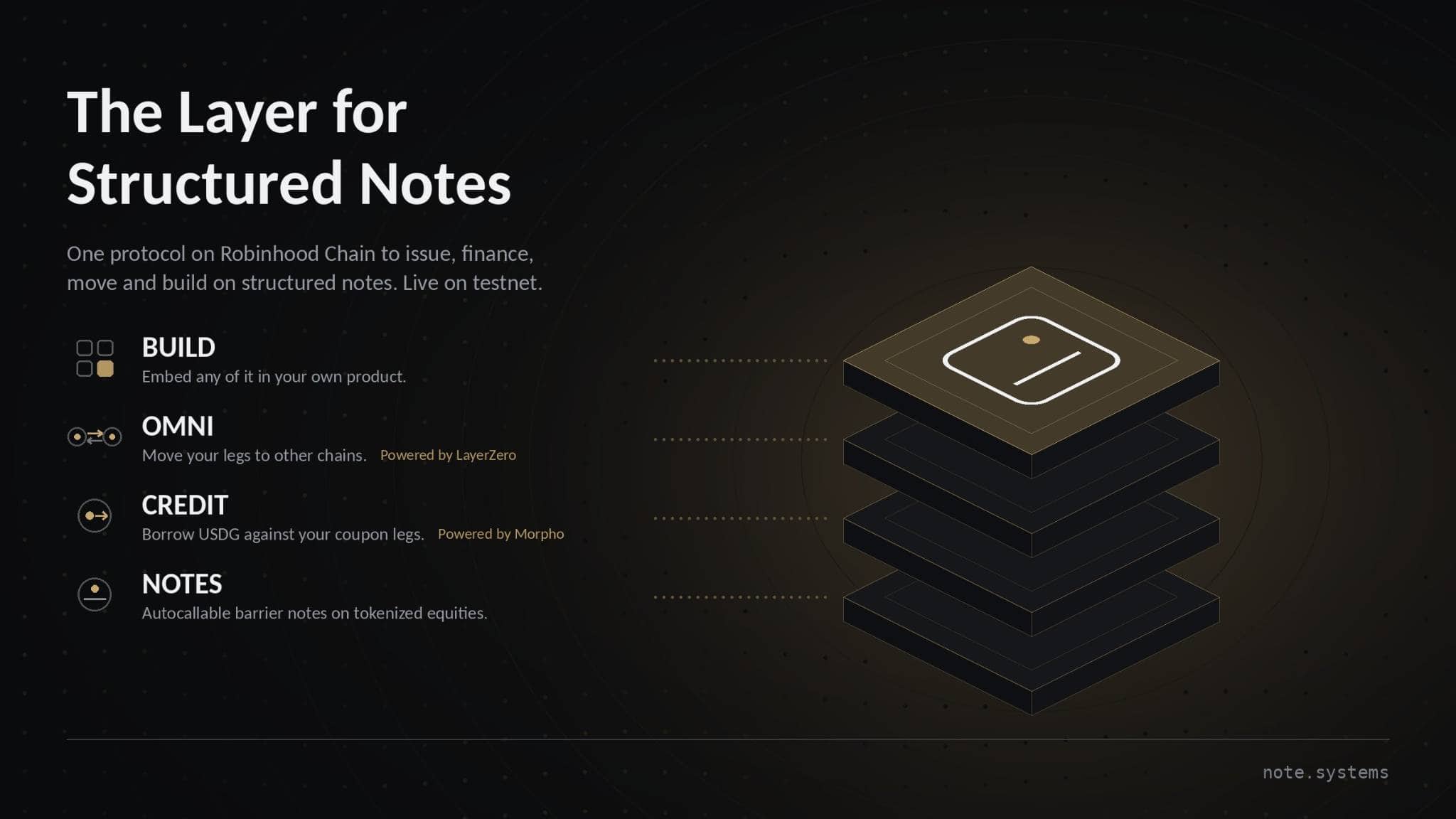
Note Systems is building this new primitive on Robinhood Chain.
Quick 80/20 on autocallables
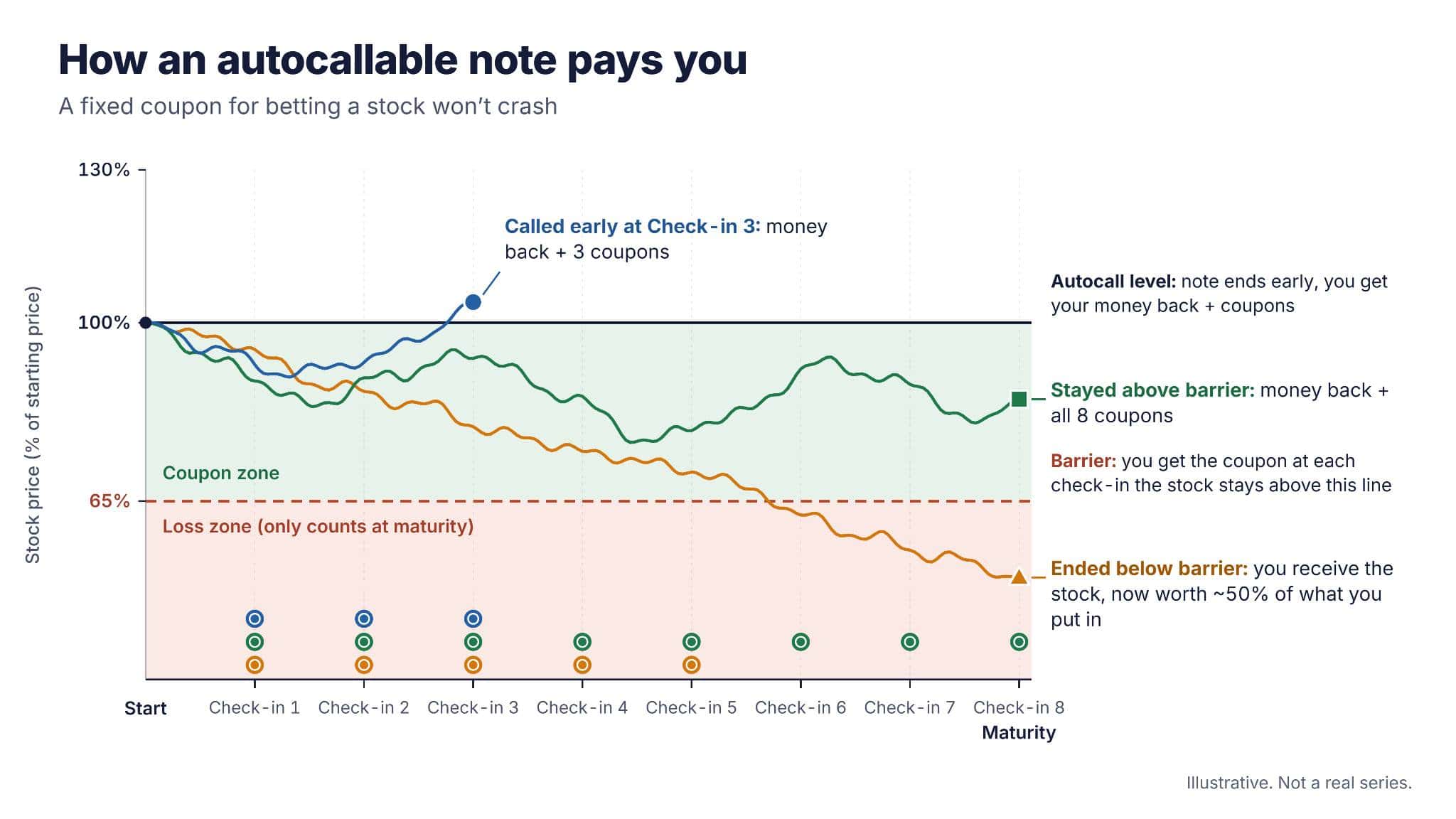
An autocallable pays you a fat coupon for betting a stock won’t crash.
Three rules:
The barrier (say, 65% of the starting price). Every check-in the stock stays above it, you get a coupon.
The starting price. If the stock is back at or above it on a check-in, the note ends early. You get your money back plus coupons.
Maturity. If the stock finishes below the barrier, you eat the loss. You get handed the stock instead of your cash.
It’s great for retail because the yield doesn’t need the stock to go up. It just needs it to not fall apart.
On the other side of the trade, the one who pays for that coupon is buying crash protection.
Why DeFi never built one
DeFi tried. In 2023, Ribbon settled one ETH autocallable, with Marex, a London broker, on the other side. Nothing followed at scale.
Why? Because it was dependent on banks. When you buy an autocallable, you’re actually selling crash protection to the bank. It pays your coupon, hedges the risk on its own books, and hands you an IOU.
That IOU is the whole product. And that doesn’t scale well onchain.
DeFi’s option vaults had the same problem in a different shape. Retail deposited, and professional market makers bought the other side at a weekly auction. The counterparty was still a desk.
What changed? Two missing ingredients finally exist.
Real stocks that settle on-chain. Tokenized stocks now sit at $3.15B, and Robinhood Chain holds $1.02bn in TVL.
And reliable prices. Robinhood’s stock tokens have Chainlink feeds, and Note Systems only reads them at the official US close. A weird (probably manipulated as well) Sunday wick can’t blow up your note.
So what does it look like with the bank deleted?
The New DeFi Primitive
Aave didn’t build a better lender. It made the lender unnecessary, and it now holds $18.9bn. It built a completely new DeFi primitive. Note Systems runs the same play for autocallables.
The bet is simple: every stock that trades onchain should have a yield curve and a protection market.
Note Systems is where those two prices get discovered, escrowed, and settled.
You hold tokenized NVDA. Today you can hold it or sell it. With a SHIELD position, you post your stock and prefund the coupons. If it finishes below the barrier, you’re paid the full starting price in USDG. You keep your exposure without selling.
You hold stablecoins. With a COUPON position, you deposit USDG and collect the coupon at every check-in the barrier holds.
Both sides lock up everything they could owe before the note goes live. Every coupon, every dollar of principal. No bank IOU, no liquidations, no margin calls (risk docs).
No dealer quotes the coupon, either. It’s discovered by supply and demand at each series close, the same way Uniswap lets pools set prices instead of professional market makers.
What does it pay? In the docs’ worked example, a note pays 0.50% a week gross. That’s about 26% annualized, or 19.6% net after the protocol’s cut. It’s an illustration, not a track record. Nothing is on mainnet yet.
The trade-off
When you buy COUPON, you get:
A fixed coupon at every check-in where the stock holds above the barrier.
A cushion. The stock can fall up to 35% by maturity, and your principal is still intact.
But you give up:
Coupons in bad weeks. Any check-in below the barrier pays nothing.
The upside. The most you can make is the coupons. If the stock rips, the note calls early, and you’d have done better owning it.
Your principal if it breaks at maturity. And the loss counts from the starting price, not from the barrier. Take a stock that starts at 180 with its barrier at 117. At 117.00 on the final day, you get your full 100,000 USDG back. At 116.99, you get stock worth 64,994. One cent costs you 35%.
With SHIELD, you keep your upside and get cash protection below the barrier without selling. But you do have to prefund the coupons.
Why this beats the bank’s version
Quick 80/20 on Note Systems advantages over TradFi:
Collateral, not an IOU. Bank notes are unsecured claims on the issuer. Theoretically, they can default on you. Holders of Lehman’s “principal protected” notes learned what that means the hard way. Here, the payout is escrowed on day one.
Retail gets the other side. In TradFi, selling protection is the bank’s trade. Here, any eligible stock-token holder can take it.
DeFi composability. A COUPON leg can be transferred, borrowed against, or bridged. There’s no secondary market for legs yet, so plan to hold to autocall or maturity.
Permissionlessness, operational and pricing transparency, and more.
To be fair, the bank version still wins on scale, choice of stocks, and regulatory protection. That’s the gap Note Systems has to close. But they’ve not even launched on mainnet, so….
Primitives get built on
Products get commoditized. Primitives get whole ecosystems built on top of them, and that’s where network effects come from.
That’s the bigger picture here. Note Systems isn’t just another product; it’s the layer for structured notes on Robinhood Chain. The protocol to issue, finance, move, and build on them.
It works because every leg is a token with a known payoff, a live price, and a coupon attached. That makes it something other protocols can use, and the testnet already has three pieces stacked on top of the notes:
Credit: wrap your COUPON leg and borrow USDG against it on Morpho, while it keeps earning.
Omni: move your leg to another chain through LayerZero. Settlement always stays on Robinhood Chain tho.
Build: wallets and apps plug in with one deposit call and keep up to 50% of the fees they bring in.
A cut of every coupon paid, which comes out of the COUPON side’s payout. If the stock is below the barrier at a check-in, there’s no coupon, so there’s no fee.
A fee on notional when the note is struck, paid by the SHIELD side.
90% goes to a continuous Dutch auction that buys NOTE off the market. The auction price decays toward the Treasury floor and never pays below it. The NOTE it buys streams to sNOTE stakers over 7 days. The other 10% goes to the Treasury.
They also have a veNOTE tokenomics system. We don’t have the space to get into it now; you can read more about it here.
Try it on the testnet
The testnet runs on faucet USDG and mock stocks. You can take either side and earn points.
It has been live for a few weeks, and the numbers look great.
~3k testnet users across both sides of the trade.
~86k deposits across 48 notes.
Note Systems will be on mainnet once the audit with Cyfrin completes.
(Btw, testnet points won’t give you tokens directly. They’ll eventually be converted to mainnet points. So, it’s worth experimenting.)
Ethena now backs USDe with stock basis trades on Binance as well. That equity basis has averaged ~11%+ annualized over the past six months.
Chainlink launched CCIP 2.0. Institutions can now add their own Cross-Chain Verifiers on top of Chainlink’s default security for cross-chain transfers.
Base shipped Cobalt, its third network upgrade of 2026, with Validity Transactions and B20 enhancements live on mainnet.
LONGxyz launched LONG 500, the “S&P 500 of tokenized stocks”. It’ll be compounding its AI pair into a community-owned reserve.
Open USD (OUSD) is live. It’s the stablecoin from Open Standard, with integration paths through Coinbase, Mastercard, Stripe, and Visa≥.
Papertrade, a Hyperliquid-based synthetic perps exchange, set October 10 as the launch date.
Solana‘s Alpenglow consensus is running on testnet. TowerBFT is retired there, and votes have moved off-chain. Devnet is next.
🧰 The Toolkit
Tempo launched Mercator, a tool router for AI agents. It lets an agent discover, price, and pay for multi-step tool workflows through one interface.
Stuck Funds Checker scans your address for unfinished bridge withdrawals on EVM, Solana, Sui, Aptos, and NEAR. It’s read-only, with no wallet connection.
Sparsity launched a Holder Strength score that rates Robinhood Chain and Solana tokens 0 to 100 on holder conviction, demand, market health, and attention.
Polymarket is being sued by New York state over alleged illegal gambling, the same week it rolled out self-exclusion tools.
The Fed opened a 60-day comment period on how banks it supervises can issue stablecoins, and what has to back them.
The SEC is losing its best-known crypto advocate. “Crypto Mom” Hester Peirce departs October 2.
KelpDAO is taking LayerZero to court, saying LayerZero signed off on its bridge configuration before blaming Kelp for the hack.
📉 Down Bad
MetaMask is exiting its validators after a security incident in its infrastructure. It says wallets face no immediate threat, and the exit should finish by October 7.
BlockTower‘s Ari Paul says Coinbase “lost” $25M of his firm’s assets while covering up repeated hacks, and still hasn’t returned it.
KelpDAO is taking LayerZero to court, saying LayerZero signed off on its bridge configuration before blaming Kelp for the hack.
🚨 Rekt Report
Bitget lost ~$351.6M from its hot wallets. It says cold wallets are untouched, and the $464M+ User Protection Fund covers users. Withdrawals were paused.
Payy, a privacy stablecoin payments app, lost ~$1.83M USDC through a forged withdrawal slipped into a verified rollup batch.
Abracadabra‘s MIM fell ~50% below its peg. The protocol is hiking rates on every Cauldron and has paused Curve bribes until the peg comes back.
🧹 Cleanup Crew
Circle and Tether blacklisted ~$318K of the Bitget loot. Most of the rest sits in ETH, which nobody can freeze.
Ostium launched a recovery portal that repays in full the 90% of affected OLP wallets with losses of 1,000 USDC or less.
DISCLAIMER: I’m NOT a financial advisor. This content is for education and information purposes only. Crypto and DeFi are risky and speculative. Please do your research before investing.
Whenever you’re ready, here’s how we can help you:
🚀 The DeFi Edge Ventures– We identify, invest, and help amplify DeFi Protocols that positively impact the Crypto space.
You’re receiving this email because you signed up for my newsletter. You can update your Preferences or Unsubscribe here. 600 1st Ave, Ste 330 PMB 92768, Seattle, WA 98104-2246