How-to
How to Farm Perp Platforms?
Points farming is trending again.
(Sorta.) Token sale to the community is the current preferred method. But point system & airdrops are still hot.
When you hunt for airdrop farms, here’s what to check:
- Previous raise & valuation: Higher valuation = bigger airdrop.
- Product & team quality: Without a solid foundation, you’re gambling.
- Wallet competition: You’ll need to be among the top farmers to make it worth it.
Right now, everyone on CT seems to be farming one perp DEX or another. So in this article, I’ll go through how you can farm perps.
#1. Farm multiple airdrops at once
This used to be a common strategy when there were constant new chains. People would ape into new apps on chains without tokens so they could earn both the chain token and the app token.
We have a similar opportunity with perps.
Liquid is a token‑less perp aggregator. For stock trading, it has integrated Ostium Perp DEX. So by trading stock perps on Liquid, you should get both Liquid and Ostium exposure.
Because the public launch is fairly new, Liquid doesn’t have a points program yet — which also means we’re very early.
#2. Be a maker, not a taker
Price discovery and fair trading require deep liquidity in the order books. Makers often take responsibility for that.
Makers set up orders in the book, while takers just hit the market price. Makers add liquidity; takers remove it.
In other words, perp platforms often give additional points for makers on their platforms. So instead of market orders, use limit orders.
As an extension of this principle, you can focus on tokens without deep liquidity. While ETH/BTC pairs have deep liquidity, Lighter is known to give 2-3x more points on average when trading altcoins with lower liquidity like KAITO and BERA.
#3. Delta neutral strategies
These are strategies that won’t lose money in any market conditions.
You might, for example, short $ETH on one platform while going long on another. In theory, you should be fine regardless of the direction.
If the short position is losing money, the long will be winning. And vice versa.
Many people still end up liquidated even with “delta‑neutral” strategies. But an extra step can reduce that liquidation risk.
Place take profits for each side of the trade at the liquidation price of the other side of the trade. This will ensure that as soon as one position is liquidated, the other one is closed.
#4. Funding rate arbitrages
These are often a sub-category of Delta-neutral strategies.
It allows you to capitalize on the difference in funding rates between exchanges by opening long and short positions for the same asset on different exchanges.
Here’s a step-by-step:
- Go to Loris.tools. You can filter for the exchanges that you’re farming.
- Click on “MAX ARB” to sort the arbitrage opportunities shown by the funding rate difference. The bigger the difference, the better it is.
- Then go to the respective exchanges, then execute the arbitrage strategy by long & shorting.
- When the funding rate difference is gone for some time, close the positions.
The biggest risk here is liquidation risk. Always pay attention to it & play it safe:
- Don’t take too much leverage.
- Check your position daily.
- Beware of manipulation on low-liquidity markets, and so on
#5. Aggressively push the right metrics
This is sorta obvious, but worth repeating. Perp Dexes will give you points according to the metrics you generated for the platform.
So try to pump your Volume and Open Interest. With higher open interest, you might get liquidated much faster. Even when pumping volume, unless the fees are zero, it’ll add up. So pay attention to that.
Using estimates around potential returns from an airdrop can be helpful here. If you are farming any big dex, there are probably tools out there to help you with that.
Some of the Perp farms on my radar are Liquid, EdgeX, Ostium, Lighter, & Variational.
Sponsored by LIt Protocol
Lit Protocol: The Key to Unlocking Autonomy
Lit Protocol is a decentralized network for managing keys and secrets.
It powers some of the biggest products in our industry. This includes names like Gitcoin, Lens Protocol, Emblem Vault, Humanity Protocol, Spheron Network, Genius Protocol, and many others.
The metrics speak for themselves:
- >$336M in transaction volume
- ~30M in encryption operations
- >1.73M+ wallets created on Lit’s Datil mainnet beta
- ~$455M in Assets Under Decentralized Management (AUDM).
Vincent is an open-source framework secured by Lit Protocol that allows devs to create AI Agents that operate crypto networks, traditional finance (TradFi), and e-commerce platforms. It can make agents follow rules like:
- Rebalance up to $150/day.
- Only touch Aave, Morpho, and Hyperliquid.
- Stop if the drawdown hits 10%.
By directly plugging into smart accounts, it is also evolving into a self-custodial automation layer. Rather than giving custody to a third party, users can authorize agents and automations inside their own wallet.
This is huge for wallets that want embedded automation. And broadly for developers creating automations.
Updates
$UNI-fication: Bullish or Bearish?
An OG DeFi protocol took over crypto Twitter.
What happened? The UNIfication proposal from the Uniswap team is making quite the waves.
Many people considered it a very bullish proposal. It has many suggestions that’ll make $UNI valuable.
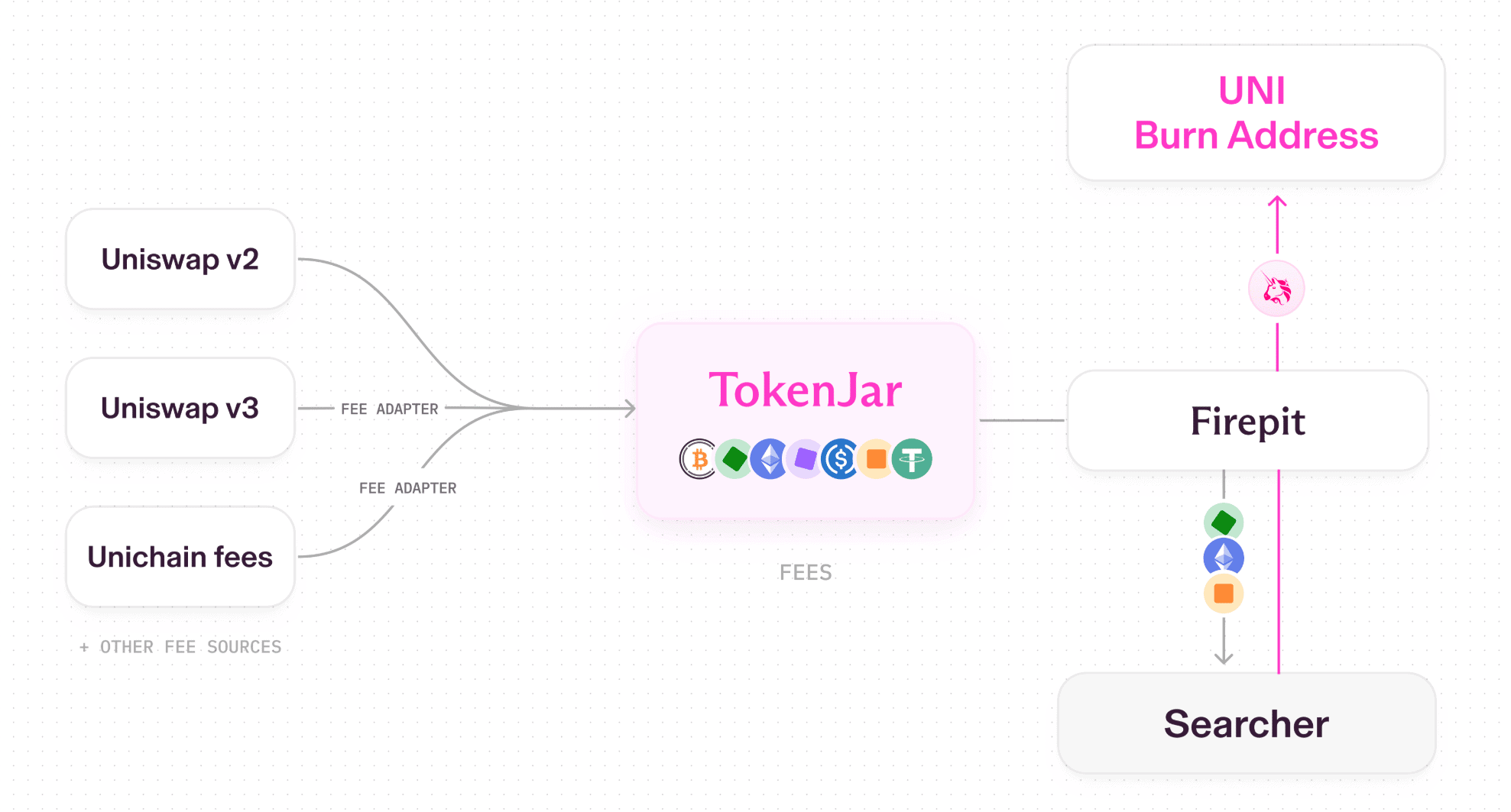
- Fee switch. A % fee from v2 & v3 will go to “TokenJar” for burning.
- Unichain value capture. Sequencer fees from the L2 will be sent to the same mechanism.
- Retroactive burn. 100 million UNI from the treasury will be burned. It’s supposed to be the amount that’d have gone to protocol if the fee switch had been active from the beginning.
- Protocol Fee Discount Auction (PFDA) auctions off the right to trade without fees for a short period of time. It should improve LP performance and internalize MEV.
- Aggregator Hooks will leverage the Uni v4 hooks to create a dex aggregator that sources liquidity from other onchain protocols and add a programmatic UNI burn on top.
It also tries to solve the “equity <> token” issue – where value accrues to company equity instead of the token. With Uniswap, all the value of the project went to the equity. For example, they had front-end fees that went to the team.
Alongside many organizational & legal restructurings, this proposal attempts to fix that issue as well. Firstly, they removed the frontend interface, wallet, and API fees. So no more value leakage from protocol token to team.
The team will just focus on protocol development and growth. The protocol will look to drive the benefits of protocol growth to $UNI via mechanisms like buybacks.
But there are some criticisms of the proposals. (It’s from competitors. So it’s very biased.)
Here’s the TLDR: The new fees will reduce LP fees and start a death spiral. Lower LP fees > lower liquidity depth > Traders leave > LP fees lower even more > Repeat
This situation looks worse when compared to ve(3,3) model, where all the fees are theoretically distributed to liquidity providers. But ve(3,3) has inflation concerns. So it’s not an apples-to-apples comparison.
Anyways, this “liquidity drain” criticism ignores:
- Existing fees like frontend fees haven’t killed Uniswap
- The Uniswap brand can keep the liquidity even if LPs get a lower rewards.
- PFDA, the new mechanism, should increase LP performance.
Uniswap v4, there are many more innovations, like the Continuous Clearing Auction Protocol as well. But that’s not really part of the UNIfication proposal, so I’ll skip over that for now.
The price action hasn’t been kind to $UNI either. After a >35% pump after the announcement, $UNI has largely retraced all that pump.
But I don’t see it as a verdict on the proposal. I’m blaming general bearish market conditions. Nobody wants to hold any alts anymore.
Long-term, this is the best thing that could’ve happened to $UNI. This puts $UNI among the same class as other OG DeFi projects like $AAVE & $SKY (formerly Maker).
🚀 DeFi Catalysts
Aztec has announced a community sale at the floor price of $350M. These types of sales have become the most reliable opportunity.
Sui introduced USDsui, a native stablecoin for the Sui Ecosystem, issued by Bridge. This is a recent trend followed by HyperLiquid and MegaETH.
Polymarket has announced official and exclusive partnerships with UFC & Yahoo Finance.
Uniswap introduced Continuous Clearing Auctions (CCA), a permissionless protocol that helps teams bootstrap liquidity on Uniswap v4
Umbra is in the final stages of the mainnet deployment. They released the final update before the mainnet launch.
Dromos Labs, the team behind Aerdrome and Velodrome, announced a few updates. Merger of the two dexes, Ethereum launch, and more.
Jupiter‘s validators are now running on Double Zero, a purpose-built networking layer for distributed technologies like blockchains.
DYDX has voted to increase the buybacks from 25% of the protocol fees to 75% of the protocol fees.
LayerZero has partnered with EigenCloud (previously EigenLayer) to launch EigenZero, a CryptoEconomic Decentralized Verifier Network (DVN) Framework.
📰 Industry News
Vitalik and the Ethereum community have published the “Trustless Manifesto“. It promotes trustlessness as the core value proposition of crypto, as opposed to efficiency gains.
JP Morgan entered crypto, specifically Base. Their clients can now swap from JPMD (digitized bank deposits) to USDC on Base.
HyperLiquid paused deposits and withdrawals on Wednesday. Reportedly, this came after a “market manipulation” on POPCAT that led to a loss for HLP.
Phantom has started rolling out Phantom Cash features inside its wallet. There’s a new “cash account” inside the wallet.
🐦⬛ X Hits
- State of “x402 standard“
- Circle Q3 earnings results.
- Liquidity flows in prediction markets.
- Stablecoins & yield-bearing assets.
- New HyperLiquid dashboard.
😂 Meme
Until next time,
Edgy
Today’s email was written by Edgy and Yayya.
DISCLAIMER: I’m NOT a financial advisor. This content is for education and information purposes only. Crypto and DeFi are risky and speculative. Please do your research before investing.
|
|
|
Be Early to the Next Opportunities
TDE Pro gives you direct access to our research, our portfolios, and the gems we’re betting on.
It’s your unfair advantage to move before the crowds.
|
Whenever you’re ready, here’s how we can help you:
- ⚙️ The DeFi Edge PRO – Designed for busy people who want to stay ahead of the curve. Leverage our research to save you hours each week, and to see what we’re personally investing in. Join today.
- 🚀 The DeFi Edge Ventures – We identify, invest, and help amplify DeFi Protocols that positively impact the Crypto space.
You’re receiving this email because you signed up for my newsletter. You can update your Preferences or Unsubscribe here.
113 Cherry St #92768, Seattle, WA 98104-2205