Protocol
Pons.family: The Bet on Robinhood’s Trenches
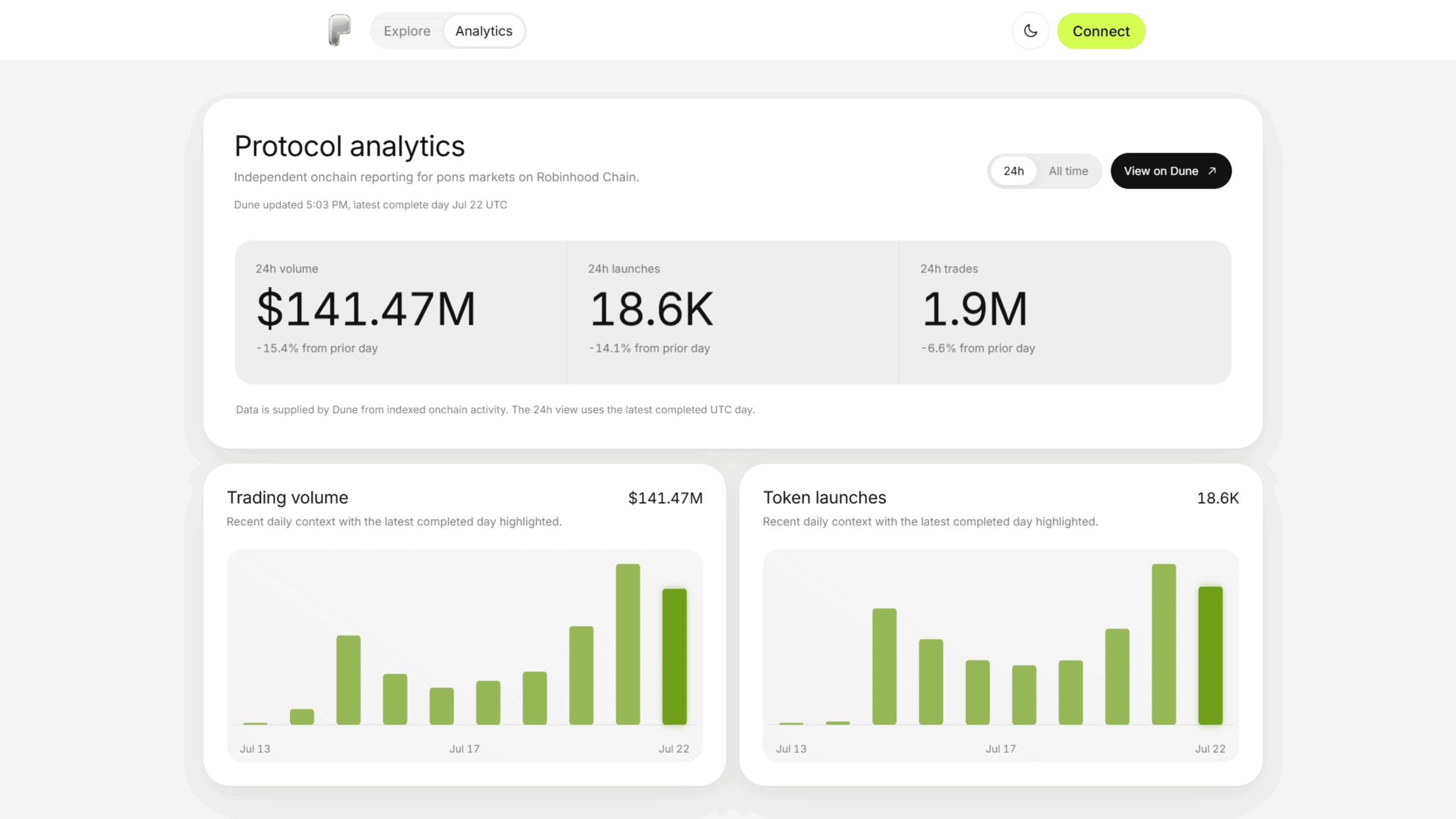
Pons is two weeks old. Annualize its current pace, and it’s pulling $30M/year in revenue!
Pump.fun has been at this for years. Its FDV is around $663M. What should $PONS be worth? We’ll get into it in this article.
What is it? Pons is a memecoin launchpad on Robinhood Chain. Same loop as Pump.fun: mint a token on a bonding curve, trade it, graduate it to a Uniswap pool once it fills. Just ported to Robinhood’s L2.
Noxa, the launchpad that owned ~75% of Robinhood Chain deployments and banked ~$12M in fees, stopped taking new launches on July 11 and lost control of its domains days later. Pons walked into the vacuum and hit #1 within 24 hours. It now has ~100k daily active addresses, roughly 4x Noxa at its peak.
The $PONS Thesis: It’s the Pump.fun of Robinhood Chain. It’s the same primitive. But it’s sitting downstream of Robinhood’s ~28M funded customers. The bet is that those customers can mint a massive fee machine.
Right now, it’s best seen as $PUMP beta play. So let’s price it against Pump.fun.
I used Dune and Claude to compare revenue from both launchpads. ($PUMP revenue includes revenue from swaps as well.)
Token
Weekly protocol revenue
Token market cap
Price-to-revenue (annualized)
| Pons ($PONS) |
~$375K |
~$29M |
~1.5x |
| Pump.fun ($PUMP) |
~$4.9M |
~$660M |
~2.6x |
The valuation gap. $PONS is worth ~$29M. PUMP sits near $660M. Pump.fun out-earns Pons about 12x on a like-for-like basis, but its token is worth about 23x more.
The difference in price-to-revenue for both tokens can be seen as an opportunity $PONS bulls.
Now, there are arguments for a discount on $PONS:
- Robinhood memecoin sector isn’t as established as Solana meme sector.
- Anon founder. It’s run by one pseudonymous dev (Ozzy, @MEADGod) and has no disclosed backers.
- $PUMP is lindy. It has already established itself as THE memecoin launchpad. Pons, in contrast, had to face a front-end attack last week.
Bulls have their arguments as well.
- The 80% buyback is more aggressive than Pump’s 50%.
- The revenue is climbing, not fading. On-chain, Pons averaged ~$82K/day over the last three days, up from under $40K/day its first week.
Personally, I’m not a fan of memecoins. But I’m fine with betting on houses. Houses will always win. PONS is becoming the memecoin house of Robinhood.
There are two things I’m looking at. First is the longevity of Robinhood meme season; the longer the better for $PONS. Second is the difference in price-to-revenue for both tokens. The larger the difference, the bigger the opportunity imo.
But this isn’t a pure valuation bet. It’s a duration bet as well. We have to see if Robinhood meme season is here to stay.
Stacks Sponsored Deep Dive
How Institutions Can Now Earn Native BTC Yield on Stacks
Institutions are sitting on billions in Bitcoin that earn them nothing.
The excuse was always the same. The only way to earn yield on BTC meant handing your coins to a lender or wrapping them into some IOU. Ask anyone who lived through Celsius or BlockFi how that story ends.
On July 16, that excuse got a lot weaker. BitGo integrated the Stacks sBTC bridge. Institutions can now convert BTC to sBTC and back, directly inside BitGo.
Why should you care? Because it’s the on-ramp that was missing. And it landed about a week before Stacks flips on something much bigger.
What BitGo just shipped
Quick 80/20: BitGo is one of the largest crypto custodians on the planet. ~$63B in assets and 1.2M users.
Until now, a BitGo client who wanted to touch Bitcoin DeFi had to ship their coins out to some external platform, take on fresh counterparty risk, and hope. Most companies looked at the risks and said no.
The sBTC integration kills that friction. A BitGo client can mint sBTC from their BTC and redeem it back, without ever leaving BitGo’s regulated custody. Additionally, with sBTC, they can lend it, borrow against it, and trade it across the Stacks economy.
Translation: the biggest holders of idle Bitcoin just got a compliant door into Bitcoin-native finance. That’s a big deal.
So what’s sBTC?
sBTC is a 1:1 Bitcoin-backed asset that lives on Stacks, the original Bitcoin L2. One sBTC, one BTC, redeemable at any time.
The part that matters: it’s not a wrapped-BTC IOU controlled by one company. The peg is run by a network of elected signers, BitGo among them, so no single party can freeze the backing or run off with it.
And it’s already working at scale. sBTC TVL peaked around $615M and sits near $192M today. The deposit cap came off in September 2025, so there’s no ceiling on how much Bitcoin can flow in. Circle’s USDC runs natively on Stacks too (as USDCx, issued via Circle’s xReserve), making Stacks the first Bitcoin L2 to plug directly into Circle’s stablecoin infrastructure.
So the plumbing is real and the institutional money can trust it. Now the payoff.
The biggest game changer
Stacks is days away from launching self-custodial Bitcoin staking. This is the part to lock in on.
Here’s the pitch that sounds too good to be true: earn native BTC yield without giving up your keys. No wrapping. No bridging. No custodian holding your bags.
How it works: you timelock your BTC on the Bitcoin L1, under your own keys, and pair it with a small STX bond (~5% of your BTC position) for a 6-month term. That bond makes you eligible for rewards. Bitcoin miners then bid real BTC roughly every 10 minutes to produce Stacks blocks, and that BTC flows back to stakers. Target yield is ~3% APY, paid in actual Bitcoin, every single week.
This isn’t a testnet promise. The underlying mechanism, Proof of Transfer, has already paid out more than 4,200 BTC (over $500M) to stakers since January 2021. Founder Muneeb Ali put it plainly: “holders can now earn yield denominated in BTC, trustlessly, while their Bitcoin stays exactly where it belongs.”
The PoX-5 upgrade that enables Bitcoin Staking is expected to fully roll out in the coming weeks. It’s ratified through Stacks governance (SIP-044 and SIP-045), with an initial capacity around 3,000 BTC. UTXO Management is already onboarded as an inaugural staker.
Now connect the dots. BitGo just handed 1.2M users a clean path into the Stacks economy. Weeks later, that economy starts paying BTC yield to anyone willing to hold their own keys. The on-ramp and the reason to use it showed up at the same time.
Why it matters
Bitcoin yield has always come with an asterisk. You either hodl without earning yield or trusted it with someone who might go degen with your BTC. The graveyard is full of both.
Self-custodial staking removes the asterisk. Your keys, your coins, and yield that comes from real Stacks miner activity instead of someone quietly degening your Bitcoin behind your back.
For institutions, the math gets hard to argue with. If you’re a fund already parking BTC on BitGo, the choice is now simple: keep earning zero, or earn ~3% in BTC on assets you were sitting on anyway. As Reubs put it, hard to see why those clients wouldn’t want yield on Bitcoin they already hold.
That’s how you turn Bitcoin from a rock you stare at into an asset that actually works for you.
Self-custodial Bitcoin staking is rolling out over the coming weeks. If you want native BTC yield without handing your keys to anyone,
🚀 DeFi Catalysts
Morpho launched Midnight on Base. It’s a fixed-rate lending protocol.
MegaETH is winding down MegaMafia after two cohorts and $80M+ raised by its 20 teams, pivoting to building consumer apps itself.
Telegram confirmed a native self-custodial wallet, the Gram Wallet. A web version is live, with the in-app wallet coming later this summer.
Maple‘s MIP-021 passed with 99.97% approval, turning SYRUP buybacks into a rules-based program that scales with revenue. Buybacks start in August, each trackable on a public dashboard.
Hyperliquid‘s HIP-4 will let anyone permissionlessly deploy outcome (prediction) markets, rolling out through upcoming testnet and mainnet upgrades.
Revert Finance launched Stable Hooks for Uniswap V4, custom hook logic aimed at efficient LPing for stablecoin pairs.
Pendle‘s new PT Looping automates the leverage loop on fixed-yield PT positions in a single click, live in beta on Ethereum, Arbitrum, and more.
Nansen introduced a new ETH Vault, a liquid staking vault built on Lido V3 that allows users to stake ETH directly to Nansen-operated validators.
Based launched Based Alpha on Robinhood Chain, a bonding-curve launchpad where tokens graduate into locked DEX liquidity pools.
ENS DAO seated a new two-year Security Council governed by a 5-of-8 multisig that can cancel malicious proposals after they pass.
Jito‘s JIP-38 passed, formally making it a token-centric network. For at least a year, 100% of the DAO’s JTX revenue share funds programmatic JTO buybacks and burns.
Rysk Finance launched USDC cash-secured puts on Ethereum mainnet for WETH and WBTC. Sellers earn a premium in USDC while setting a price they’d be happy to buy at.
Robinhood Chain overtook Base chain on daily active users less than a month in, hitting nearly 324k DAU and a $588.9M TVL high.
Base App has a new leader in Cobie, as Jesse Pollak shifts focus.
📰 Industry News
Citadel Securities invested $400M in Crypto.com at a $20B valuation.
France told ISPs to cut off access to Polymarket, calling it unlicensed gambling before the World Cup final.
Galaxy joined Morpho as a curator, launching institutional stablecoin vaults distributed through Fireblocks Earn.
Payward, Kraken’s parent, partnered with GTN to bring Hong Kong, UK, and South Korean stocks onchain through xStocks, expanding past its US-only lineup subject to local approvals.
Ondo launches first tokenized stocks based on DTC tokenized entitlements to DTC-held securities, generated through the DTCC Tokenization Service.
S&P and Pantera built a revenue-weighted crypto index that only admits tokens with real network revenue, led by ETH, BNB, SOL, TRX, and HYPE.
🚨 Rekt Report
Ledger warned of a malware campaign draining user funds. It’s a phishing/malware attack, not a protocol exploit.
Hinkal started paying users back, an early step toward making its users whole after a hacker took ~797K USDC from a Hinkal contract on Ethereum.
Across got exploited on the Solana side, but says no user funds were touched; Solana deposits are back online.
Ostium lost ~$24M from its OLP vault on Arbitrum. The attacker used a hijacked Gelato forwarder to feed future-dated timestamps and extract fake profits, then laundered through Tornado Cash.
🐦⬛ X Hits
- Crazy story of finding edge.
- What are Fake World Assets?
- Bitwise CIO’s take on catalyst for next bull market.
- The $ANSEM thesis. Warning: I hate “creator coins”.
- A galaxy-brain thesis for investing in AGI society.
😂 Meme
Until next time,
Edgy
Today’s email was written by Edgy and Yayya.
DISCLAIMER: I’m NOT a financial advisor. This content is for education and information purposes only. Crypto and DeFi are risky and speculative. Please do your research before investing.
Whenever you’re ready, here’s how we can help you:
- 🚀 The DeFi Edge Ventures – We identify, invest, and help amplify DeFi Protocols that positively impact the Crypto space.
You’re receiving this email because you signed up for my newsletter. You can update your Preferences or Unsubscribe here.
600 1st Ave, Ste 330 PMB 92768, Seattle, WA 98104-2246