Update
Aave Will Win Framework
Conflict of interest between tokenholders and team members is a common crypto issue.
Recently, Aave was involved in one such drama. It started with the Aave team taking revenue that previously went to the DAO. We’d covered it in detail here.
There were some developments afterwards. Like the Aave team trying to get a DAO-friendly proposal rejected by voting on it during the Christmas holidays.
Last week, the Aave team published a proposal that was received much better. They’re calling it the Aave Will Win framework.
You can read the full proposal here. This article will cover key points.
There are many reasons for $AAVE holders to celebrate:
- 100% of all revenue will go to the $AAVE DAO.
- The proposal highlights many new revenue opportunities with Aave v4.
- More focus on Aave v4 and (eventually) putting Aave V3 into maintenance mode.
- The legal ownership of Aave IP will be transferred from the team to a new foundation.
- Create more demand for $AAVE by enabling better access to it via instruments like ETP products.
But the tokenholders can still find some issues in the proposal.
Marc Zeller from Aavechan has written a great article on it. Here are the key points:
- Marc Zeller prefers the running of both v3 and v4 in parallel, at least until v4 is validated by the market.
- The definition of revenue still allows too much control over protocol funds to the team. The funds that should go to the DAO can be directed by the team to somewhere else.
- Proposal asks for $42.5M in stablecoins ($25M primary + $17.5M in milestone grants) and 75k AAVE. It’s 35% of the current Treasury. Giving that much money to a single service provider in a single ask is difficult to explain.
- This proposal should be divided into four different proposals: revenue alignment, V4 ratification, Foundation creation, and a $50M funding request.
Marc Zeller has also suggested specific steps that will address the problems he highlighted. Personally, I lean towards his position. You can read a more balanced position here.
This is a great proposal in the right direction, but to get the full mark, it needs a few more tweaks.
Sponsored by Katana
Katana: The DeFi-Optimised Home for Your Capital
Nobody wants another generic chain.
Specialisation allows you to optimise all parts of the system for your niche. And Katana is the first specialised DeFi chain. And it’s DeFi-optimised from its foundation.
It creates multiple revenue streams and directs them all to increase yield and liquidity. Here are its revenue sources:
- Sequencer fees are generated as transaction gas fees
- AUSD treasury yield comes from Katana’s native stablecoin, AUSD.
- Chain-owned liquidity of core assets to provide the best pricing and liquidity.
- VaultBridge revenue is generated by deploying the assets on the L2 bridge contract into low-risk strategies on Ethereum L1.
Then all these revenue flows are used to incentivise deeper liquidity and onchain activity
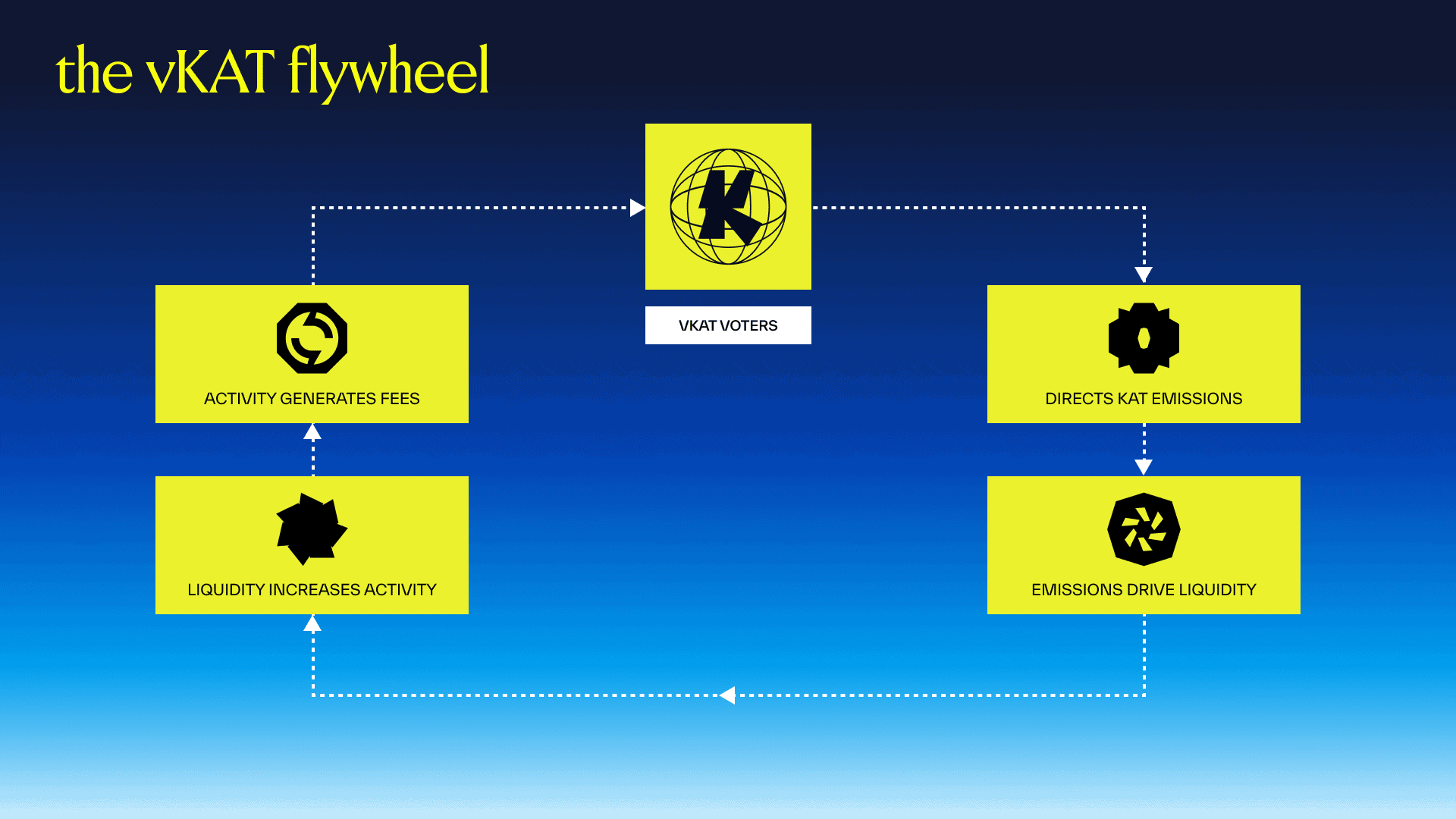
More importantly, Katana has a vKAT tokenomics system that’ll guide its economy. Here’s how it’ll work:
- $KAT holders can stake it to receive vKAT
- vKAT holders participate in weekly voting cycles
- The weekly voting will decide where the KAT incentives will go
- Voters earn a portion of the fees generated by the protocol pools they support.
This will create a virtuous flywheel.
This system isn’t live yet. But the Katana app is. And right now, you can earn XP by doing onchain activities and completing quests.
Get started before the season ends.
Category
Stablecoin-as-a-Service 101
In the current conditions, it’s rare to see a chart like the above.
It’s tracking the total market cap of stablecoins issued by Ethena’s Stablecoin-as-a-Service (SCaaS). The growth from zero to $131M in ~6 weeks is very impressive.
After consistent growth, even the total stablecoin market cap has been stuck on ~$308 B since October 2025. So the outperformance here is noteworthy.
What’s SCaaS? It’s what it sounds like. These service providers allow businesses to launch customised stablecoins. It’ll handle all the difficult parts like ensuring stablecoin is always backed by high-quality collateral.
In the case of Ethena, they’re managing stablecoins for Jupiter, MegaETH, and Sui.
The massive growth was driven by JupUSD. Since Jupiter is the cornerstone of Solana DeFi, this is understandable. MegaETH is also one of the most interesting projects in the space, so I’m expecting notable growth there as well.
Here are the other major projects in the sector.
I’m expecting this SCaaS sector to grow much more in future.
All the tailwinds of stablecoins in general apply here as well. So that includes regularity clarity with Genius Act and MiCA, wider acceptance/utility, proven product-market fit, etc.
For SCaaS in particular, this addresses the biggest problem with current stablecoins. In the current model,
- Apps generate demand for stablecoins
- Users take risks by holding stablecoins for no reward
- But issuers like Circle and Tether keep all the revenue from stablecoin collaterals like T-Bills.
- This means Apps and users aren’t getting their fair share.
There are exceptions to the above argument. For example, Circle and Lighter have come to a deal where Circle will share a % of the yield with Lighter. And Lighter is using that revenue to drive the Funding Rates Rebates program. But these are exceptions, not the rule.
With the current duopoly, we are adding in centralisation risk. Circle can freeze our funds anytime. Plus, if something happens to Tether or Circle, the entire DeFi will blow up. That’s too much dependency risk.
If well-designed, like M0 Protocol, we’ll be able to remove these problems while keeping the benefits like the reliability of USDC.
Any app/business will be able to capture the value of generating stablecoin demand by issuing it themselves. Since often protocols will spend revenue on improving the product or incentivising activity, users will indirectly benefit as well.
This is a stablecoin sub-sector that I’m following. Imo, M0 has the best technical design within the category. If you want me to go into more detail about M0, let me know by replying to this email.
🚀 DeFi Catalysts
Flying Tulip has launched its public sale. They’re experimenting with a new type of sale/token mechanic that enables downside protection.
Drift Protocol has said that equity perps are coming soon to its platform. Recently, the demand for equity and commodity perps has increased.
Canton Network launched private payroll for institutions. It happened with a collaboration between Toku and Cantor8.
Lighter launched Korean equity perps with upto 10x leverage. They’re claiming to be the first DEX to offer the Korean equity perps.
Dreamcash is a HyperLiquid frontend built using HIP-3. It has received investment from Tether to host markets that use USDT0 as collateral.
Ink, the L2 chain from Kraken, introduced Nado, the native trading engine within the Ink ecosystem.
Polymarket has launched 5-minute up/down crypto polymarkets for BTC. It has received a lot of attention from crypto Twitter.
Kalshi is partnering with Game Point Capital, a sports insurance broker. This allows the platform to tap into liquidity while providing value for the broker.
Theo Network introduced thGOLD. It claims to be the first ever yield-bearing gold. Yield is earned by lending gold out to gold retailers.
DefiLlama has launched a new tool. It allows users to find the correct link for crypto projects. They manually curate the links for users.
📰 Industry News
Tomasz K. Stańczak has stepped down from the Co-Executive Director position in Ethereum Foundation. He had a huge positive influence on the org.
Clarity Act, the market structure act for the crypto industry, ended without a compromise. The main point of contention is the yield/rewards on stables.
Helius launched Gatekeeper. It’s a low-latency edge gateway that provides a unified entry point for all Helius RPC, WSS, and API traffic.
Braden Karony, a fraudster behind SafeMoon, was sentenced to 100 months in prison by EDNY Judge Komitee.
ZeroLend has announced the protocol wind-down. They’re asking users to withdraw their funds.
🐦⬛ X Hits
- Ray Dalio on the global order.
- The truth about no-KYC cards.
- The seven axes of prediction markets.
- Problems with time-based token unlocks.
- Application-controlled execution (ACE) as the key to value capture.
😂 Meme
Until next time,
Edgy
Today’s email was written by Edgy and Yayya.
DISCLAIMER: I’m NOT a financial advisor. This content is for education and information purposes only. Crypto and DeFi are risky and speculative. Please do your research before investing.
|
|
|
Be Early to the Next Opportunities
TDE Pro gives you direct access to our research, our portfolios, and the gems we’re betting on.
It’s your unfair advantage to move before the crowds.
|
Whenever you’re ready, here’s how we can help you:
- ⚙️ The DeFi Edge PRO – Designed for busy people who want to stay ahead of the curve. Leverage our research to save you hours each week, and to see what we’re personally investing in. Join today.
- 🚀 The DeFi Edge Ventures – We identify, invest, and help amplify DeFi Protocols that positively impact the Crypto space.
You’re receiving this email because you signed up for my newsletter. You can update your Preferences or Unsubscribe here.
600 1st Ave, Ste 330 PMB 92768, Seattle, WA 98104-2246