News
Base is Divorcing Optimism
What does a $66B exchange’s pet blockchain have in common with a bitter divorce? According to the latest drama, everything.
What happened? Base, the most successful L2, announced its leaving Optimism’s Superchain. This will end the revenue share between Base and Optimism.
(Base was built using OP Stack from Optimism. From now on, they will build independently of OP Stack. The new tech stack is called “Unified Stack”.)
This is disastrous for $OP.
- In H2 2025, Base contributed ~75% of the revenue of OP Collective. Losing it will be a disaster.
- OP holders had given >118M in OP grant to the Base. We don’t know if Base will return this money.
- Base claims they’ll ship much faster flying solo rather than coordinating with a “wider collective.
But wait — if Base could just fork the tech, why stick around this long?
The promise of Superchain: a network of L2s sharing interoperability and network effects. Problem is, Optimism never actually delivered on that interop dream. No shared network effects = no reason to stay married.
Could Robinhood pull the same move on Arbitrum?
Theoretically, they can. But it’ll be much more difficult. The code of Arbitrum isn’t fully open source. So Robinhood cannot fork and use it commercially without paying its due profit share to Arbitrum DAO.
That’s the irony here.
Optimism’s open-source approach won them community goodwill and a massive tech lead. If you’re launching a new chain today, OP Stack is still the go-to. But OP is failing to capture value from what it created. Base keeps using the tech; OP holders get nothing.
This is another case of a widely adopted tech that doesn’t benefit its creators. Adoption of protocols like HTTP, which is the foundation for the modern internet, doesn’t lead to any economic benefit to its creators.
After seeing Base leaving Superchain, many are speculating that Base will leave Ethereum as well. Here are the only legitimate arguments for that side:
- L2 tech is not as mature as L1 tech.
- L1 tokens have more premium than L2 tokens.
- L2s might have higher regulatory constraints than L1s.
But Base won’t leave Ethereum. Here are my reasons for it:
- L1 premium is shrinking rapidly.
- Running a decentralized validator set is very expensive.
- Coinbase can control block building only with an L2 structure. This is the MEV (aka, the most profitable) layer.
- L2 businesses are insanely profitable. Base only pays <2% of the revenue it generates to ETH.
The only real wildcard? Regulatory uncertainty. Which is… everyone’s wildcard.
TDE Pro
The $10K Yield Experiment: Live Wallet, Real Money, No BS
If you’re parking stablecoins on Aave right now, you’re earning 2.28%, that’s less than the US risk-free rate.
While it’s safe, it’s not the most effective strategy. The sweet spot is finding the perfect intersection of safe, solid yields and not wasting too much time babysitting the positions.
We’re DeFi nerds, and we’re farming part of our treasury. We deployed $10k last month, and we’re currently running 8.67% effective APR.
Here’s one of the positions driving that.
- We deposited sUSDS into the sUSDS/USDT vault on Morpho.
- sUSDS earns 3.92% in the background.
- We then borrowed 90% of its value in USDC – both reliable stablecoins, so liquidation risk is minimal.
- The borrow cost runs about 2.3%, leaving a net 1.6% on this position.
That borrowed USDC doesn’t sit idle. It gets deployed into additional positions, which is how the overall portfolio compounds to 8.67%.
That’s the TDE Pro $10k farming challenge. This isn’t “theory” – we have skin in the game. Become a TDE Pro member, and you get:
- A public wallet so you can verify every move onchain
- Full video breakdowns of each position
- A live spreadsheet tracking allocations and performance in real time
- Direct access to ask Alphonse questions
Unlike memecoins, there’s no harm in copying us. If we exit a position, it doesn’t crash yours. Transparency works here because yield farming isn’t zero-sum.
The gap between knowing and doing doesn’t close by reading more threads. It closes by watching real money move, step by step.
Protocol
M0 Protocol: New Monetary Stack for Onchain Economy
We created this article because you asked. Thanks, Jyck, Alisa, Chakravart, and many others. You ask, we deliver!
Tether is the #1 business in profit per employee on the planet.
Now everyone wants a piece. The apps generate stablecoin demand. Users take the risk. So why should Tether pocket all the yield?
Breaking in is brutal. You need collateral management, liquidity, confidence-building—the whole stack. And liquidity network effects? Those compound exponentially.
Enter stablecoin-as-a-service.
What’s M0? It’s decentralized middleware—a shared liquidity layer that lets other businesses issue their own stablecoins without building from scratch.
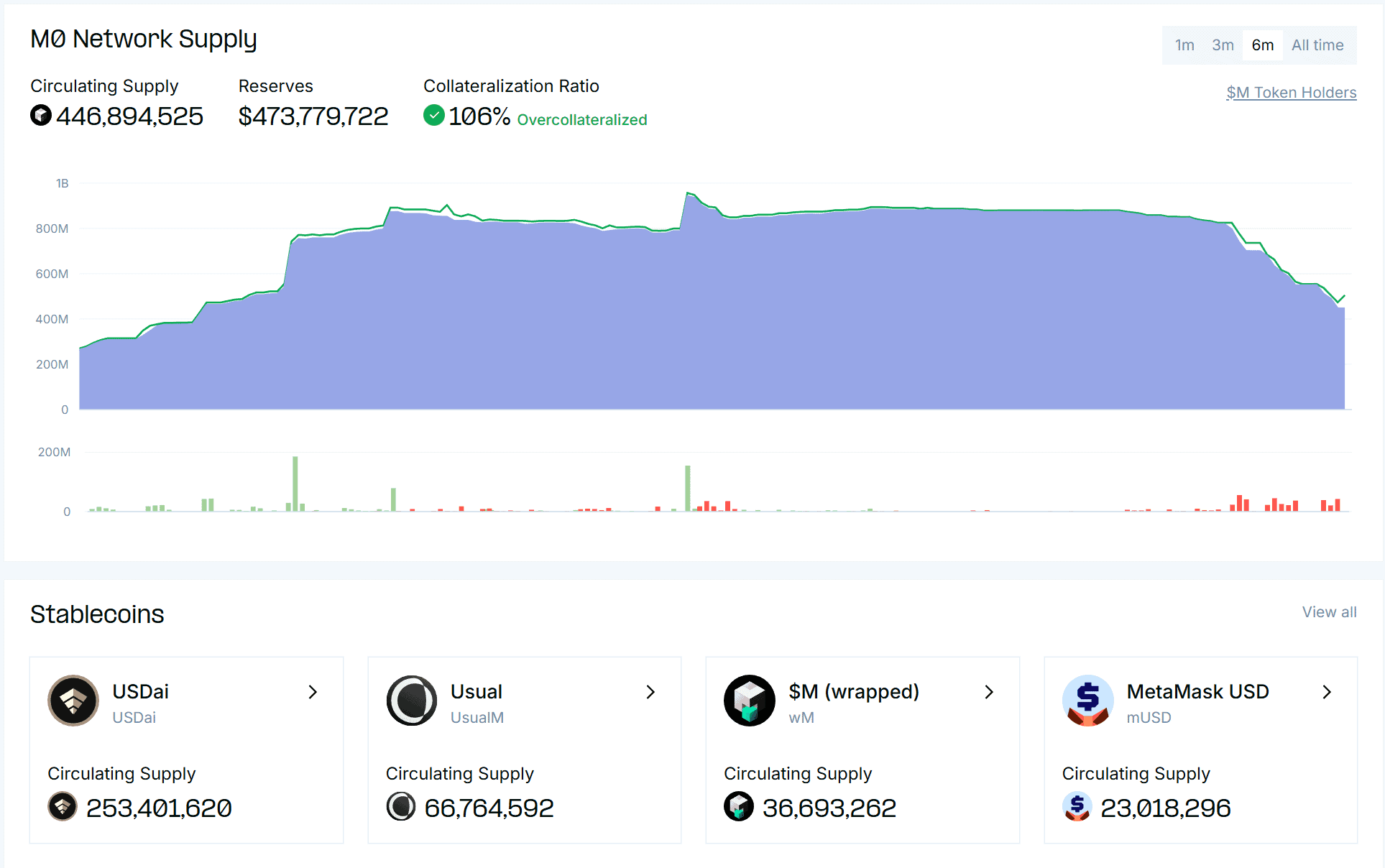
Some big names that use M0 to issue stablecoins are USDai, MetaMask, Citrea, Noble, and more. You can see the full list on their ecosystem dashboard.
How it works:
- Every stablecoin launched via M0 is 1:1 backed by $M, which itself is backed by short-term US Treasuries held in bankruptcy-remote SPVs
- The shared liquidity pool via the base $M token makes all the stablecoins interoperable with each other. This compounds liquidity network effects among all M0 stablecoins.
- At the same time, businesses can customize their stablecoins for branding, compliance rules (allow/block lists, freezes), yield distribution, upgrades, and chain support
- $M issued via a permissioned but open federated multi-issuer model (qualified minters in key jurisdictions, including the US).
M0 can provide the benefits (liquidity & reliability) of centralized stablecoins like USDT due to their well-thought-out architecture.
$M is the core building block of all M0 stablecoins.
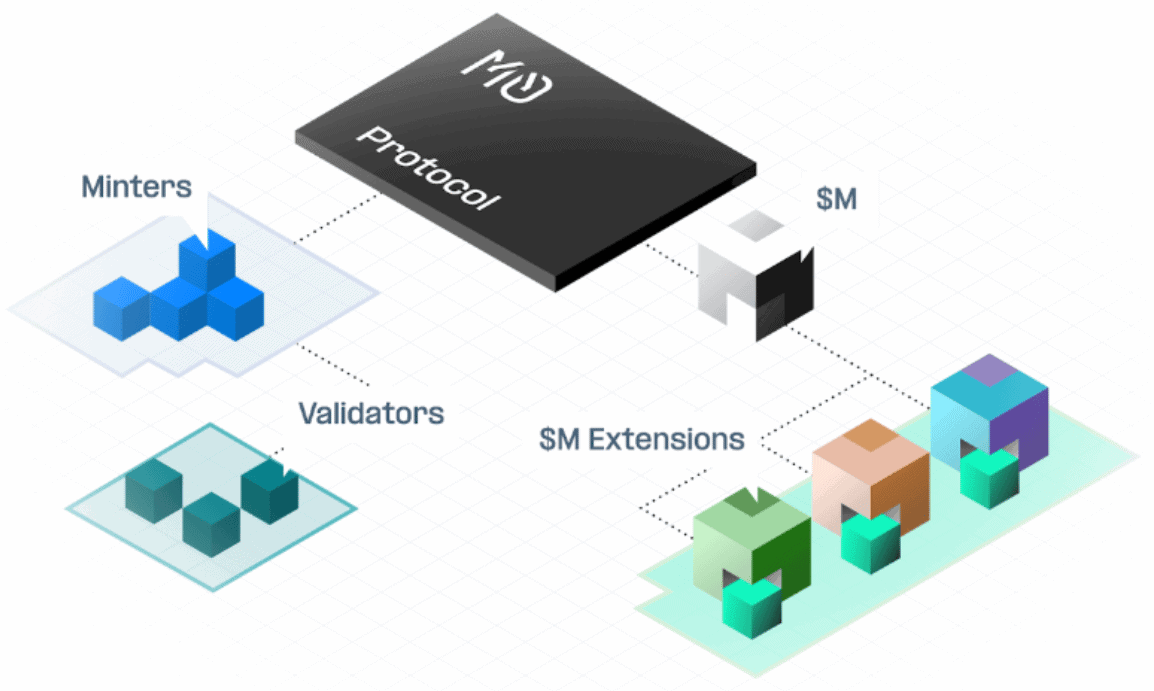
The architecture: Minters and validators decentralize operations and manage the T-Bill collateral. Read more about the mechanics here.
$M Extensions in the above diagrams are the stablecoin issuers like MetaMask and USDai. They can leverage the security and network effects of $M. Plus, they’ll get a big part of the yield generated by the T-Bills.
Two-token governance: $ZERO claims protocol revenue (traditional token economics). $POWER enables fast emergency response. Neither trades on liquid markets yet, so retail’s locked out for now.
As of now, there are no liquid onchain markets for either tokens. So, there’s no easy way for retail to invest in the protocol.
The bull case: If M0 becomes the “Layer Zero” for stablecoins and captures meaningful share of the multi-trillion stablecoin future, the revenue potential is massive.
The catch: They’re going up against Circle and Stripe.
But the ambition is real. M0 isn’t slapping another layer on bank deposits—they’re redesigning the entire monetary stack.
🚀 DeFi Catalysts
Zora has completely revamped their product and has moved onto Solana. It’s now describing itself as the “world’s attention market”.
Pump.fun introduced Trader Cashback. Coin creators can now choose between Trader Cashback or Creator Fees before launch.
Uniswap is voting on expanding protocol fees on v2 and v3 to Arbitrum, Base, Celo, OP Mainnet, Soneium, X Layer, Worldchain, and Zora.
Hyperbeat introduced USD+. It’s a vault that’ll earn yield on your USDC and automatically use deposits as collateral for instant credit spend.
Sports.fun has integrated Polymarket into its platform. This will allow SDF users to speculate on sports through two distinct mechanisms.
LI.FI Protocol has introduced LI.FI Composer. It allows developers to compose any complex, multi-chain DeFi workflows into one transaction.
Balancer has launched LBPools on its v3. The new version has Fixed-price sales and Zero-collateral launches that won’t need a reserve asset.
Polymarket has announced a new partnership with Substack. The authors there will be able to integrate Polymarket data natively on Substack.
Succinct has released the mainnet of SP1 Hypercube. It’s the first zkVM to have complete formal verification of all 62 RISC-V opcodes.
📰 Industry News
Hyperliquid Policy Center announced its launch. Its goal is to ensure that DeFi can flourish in the United States.
OpenAI introduced EVMBench. It’s a new benchmark that measures how well AI agents can detect, exploit, and patch vulnerabilities in smart contracts
Blockworks introduced Token Transparency Filing. The B1 filing is a one-time disclosure for all ICOs & launch platform TGEs.
Tether Gold (XAU₮) enabled the first-ever Gold dividend distribution by a public Gold company called Elemental Royalty Corporation.
Ethereum Foundation announced the Platform Team. They’ll ensure L1 and L2s are best positioned to support users, apps, and all organizations building on Ethereum.
🐦⬛ X Hits
- A great farm opportunity.
- Onchain payments market map of 2026
- What’s Confidential Token Standard (ERC-7984)?
- Reflections after losing entire net worth to a scam link.
😂 Meme
Until next time,
Edgy
Today’s email was written by Edgy and Yayya.
DISCLAIMER: I’m NOT a financial advisor. This content is for education and information purposes only. Crypto and DeFi are risky and speculative. Please do your research before investing.
|
|
|
Be Early to the Next Opportunities
TDE Pro gives you direct access to our research, our portfolios, and the gems we’re betting on.
It’s your unfair advantage to move before the crowds.
|
Whenever you’re ready, here’s how we can help you:
- ⚙️ The DeFi Edge PRO – Designed for busy people who want to stay ahead of the curve. Leverage our research to save you hours each week, and to see what we’re personally investing in. Join today.
- 🚀 The DeFi Edge Ventures – We identify, invest, and help amplify DeFi Protocols that positively impact the Crypto space.
You’re receiving this email because you signed up for my newsletter. You can update your Preferences or Unsubscribe here.
600 1st Ave, Ste 330 PMB 92768, Seattle, WA 98104-2246