Updates
The New Rulebook For Crypto
To raise $23 million the legal way, Blockstack had to spend $1.8 million and over a year on paperwork. So they bailed the second the rules let them.
The SEC just proposed a better way.
What happened? The Commission dropped a new regulation for Crypto Assets. It’s the first purpose-built path for legally selling a token in the US.
One caveat before we go further: this is a proposal, not law. There’s a 60-day comment period, then a final vote. Also, I did not read all 400 pages of the proposal. I read the fact sheet and then used Claude to understand the full proposal.
Back in March, the SEC and CFTC had already put out joint guidance saying most crypto assets aren’t securities. Five buckets: digital commodities, collectibles, tools, stablecoins, and digital securities. The first four buckets didn’t have to follow securities laws.
But guidance isn’t a rule. It doesn’t bind a court, and it did nothing for the projects that actually want to sell tokens as securities.
The hole we were digging out of
US securities law runs on the Howey test, a 1946 Supreme Court case. Quick 80/20: if you put money into a common enterprise expecting profit from someone else’s work, that’s an investment contract, and an investment contract is a security. Securities have to be registered.
The problem is, there was never a realistic way for a crypto protocol to register. Early-stage projects are too small to eat the cost. Mature protocols like Ethereum look nothing like a company with a CEO and quarterly earnings.
How unrealistic? Only three token offerings made it through in six years! Only Blockstack (our friend from the intro), Props, and INX made it. Blockstack’s filing alone ran over a year and cost $1.8 million, which is roughly 8 cents of every dollar they raised going to lawyers.
The previous SEC administration was actively hunting crypto projects as well. Gensler’s SEC pulled $6.05 billion in crypto enforcement penalties between 2021 and 2024!
So crypto projects started becoming Cayman Islands foundation company, which has a wild feature: they can be legally ownerless. No members required, and losing all of them doesn’t kill the entity as long as a Supervisor hangs around. Perfect wrapper for a DAO. Switzerland also caught the overflow.
The bill for all that offshoring landed on US users, who kept getting geoblocked out of their own airdrops. Dragonfly put it at $1.84 billion in airdrop value Americans couldn’t claim between 2020 and 2024.
So what did the SEC propose?
Two ways in for projects that want to sell tokens as securities.
- The small door. Up to $5 million over four years, one time, with whitepaper-style disclosure instead of a full S-1. File a Form NOR to start.
- The bigger door, in two tiers. Tier 1 is $20 million a year, no audited financials. Tier 2 is $75 million a year, audited financials required, with an offering statement plus annual and semiannual reports.
On disclosure, there are ten required categories, and the ones that matter to you are the economic ones: total supply, lockups, insider holdings, distribution method, and release schedules.
Two details worth pulling out of the pile:
- No mandatory insider lockup. The rule doesn’t force one. It just makes you disclose whether you have one.
- There’s also state law preemption for both primary sales and secondary trading, so you’re not fighting 50 state regulators on top of the SEC.
- The exit ramp. A token can stop being a security once the issuer certifies it’s finished all the “essential managerial efforts” it promised and files a Form TR with an analysis backing it up.
Translation: once your protocol is actually decentralized, your token can graduate out of being a security.
Why does this matter? For founders who want to play it straight, there’s finally a path that doesn’t cost 8 cents on the dollar and a year of their life. They raise as securities, and retail gets real disclosure.
For founders who don’t want their token to be a security, the incentive gets interesting. To stay out of the regime, they’ll avoid promising holders revenue share or anything that smells like profit-from-someone-else’s-effort. Sounds like a loss for holders. But if founders under-promise and over-deliver via buybacks or something, it could be good for retail as well.
What’s next?
This isn’t law yet, and not close. The proposal hasn’t formally hit the Federal Register. Once it does, there’s the 60-day comment window, then revisions, then a final vote, then compliance dates. Realistically, it’ll only go live in 2027.
And it’ll get fought. Interest groups will work the comment period, and Gabriel Shapiro expects some of them to sue the SEC outright. I’m not a lawyer, but “does the SEC even have the authority to do this?” is a live question.
Chains
Is Robinhood Chain the Next Solana?
Robinhood Chain looks like the best chain launch in years.
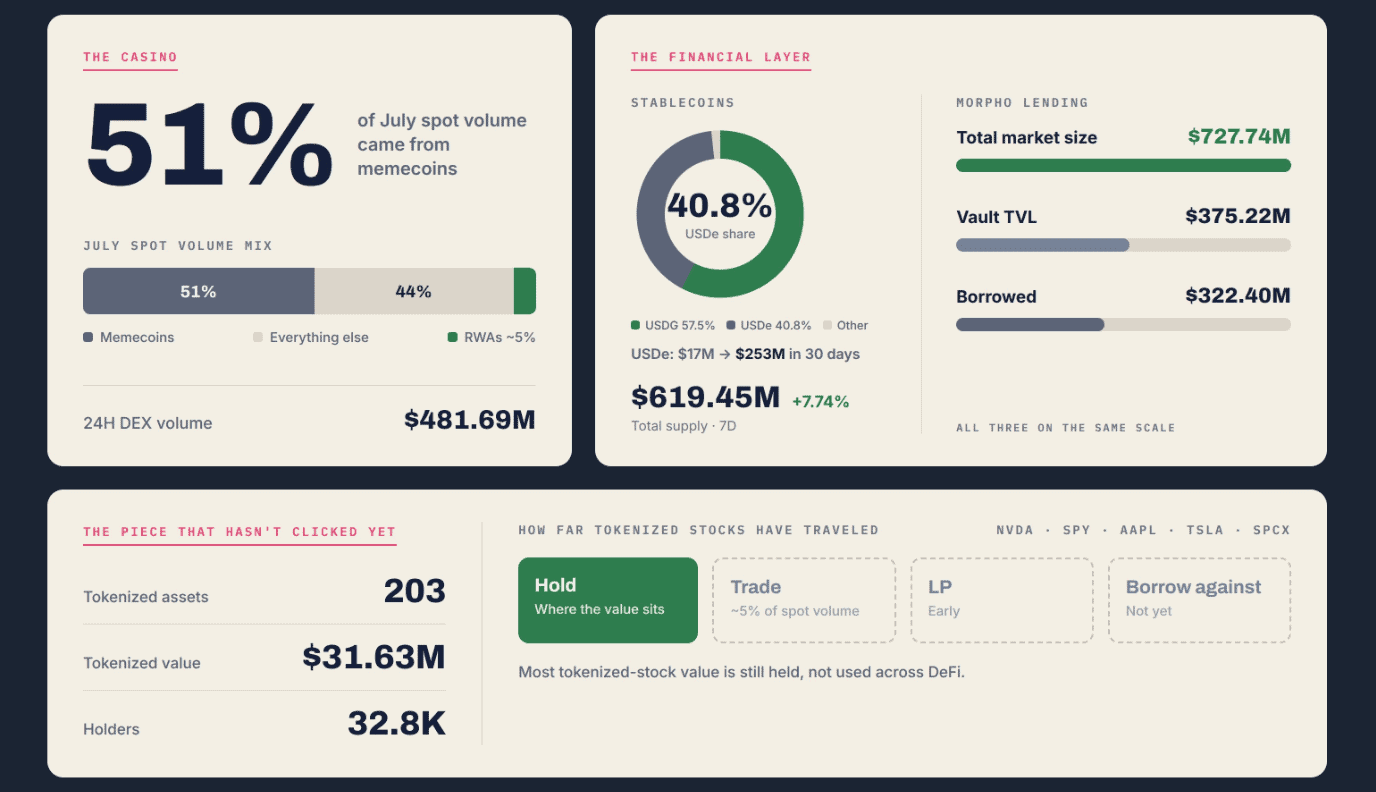
It did $3.6M in revenue in July, the most of any L2 (and more than Base and Arbitrum combined). The TVL went from $39M to nearly $1B in six weeks.
But the catch is almost everything on the chain is “rented.”
1) The traders. Memecoins are 51% of spot volume, and meme money is the fastest money in crypto. The tokenized stocks everyone talks about? 5%, mostly trading against memecoin pairs. The casino is providing the liquidity for the “real” market.
2) The capital. ~$600M in stablecoins, and Morpho’s lending markets are at $728M with $322M borrowed. It looks like real money, except the growth is USDe, which went from $17M to $253M in a month.
That’s Ethena yield capital, and it stays exactly as long as the rates do.
3) The gas. Robinhood is paying everyone’s gas for the first 90 days.
To be fair, rented demand is how most good launches work (like how some chains and apps do airdrops)
But is the crowd going to stick around?
The number I’m watching is daily active accounts. Transactions are at all-time highs, but active accounts peaked July 16. It’s the same degens, but trading harder.
That matters because Robinhood’s edge was never the tech. The chain runs on Arbitrum’s stack, and anyone can fork faster blocks and cheaper fees by next quarter.
What nobody can fork is DISTRIBUTION/brand awareness. Robinhood already has ~28M brokerage customers who open the app every day.
But they’re not onchain yet.
Stock Tokens are illegal to sell to Americans, and Robinhood’s customers are almost all American. The flagship product is banned in its home market.
The SEC hasn’t written rules for tokenized stocks. Robinhood is lobbying hard (they sent a 42-page proposal). Until then, the only thing an American can touch is an in-app lending product paying ~7% on USDG.
Overseas is the only preview we’ve got. 203 stock tokens live in 120+ countries, and most just sit in wallets.
The users are flat at home, and it hasn’t taken off abroad yet.
1. The bear case is that the demand was never there. If tokenized stocks can’t get traction where they’re legal, the SEC unlock matters less than everyone thinks.
2. The bull case is they’re winning the L2 race and haven’t even used their best weapon yet. Who cares about foreign demand bc Robinhood’s base are mainly Americans.
I’m leaning bullish.
Either way, ignore the temporary TVL, volume, and transaction counts. Any chain can rent those for a quarter.
Watch what Robinhood actually owns. Active accounts, USDG from real users, and stock tokens getting borrowed against instead of just held.
1. The first test comes in late September when the gas subsidy ends. Free casinos are always crowded. Then we find out what the paid one looks like.
2. The second test is the SEC. Whenever they move on tokenized stocks, we find out whether the owned layer shows up at all.
There definitely is a chance that Robinhood becomes the next Solana.
The launch was great. Now time to see if they can keep the momentum going.
🚀 DeFi Catalysts
Rise Chain has launched its ecosystem portal. The first wave of ecosystem apps is live.
Ether.fi is now buying back ETHFI on autopilot, routing ~$1.33M a month in protocol revenue into the token.
Jupiter launched Lend V2 Smart Vaults on Solana. They convert your collateral and debt into DEX liquidity, so a lending position earns trading fees too.
Solstice Finance launched strcUSX on Solana, splitting the ~12% STRC dividend into a ~7% senior tranche and a ~20% junior tranche.
Centrifuge proposed converting $CFG into company equity 1:1, restructuring the foundation and introducing a shareholder structure.
Morpho introduced an open-source Quoter Bot for Morpho Midnight that quotes both sides of the market around a reference rate. Forkable and configurable.
Optimism has decided to redirect 546.9M OP from airdrops into a Strategic Ecosystem Fund via voting.
Mezzanine launched Tranche Anything, a feature for splitting tokenized assets into risk tranches. It’ll allow them to launch two to three strategies per month.
Ether.fi is moving its Cash card backend to Aave V4 on Optimism. Card spend now settles against a dedicated lending market instead of a generic one.
Hyperliquid is opening low-latency data nodes to infrastructure providers for under $1,000 a month. Cheap access to the fastest feed in perps.
Kaito launched Pulse and Aura. They analyze your full onchain activity and score you on what you do. It has created big privacy concerns.
Berachain renamed HONEY to Bera USD (ticker BUSD), pitching clearer recognition as a USD stablecoin for institutions.
Compound replaced its leadership team and approved a $52M budget to chase institutional capital. Many are skeptical about the move.
Ansem launched his own launchpad plus z500, an onchain index where teams airdrop supply to $ANSEM holders and buy-and-burn $ANSEM to climb a leaderboard.
Aligned published its airdrop details: 8.74% of a 10B ALIGN supply to the community, with 44.36% unlocking at TGE.
Ethos Network launched the Ethos Foundation.
📰 Industry News
Tether completed its first full financial audit, with KPMG issuing an unqualified opinion and reserves exceeding liabilities by $6.814B.
Telegram applied for the .gram domain zone. If ICANN approves, users could register yourname.gram and run one-click Telegram-powered sites.
Nasdaq is launching overnight stock trading from 9 PM to 4 AM ET in December.
🚨 Rekt Report
Harmony is rolling the chain back to just before the Aug 11 exploit. With the ONE supply past 2.3 trillion, discarding corrupted blocks is the way to remove the forged tokens.
Neutrl‘s sNUSD crashed 46.9% to $0.5582 after the protocol froze minting and redemptions, citing reserve issues and legal advice. $3.5M got pulled from the Curve pool as a precaution.
Scammers stole US$11.8M in Singapore using fake LinkedIn job offers, installing malware during a bogus technical assessment.
🐦⬛ X Hits
- On the loss of crypto’s appeal.
- Robinhood founder on tokenized assets.
- Uniswap founder on why AMMs will win.
- Privacy concerns regarding new Kaito Aura program.
- Anatomy of a stablecoin swipe.
😂 Meme
Until next time,
Edgy
Today’s email was written by Edgy and Yayya.
DISCLAIMER: I’m NOT a financial advisor. This content is for education and information purposes only. Crypto and DeFi are risky and speculative. Please do your research before investing.
Whenever you’re ready, here’s how we can help you:
- 🚀 The DeFi Edge Ventures – We identify, invest, and help amplify DeFi Protocols that positively impact the Crypto space.
You’re receiving this email because you signed up for my newsletter. You can update your Preferences or Unsubscribe here.
600 1st Ave, Ste 330 PMB 92768, Seattle, WA 98104-2246