Updates
Farcaster Strategic Pivot: What’s Happening?
The top web3 social platform is pivoting.
What happened? Farcaster, the leading “decentralized X/Twitter”, announced a strategic pivot to focus on the wallet.
According to the founder, Facaster didn’t find product-market fit despite working on the project for ~5 years.
But when they launched an in-app wallet earlier this year, it got traction. So they’re pivoting to focus on the wallet.
It’ll benefit the “decentralized social” platform as well.
- They can leverage the protocol to add social features to the wallet.
- “Come for the tool, stay for the network” strategy. Every wallet user is also automatically on social protocol. Aka, wallet growth = farcaster growth.
Is SocialFi dead then?
I don’t think so. It’s just not the time for this niche yet.
Farcaster is also sufficiently decentralized. Even if the core team pivots, independent clients can keep building.
Recaster is a good example. There are multiple alternative clients listed on their ecosystem page. Here’s a list of independent clients.
So, crypto social isn’t dead by any means.
In fact, it’s a pretty competitive space. Base App from Coinbase is the leading contender. Many smaller apps combine crypto trading with social elements as well.
These apps haven’t found the “final form” yet. For example, public wallets attached to social apps let anyone read your entire history. Is that a feature or a privacy bug? Hard to say, but I suspect most people want more privacy.
This sector is like Perp DEXes before HyperLiquid. We always knew it was a great niche. But before HyperLiquid, the crypto versions sucked in comparison to centralized versions.
The network effects of current web2 social apps are really powerful. To compete against them, the crypto social products need to be 10x better. The “everything app” approach by combining trading, social, wallet, and other mini-apps is the way towards that 10x version.
But it still requires a lot more tinkering. The time for crypto social is not here yet.
The simplistic “x, but onchain” apps won’t work. In previous cycles, there were many ideas like that. Uber, but onchain. Airbnb, but onchain. And so on.
The actual product needs to be competitive.
The backlash against Farcaster
While many people said “decentralized social” is not a viable niche, many people blamed Farcaster for its failure.
- The USDC leaderboard alienated users by creating a “LinkedIn but crypto” vibe
- The mobile app is unreliable and slow to load
- Farcaster has raised ~$180M from VCs. The Farcaster team could be getting pressure to make a return for those investors.
- A vocal share of Farcaster users are also disappointed by the Farcaster content moving away from the original discussions and towards memecoin-like tokens.
At the end of the day, this pivot doesn’t change things much for the SocialFi space.
It’s a very attractive niche. More experiments are coming in this niche.
Sponsored by HeyAnon
HeyAnon: Your AI-Powered DeFi Assistant
Leveraging AI is a massive opportunity. Especially for digital activities like crypto.
HeyAnon helps you leverage AI for everything crypto.
- Chat interface for researching crypto.
- Execute DeFi transactions via chat interface
- Portfolio management features like asset lists, DeFi positions, and AI-powered portfolio analysis are available.
- The variety of features is presented in a great web UX. You can customize the homescreen only to include the features you want.
And HeyAnon keeps shipping. The latest 2.2 update added many practical features.
For example, Rug-o-meter is a Solana native toolkit built to detect and predict the likelihood of a rug pull before it happens.
It also has separate products like HUD, where AI assistance is provided via a Chrome extension. I’ve written about it here.
HeyAnon has even teased a decentralized prediction market.
ANON isn’t just another chatbot. It’s a full-fledged ecosystem that you should monitor.
Report Takeaways
Do Fundamentals Matter In DeFi?
Narratives dominate crypto short term. But what does the data say over longer periods?
Greenfield Research analysed 77 DeFi projects from mid-2021 to mid-2025. They used machine learning models (random forest) to test whether fundamentals make a difference.
Some models included fundamentals, others didn’t, and they compared how well each one predicted token prices over different time periods.
That’s the simple version. If you want their full methodology, check out the full report.
In this article, I’m breaking down the top three takeaways from the research.
Takeaway #1: Retail can get an edge via fundamental analysis
Fundamental metrics like TVL are visible onchain. So you might think bots and professional funds will buy and price it in as soon as the fundamentals begin to improve.
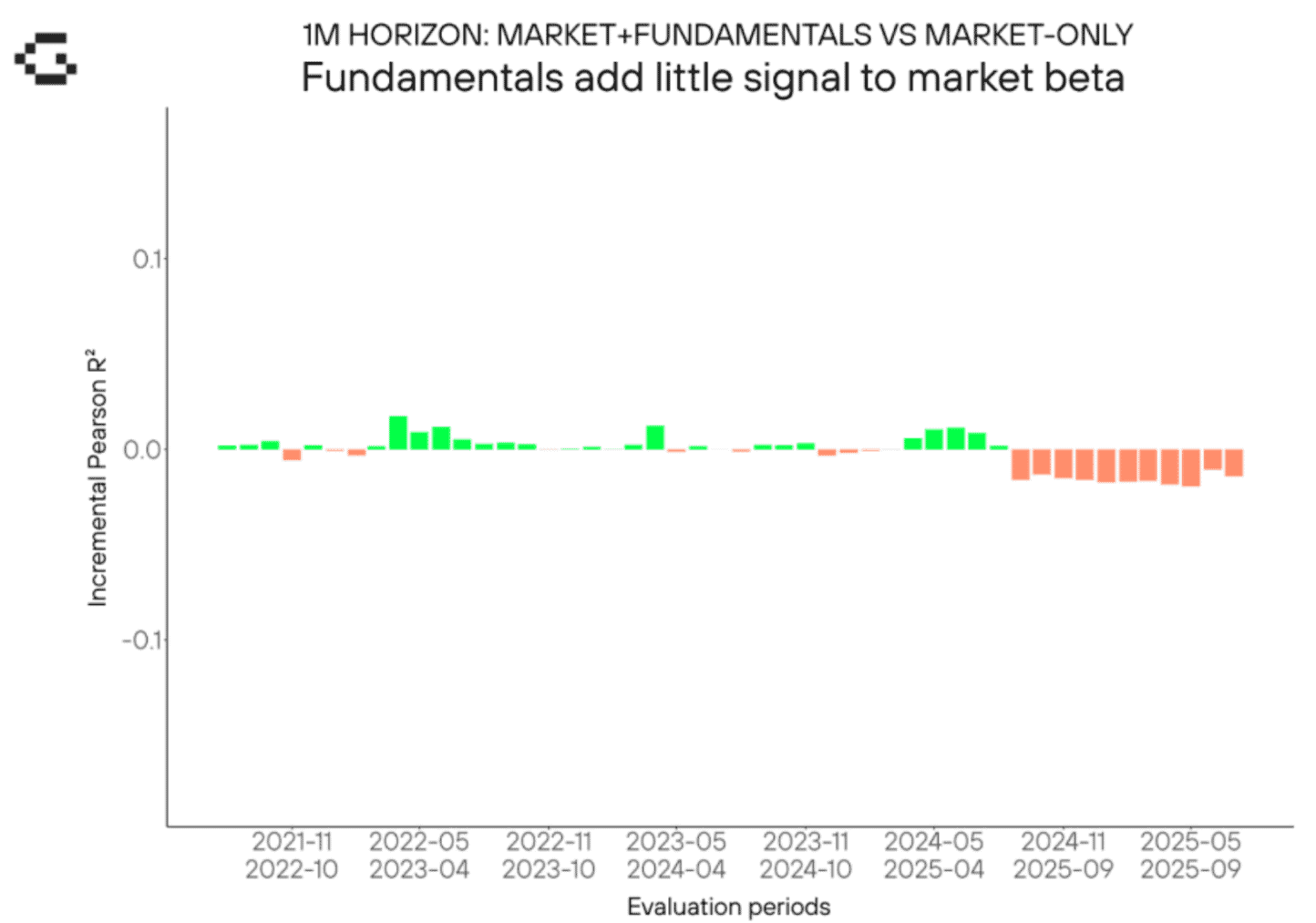
That’s not the case. In the 1-month horizon, fundamental metrics don’t impact valuation much.
The age-old wisdom is validated here: short-term price action is based on liquidity and sentiment.
But the longer the horizon, the more fundamentals matter.
At 6 months, fundamentals were significantly more predictive. That means retail can generate alpha by tracking TVL, fees, revenue, and usage before the market fully reacts.
This means retail investors can generate alpha by monitoring fundamental metrics. The market takes time to price in those improvements. You can buy before everyone else.
Takeaway #2: Some metrics are more predictive than others
Here’s their rank order of importance for the 6-month horizon.
- Total Value Locked
- Protocol Fees
- Protocol Revenue
- Active Users (DAU)
- Daily transaction
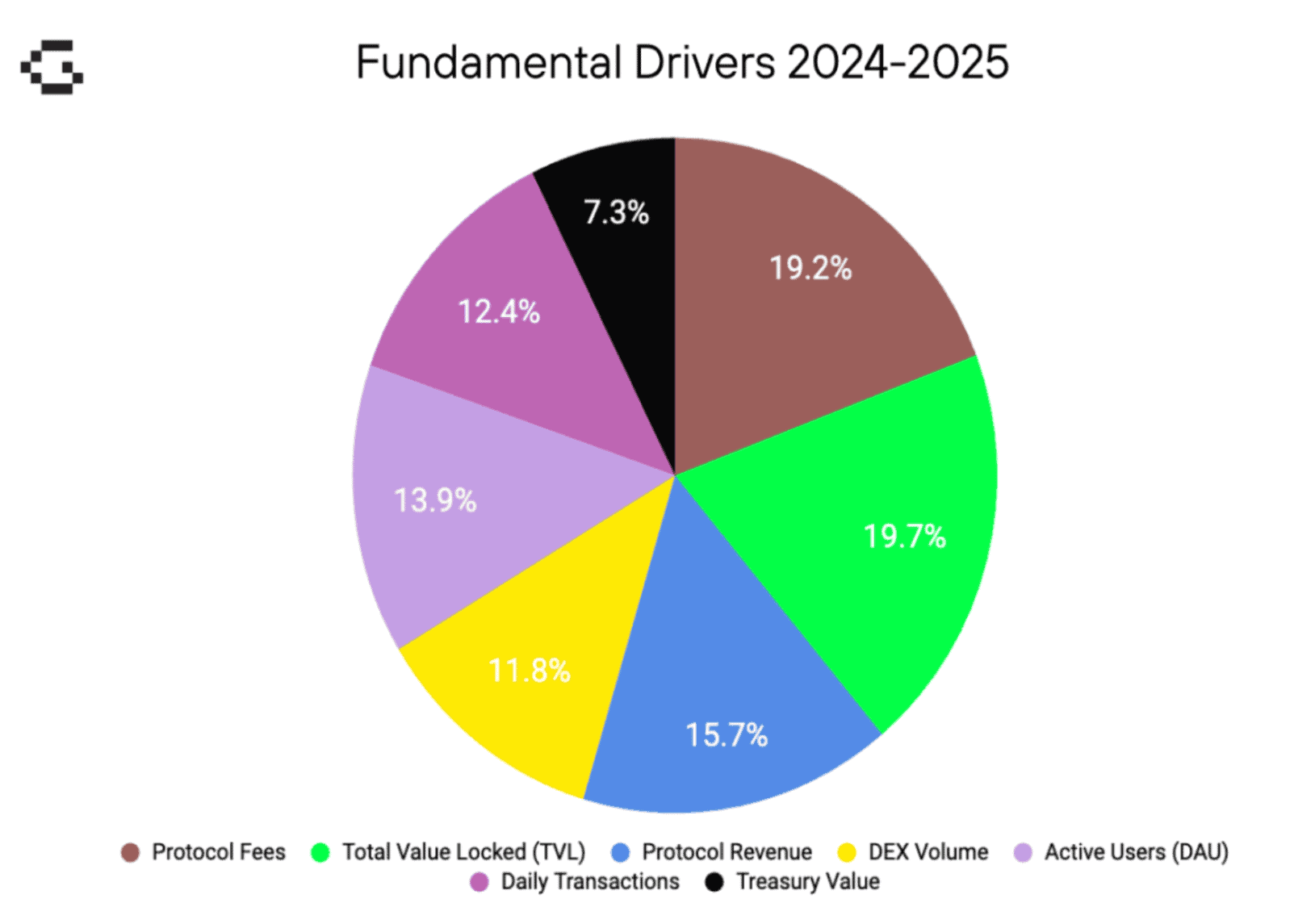
The influence of different metrics for the 6M period has changed by 2024-2025. Relative to pure liquidity metrics like TVL, more sustainable economic indicators like protocol fees are gaining more importance.
But this is not rigid. For example, TVL is far more important for an AMM than for a lending protocol. Use the metrics, but contextualize them.
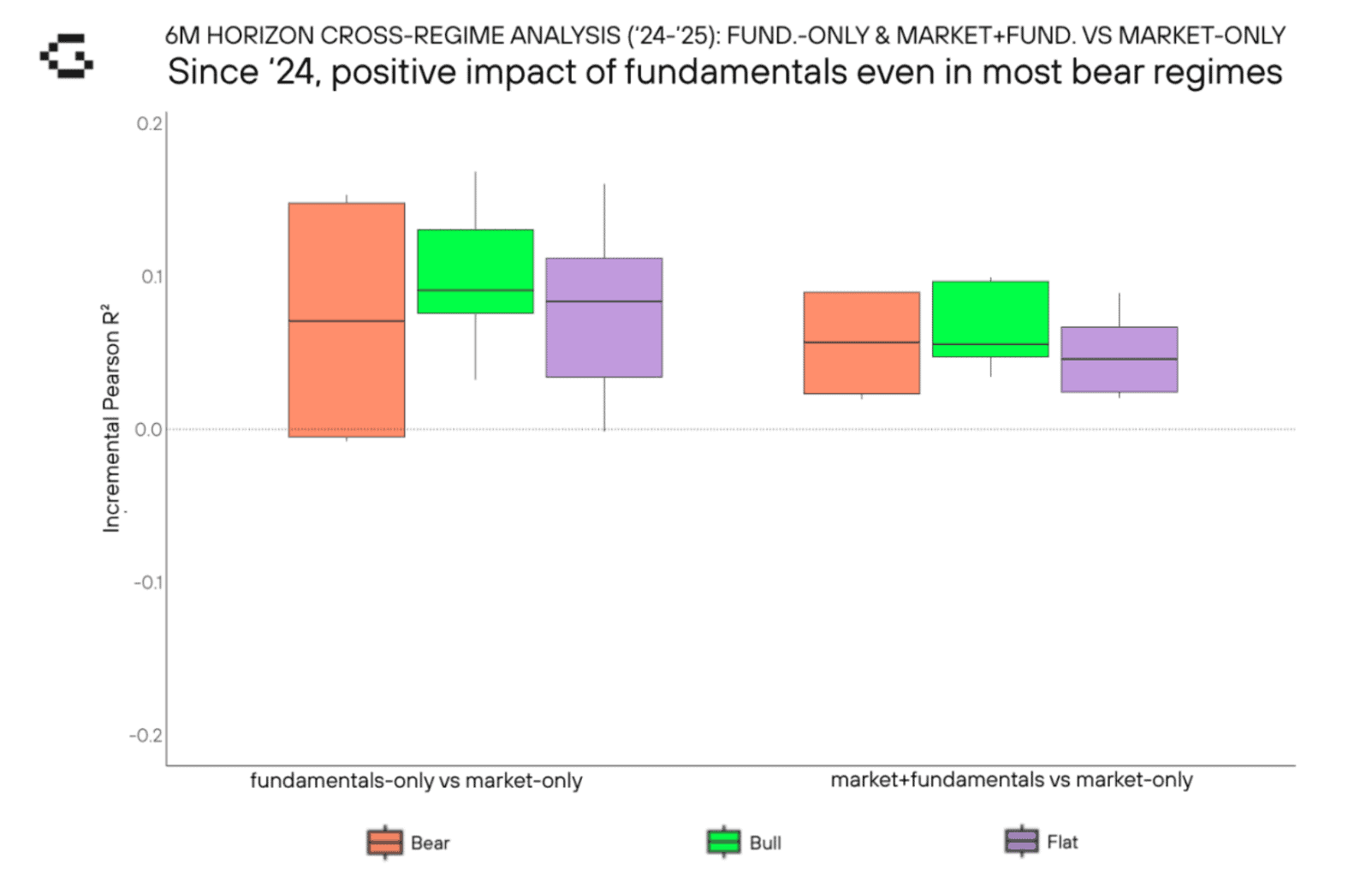
Takeaway #3: The importance of fundamentals is increasing in bear conditions.
From 2021 to 2025 as a whole, market data was still more predictive in bearish periods.
But that changed after 2024.
But after 2024, fundamentals became comparatively more important during bearish conditions. A sign that the market is maturing.
Investors are slowly shifting from pure sentiment to real fundamentals. It’s a healthier direction for DeFi.
If you want to read the full report, click here.
🚀 DeFi Catalysts
Stable mainnet is officially live. It’s a Tether-backed L1 designed for high-volume, predictable stablecoin settlement.
Curve Finance is entering the FX game. The first pilot USD<->CHF (Swiss Franc) liquidity pool is live on Ethereum.
Lighter, the leading perp dex by volume, has started rolling out spot trading. They’ve started with $ETH as the first asset on the chain.
Ethena has released HyENA, its HyperLiquid-powered HIP-3 perp DEX. It’ll go live today.
Talus released the tokenomics of its token: $US. It’s a fixed-supply Sui token with many utilities, ranging from node staking to tool monetization.
Ondo Finance has great news on the legal front. SEC has ended the 2-year investigation into Ondo.
Superform is conducting the community sale of its token $UP. It’s curated by Cookie and powered by Legion infrastructure.
Near Protocol introduced NEAR AI Cloud and Private Chat. NEAR AI Cloud makes it easy to move existing AI workloads to a verifiably private environment.
Balancer is discussing the distribution of rescued funds (worth ~$8M) from Balancer v2 exploits on November 3rd to the LPs and whitehats.
Base has released a two-way bridge between Base and Solana. The marketing surroung the bridge had created drama between the Base and Solana teams.
Hyperliquid has linked the USDC between HyperCore and HyperEVM. It enables secure, natively minted cross-chain USDC deposits directly to HyperCore.
Cocoon, a decentralized confidential compute network, has gone live. Telegram users can expect new AI-related features built on 100% confidentiality.
ETHGas introduced the Open Gas Initiative. It’s a way for protocols to subsidize gas for users with zero-code integration.
📰 Industry News
Rainbow, a top web3 wallet, is giving 20% of the company equity to Rainbow Foundation, which’ll proxy-hold equities for the tokenholders.
Stripe is rolling out USD-settled stablecoin payments across Ethereum, Base, and Polygon. They’re charging a 1.5% transaction fee as well.
Kraken launched an invitation-only VIP program that requires $10 million average balances or $80 million annual trading volume.
Stable, the Tether-backed L1 chain competing in the “stablecoin chain” niche, has published its whitepaper.
Doodles launched 25K Doopie Cubes on Solana with free claims for OGs and Dooplicators.
🐦⬛ X Hits
- The L1 valuation debate.
- HyperLiquid frontend wars.
- A story of disillusionment in crypto.
- Strategies for earning on Polymarket.
- Problems with the current crypto neobanks.
😂 Meme
Until next time,
Edgy
Today’s email was written by Edgy and Yayya.
DISCLAIMER: I’m NOT a financial advisor. This content is for education and information purposes only. Crypto and DeFi are risky and speculative. Please do your research before investing.
|
|
|
Be Early to the Next Opportunities
TDE Pro gives you direct access to our research, our portfolios, and the gems we’re betting on.
It’s your unfair advantage to move before the crowds.
|
Whenever you’re ready, here’s how we can help you:
- ⚙️ The DeFi Edge PRO – Designed for busy people who want to stay ahead of the curve. Leverage our research to save you hours each week, and to see what we’re personally investing in. Join today.
- 🚀 The DeFi Edge Ventures – We identify, invest, and help amplify DeFi Protocols that positively impact the Crypto space.
You’re receiving this email because you signed up for my newsletter. You can update your Preferences or Unsubscribe here.
113 Cherry St #92768, Seattle, WA 98104-2205