A guy locked out of his Bitcoin wallet for 11 years just uploaded his entire old college computer to Claude and asked it to figure things out.
The AI parsed thousands of files, identified the encryption scheme, debugged the recovery tool, and helped him unlock roughly $398k in BTC.
Sober-him would’ve paperhanded it. Drunk-him didn’t. Bullish drinking lol.
Here’s what we got today:
Beta plays for Venice AI. Barbell strategy and potential beta plays.
Bitcoin Staking Deep Dive. Stacks has released BTC staking on L1.
Around the web. Jupiter Poker, strkBTC from StarkNet, Mainframe from MetaLeX, Clear signing from Ethereum, and more.
Today’s email is brought to you by Stacks — the smart contract layer of Bitcoin.
Here’s your Edge 🗡️!
Narrative
What’s the Next Venice ($VVV)?
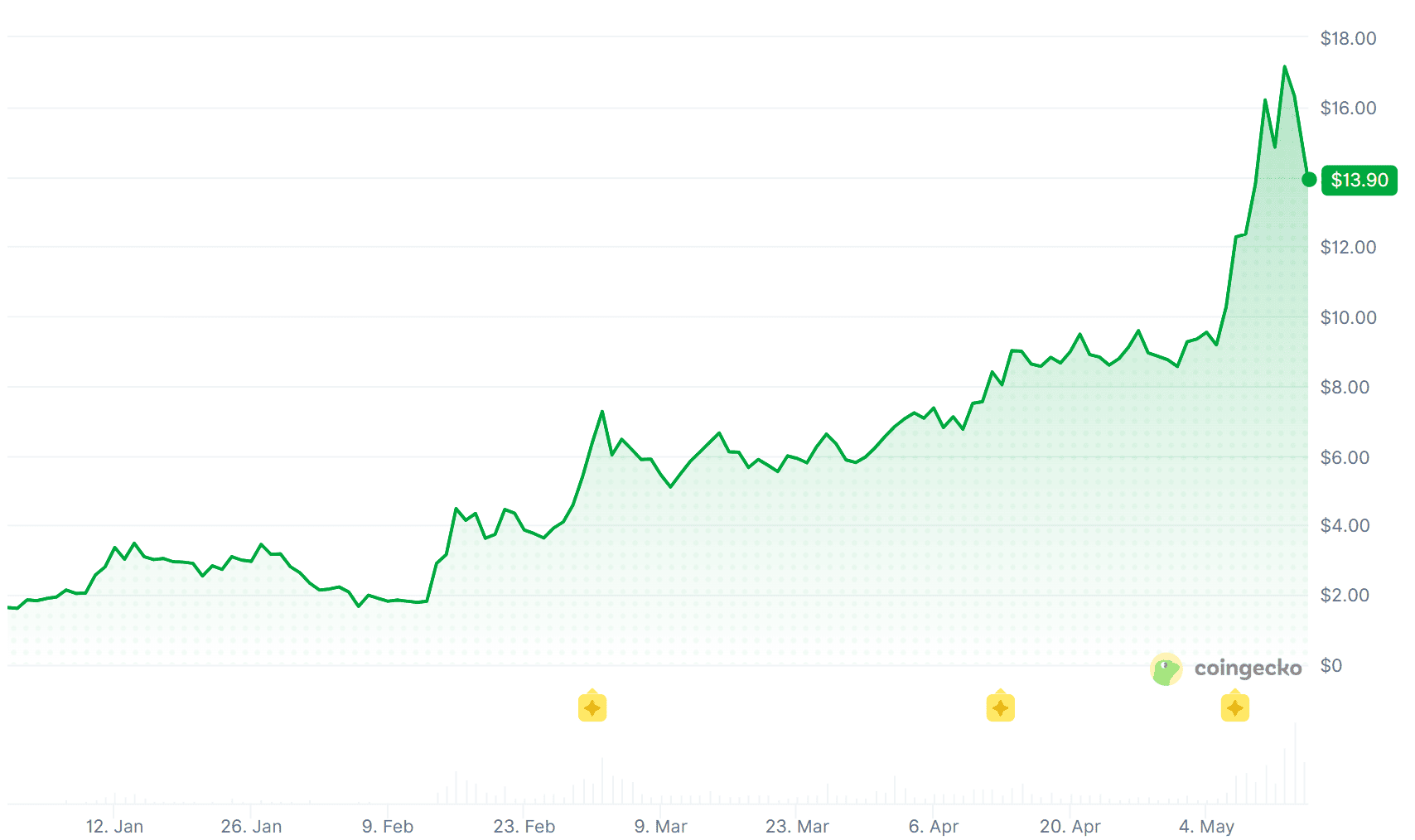
Venice ($VVV) is up ~8x YTD. From $1.75 in January to ~$13.81 today.
Now every degen on the timeline is hunting for the next Venice. Most betas are going to zero. But there are some good ones. I’ll share my research here.
Firstly, what is Venice? It’s a privacy-first, uncensored AI platform. No content filters, no surveillance, no Sam Altman hovering over the off-switch when you ask a weird question. VVV is the token tied to it.
It’s a rare crypto-product that caters to a real use case. And it has created a new narrative: decentralized inference.
Why is $VVV pumping?
There are many reasons to be honest. Here are the top 3.
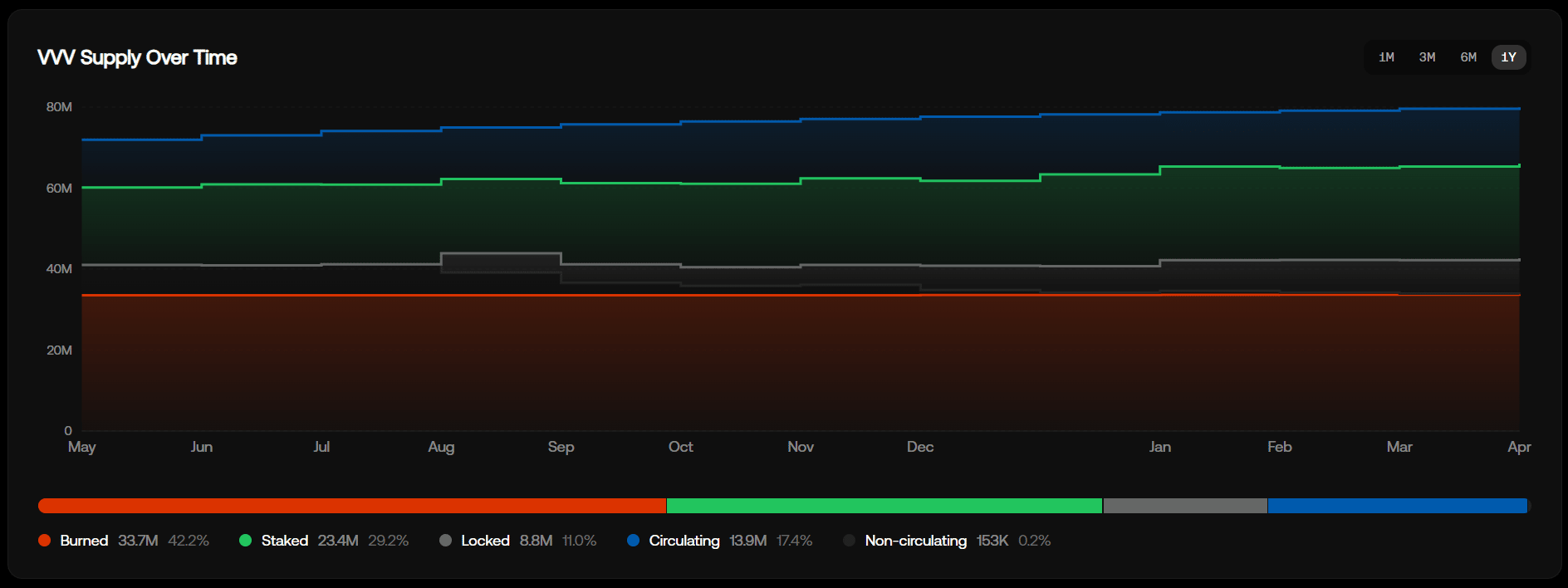
#1. Revenue & buybacks. Starting Dec 2025, Venice uses a portion of monthly revenue to buy and burn the VVV token on an ongoing basis. Till now, ~33.7M VVV have been burned. That’s ~$470M!
Plus, only 17.4% of the token supply is circulating. ~30% is staked. 11% is locked. And 42.2% has been burned.
Source: Venice Token Dashboard
#2. Real demand. Venice has 2M+ registered users. ~50k DAU. ~15k inference requests per hour. API token usage is up ~10x since January, with integrations into OpenRouter, Cursor, Brave Leo, Fleek, and VOID.
#3. Falling emissions. Annual issuance cut from 8M to 6M VVV in February (-25%). Another cut on May 1 (6M to 5M, -17%). Two more queued for June 1 and July 1, targeting 3M/yr by July (CoinMarketCap).
So, it’s a solid asset. But for hot narratives, I like the barbell strategy
I anchor the bag with the leader (lower variance, real fundamentals) and pair it with one higher-risk beta (asymmetric upside). For this category, the anchor is obviously VVV. This article will share the betas I found.
Some basic filters I used.
In: real shipped product, FDV under $200M, chart already woken up, not already up 5x+ in 30 days.
Out: anon teams, narrative-only with no product, parabolic-already, FDV above $200M.
Your job is to size positions accordingly, not to convince yourself a $4M-cap nano with 30 followers is the next Solana.
Decentralized inference on consumer GPUs. Eric Hartford spent 3+ years building the model. It’s now the default uncensored option on Venice, with 100% of revenue routing to buybacks.
The catch: +1,335% in 30 days blows the screen by ~3x. I might already be too late to this play.
Verifiable inference for smart contracts. Every AI output gets a cryptographic receipt proving the right model ran on the right data. Founders out of Two Sigma and Palantir, a16z-backed.
The catch: DeFAI is still early. This is a future bet, not a now bet.
P2P network for personal AI agents. Operators run the compute, users run their agents on it. Staking MOR mints daily inference credits. 2.2M staked, ~30% of supply. No VC allocation, no founder premine, 42M max supply.
The catch: ~2,968 MOR hits the market every day. That’s roughly $2.9M/yr of structural sell pressure.
Humanoid robots for dangerous industrial work, running Venice as the VLM reasoning layer. Top 10 in Base Batches 003, also in the Virtuals Robotics Track.
The catch: barely any public info on team, backers, or funding. The Venice partnership earns a watchlist spot. Everything else is faith.
Open-source framework for autonomous AI agents running in Docker. 13,500+ GitHub stars before there was ever a token. Currently #6 on OpenRouter in the Coding category. Bootstrapped, EU-registered, no VC overhang.
The catch: $4M MC could be too low. It can move 5x in a week and give it all back the week after. Highest beta of the five.
Nano-caps. Real risk of complete failure. Watchlist only.
$SQUIRE (@squire_bot): MC $569k. Agent-built CLI tools and a Solana inference marketplace.
The barbell strategy exists because hot narratives produce more wreckage than winners. VVV is the safe side. Betas are higher risk, but they also promise higher reward.
Disclaimer: I’m just sharing my research; none of these are recommendations to buy.
Sponsored Deep Dive
Yield on Self-Custodial Bitcoin, Paid in $BTC. It’s Finally Here.
$1.3 trillion in Bitcoin is sitting around doing absolutely nothing.
Most products that have tried to fix that problem have ended in tears. Celsius. BlockFi. Voyager. Wrapped BTC tokens that got bridge-exploited for nine figures. CeFi platforms whose “institutional-grade security” turned out to mean “we’re going to degen with your money.”
The takeaway was clear. Every “Bitcoin yield” product has had a catch. Wrap it (custodial risk). Bridge it (exploit risk). Lend it to a CeFi platform (Mashinsky risk). Stake it on a sidechain (give up self-custody and pray).
Stacks is shipping a different version.
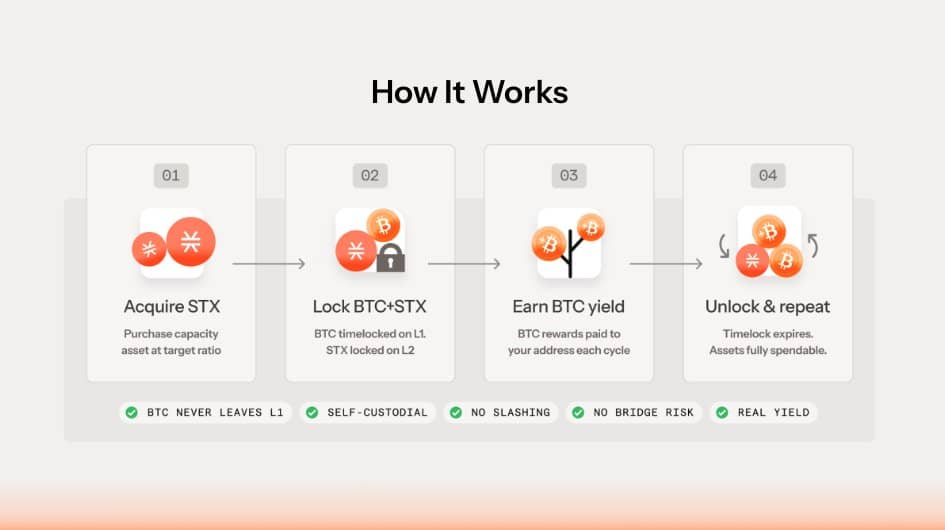
Quick 80/20: Bitcoin Staking lets BTC holders lock their BTC on the Bitcoin blockchain, under their own keys, and earn yield denominated in actual BTC. No wrapping. No bridging. No custodian. No slashing. The BTC never leaves Bitcoin L1.
This is the first time Bitcoin holders can earn BTC yield on their BTC without giving up custody.
This Isn’t Some Untested Experiment
Stacks isn’t launching a new yield product from scratch. Bitcoin Staking is an upgrade to their consensus mechanism that’s been running in production since January 2021.
The current system is called Proof-of-Transfer (PoX). Simplified: Stacks miners spend BTC to compete for STX block rewards. The BTC they spend gets distributed to participants who lock STX. It’s been running for almost five years.
The receipts: over 4,200 BTC distributed to participants since launch. Real BTC. Real participants. Real onchain history. At current prices, that’s ~$335M routed through the mechanism.
That’s the foundation. Bitcoin Staking doesn’t reinvent it. It changes who qualifies for the BTC rewards.
What’s Actually Changing
Under the current model, you lock STX and earn BTC. STX is what makes you eligible. BTC has no participation role.
Under Bitcoin Staking, you lock BTC and STX together as a “protocol bond.” The BTC portion is what earns yield. STX becomes the capacity asset that gates participation.
The mechanics:
Bonding period is ~6 months.
Your BTC stays on Bitcoin L1, locked in a timelocked UTXO under your own keys. When the time lock expires, you can spend it again. Nobody else can touch it.
You simultaneously lock STX on Stacks. The protocol matches the two commitments via a script that encodes your Stacks address inside the Bitcoin timelock.
At launch: 3% target APY on BTC, 3,000 BTC capacity, 5% STX ratio minimum (lock 10 BTC, you also lock ~$50K worth of STX alongside it).
Where the Yield Actually Comes From
“If you don’t know where the yield comes from, you are the yield” — The APY Fairy.
Fortunately for us, with BTC Staking, we know exactly where the yield is coming from.
Stacks miners spend BTC to bid for the right to produce Stacks blocks.
Winning miners earn STX block rewards (now 1,000 STX per Bitcoin block, with halvings explicitly removed) plus transaction fees.
The BTC miners spent gets routed to participants.
Miners only bid BTC if they expect the STX rewards to be worth more. So the BTC yield is fundamentally backed by miner economics, which scale with STX demand and transaction fee revenue.
This is more durable than token emissions (no farm-and-dump dynamics, no inflationary printing pretending to be yield), but it’s not magic. The yield is tied to a real economy operating on Stacks.
How This Stacks Up Against Competitors
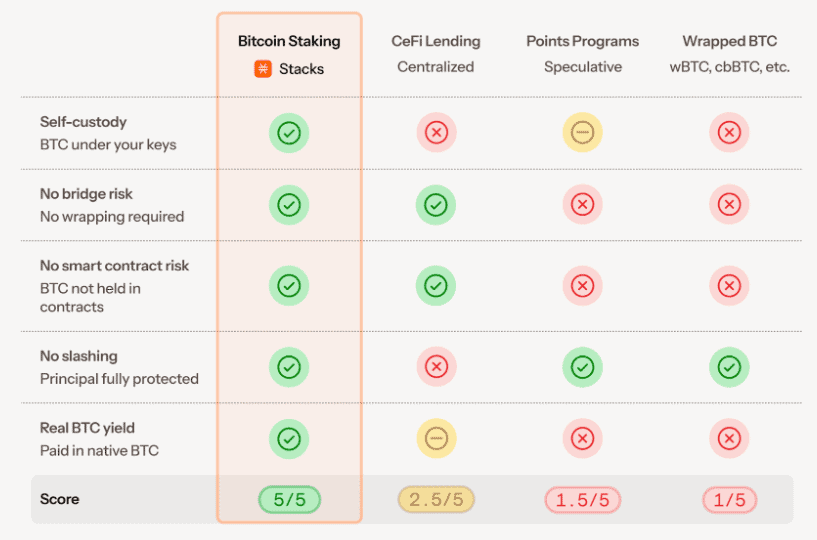
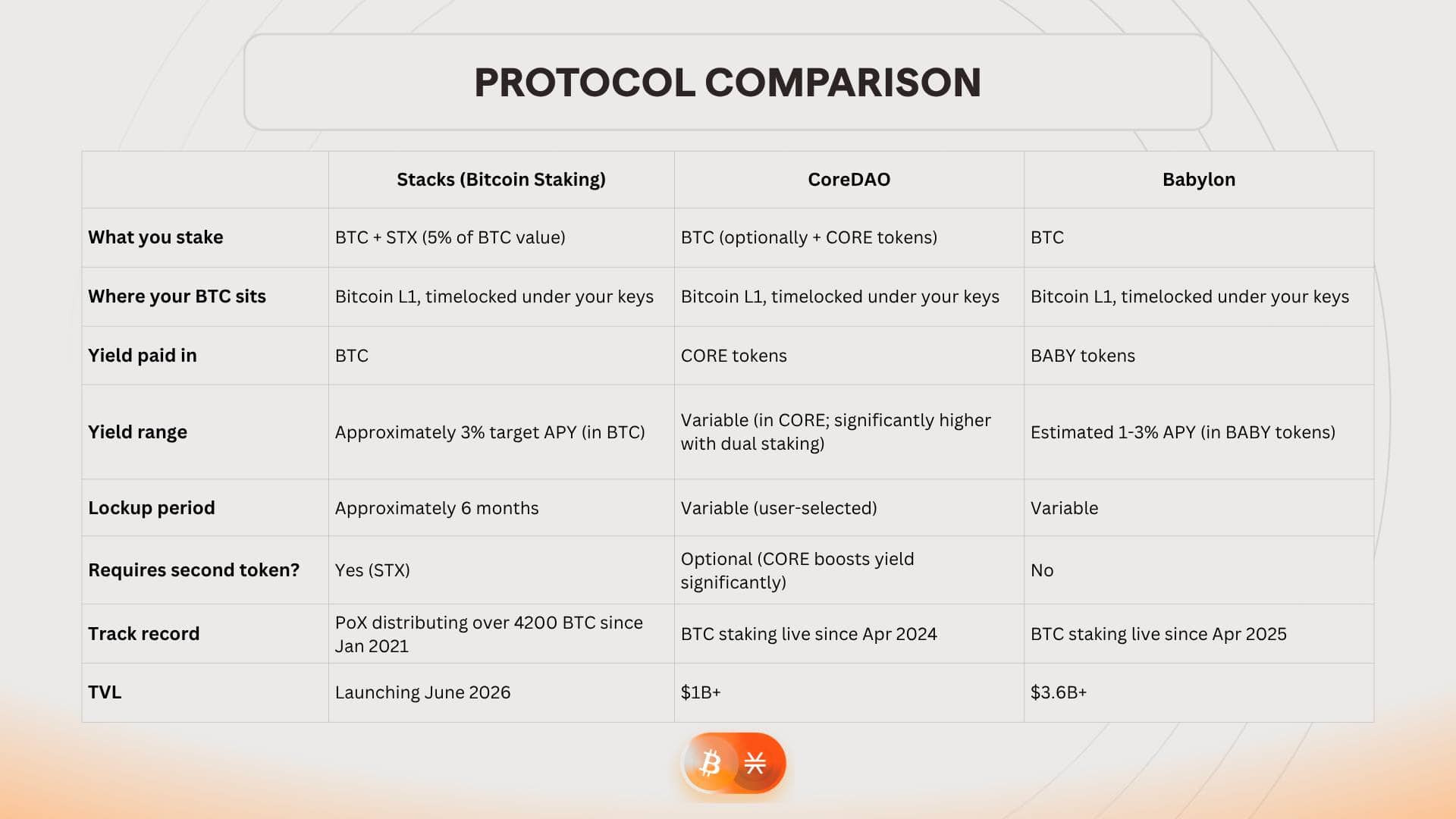
There are two other serious players in self-custodial BTC staking right now: CoreDAO (live since April 2024) and Babylon (April 2025). All three keep your BTC on Bitcoin L1 via timelock. That’s where the similarities mostly end.
The split that actually matters: yield denomination. Stacks pays in BTC. The other two pay in their own native tokens, which means your real return depends on where those tokens trade.
See the table below for the full comparison.
The Catch (Because There’s Always Tradeoffs)
Pretending there are no tradeoffs is how you’ll lose money. So here you go:
1. Your BTC is locked for ~6 months. There’s an early-exit option, but using it forfeits all your yield for that bonding period. The illiquidity is real.
2. STX exposure is baked in. You can’t earn BTC yield without committing STX too. The 5% minimum ratio means real STX price exposure for the duration of your bond. If STX drops 30% during your bonding period, that’s a real hit to your total position, even if your BTC yield gets paid in full.
3. Reflexivity risk. BTC yield depends on miner bids. Miner bids depend on STX price and Stacks network activity. If STX tanks for a sustained period, miner bids shrink and the BTC reward pool compresses. To be fair, the protocol has a reserve fund and a waterfall structure (paired BTC stakers get paid first, STX-only stackers absorb the residual). But in a deep enough drawdown, the reserve can deplete.
4. The bootstrap phase is managed. At launch, this is PoX-5, a managed program operated by the Stacks Endowment with whitelisted partners getting most of the BTC capacity allocation.
The fully decentralized, permissionless auction (PoX-6) is expected roughly 12 months later. Early adopters are entering during the controlled phase, which means more guardrails but also less open access.
Does Bitcoin Staking Even Matter?
A useful way to think about Bitcoin Staking is what happens if it actually works.
Even 1% of Bitcoin’s market cap (~$13B) opting into productive use is a massive shift in how the asset behaves. Right now, virtually all BTC is parked in cold storage or sitting on exchanges, doing nothing economically. The BTC holders who want yield have historically had to choose between custody risk, bridge risk, or slashing risk.
Bitcoin Staking is the first credible answer that doesn’t force that choice. The yield is modest (3% isn’t going to mint millionaires), but for self-custodial BTC with no slashing and BTC-denominated payouts, it doesn’t have to be.
This is also the foundation for what Stacks is building toward. Liquid staking tokens for protocol bonds. Self-custodial Bitcoin lending. A real BTCfi layer that doesn’t run on bridges and IOUs.
Zooming Out
There’s a reason most BTC yield products in the 2021 cycle ended with investors serving as exit liquidity. They were designed to extract value from BTC holders, not to compensate them for real risk. Yield came from token emissions, undisclosed rehypothecation, or pure ponzinomics.
Bitcoin Staking is honest about what it is. The yield is backed by Stacks miner economics. The tradeoffs (6-month lock, STX exposure, reflexivity, managed bootstrap) are fine for the R/R.
It’s not free money. Nothing is. But if you’ve been waiting for a way to earn BTC on your BTC without trusting anyone, this is the first product that does it.
Jupiter introduced Jupiter Poker. It lets fans buy “action” in elite poker pros’ tournaments.
Aave has liquidated the Kelp/L0 attacker’s rsETH positions on Aave on Ethereum and Arbitrum.
StarkNet launched strkBTC. It’s designed to be a private Bitcoin on Starknet. It’s powered by STRK20, the privacy framework that enables shielded balances and private transfers on Starknet.
Solstice announced that the SLX token will launch on May 21. The allocation checker is already live.
Citrea is a zk-rollup on Bitcoin. It introduced its native token: $CTR. The tokenomics include a gauge system and a staked version of the token.
Alchemix lifted its V3 deposit caps. They’ve opened up 90% LTV vaults, new Mix-Yield Tokens, and the Fixed-Duration Transmuter.
Token Works, the team behind Punk Strategy, introduced a new experiment: “Ten Thousand Tokens“. Allowlist checker is live.
Safenet is the protocol layer that enforces transaction security onchain. SEP-55 Phase 2 is live, and users can now stake $SAFE and secure the network.
ARC, the layer-1 chain from Circle, has released the whitepaper for $ARC, its native token.
MetaLex has launched Mainframe. It’s the first DeFi-style app that lets companies issue and administer tokenized securities entirely on their own.
21Shares launched the Hyperliquid ETF (THYP) on Nasdaq. It has 0.30% management fee and has enabled staking.
Jupiter Lend has onboarded Bitwise to curate an Ethena lending market. Users will be able to deposit USDe, borrow against it, and run leveraged strategies.
Chainlink will be used by DTCC for its collateral AppChain. It’s a US financial market infrastructure that processes securities transactions valued at $2.5 quadrillion.
📰 Industry News
Ethereum released Clear Signing. It’s an open standard to end blind signing and make human-readable transactions the default.
Offchain Labs has rebranded into Offchain to show the evolution from Ethereum R&D into a larger mission.
Circle introduced Circle Agent Stack. Initially, it’ll have Agent Wallets, Agent Marketplace, Circle CLI, Nanopayments, and Circle Skills.
Coinbase released its Q1 2026 Earnings Report. The total revenue fell 31% YoY to $1.4B. The net loss was $394 million.
DL News, which launched in 2022 as the news arm of DefiLlama, announced they’re shutting down.
DISCLAIMER: I’m NOT a financial advisor. This content is for education and information purposes only. Crypto and DeFi are risky and speculative. Please do your research before investing.
Be Early to the Next Opportunities
TDE Pro gives you direct access to our research, our portfolios, and the gems we’re betting on. It’s your unfair advantage to move before the crowds.
Whenever you’re ready, here’s how we can help you:
⚙️ The DeFi Edge PRO– Designed for busy people who want to stay ahead of the curve. Leverage our research to save you hours each week, and to see what we’re personally investing in. Join today.
🚀 The DeFi Edge Ventures– We identify, invest, and help amplify DeFi Protocols that positively impact the Crypto space.
You’re receiving this email because you signed up for my newsletter. You can update your Preferences or Unsubscribe here. 600 1st Ave, Ste 330 PMB 92768, Seattle, WA 98104-2246