Analysis
The Apostasy of Michael Saylor
Strategy sold Bitcoin.
Go ahead and read that sentence again. The company that took BTC HODLing religion into the mainstream sold. They disclosed in an 8-K around June 1 that they sold 32 BTC between May 26 and 31 at an average net price of ~$77,135.
Total proceeds: ~$2.5M. That’s 0.004% of their stack.
A rounding error. And it still managed to break everything.
What’s the official story?
CEO Phong Le gave three reasons:
- Prove Strategy can sell when it needs to
- Confirm their internal disposal systems work
- Harvest tax losses on high-cost-basis coins
All reasonable on paper. But imo, this was about $STRC, their perpetual preferred stock. It’s been trading below its $100 anchor, and a “see, we’ll sell BTC to pay STRC” flex was supposed to push it back.
Why was the market nervous in the first place?
Look at the balance sheet.
Strategy used to hold $2.25B in reserves, enough to cover ~3.9 years of preferred dividends. Then in late May, they spent $1.5B of it repurchasing their 0% Convertible Notes due 2029, retiring cheap debt early.
The reserve now sits at $871M. Against a $1.7B annual dividend obligation, that’s roughly 6 months of runway.
They traded years of dividend cushion for a cleaner balance sheet. I think that was the wrong move. A thin cash buffer is exactly what turns the reflexive death spiral (sell BTC → price drops → mNAV drops → forced to sell more) from theoretical into plausible.
So Strategy announced a BTC sale to a market that was already doing this math.
Did it work?
They went 0 for 3.
- $STRC never made it back to $100.
- $MSTR fell from ~$150 on June 1 to ~$118 today. Down 21%.
- $BTC dropped from $70.3k to $60.3k by June 5.
The problem wasn’t just selling. But selling so little.
32 BTC raises $2.5M. That doesn’t refill the dividend reserve. It doesn’t fix the runway. Financially, the sale accomplished nothing.
Psychologically, it broke everything in the worst possible way. Until last week, Strategy’s stack was treated as permanently removed from supply. “Saylor never sells” was priced in. One tiny sale and that assumption is dead. This was like a massive token unlock.
If you’re going to pay that psychological price anyway, get something for it. Sell enough to top up the reserve and kill the runway question for years. Instead, they cracked the confidence for zero financial benefit.
Why this matters going forward
The STRC model works beautifully when BTC goes up. When BTC is flat or down, Strategy is paying 11.5% annual carry on an asset that isn’t moving.
At current prices, covering dividends through BTC sales alone means liquidating ~23,600 BTC per year. That’s ~2.8% of the stack. Every year.
It’s a slow bleed, not a fire sale. Survivable for a while.
And that’s not the real risk. It’s what happens to the market’s psychology when its single largest source of marginal demand becomes a holder.
Or worse, a seller.
Sponsored by Katana
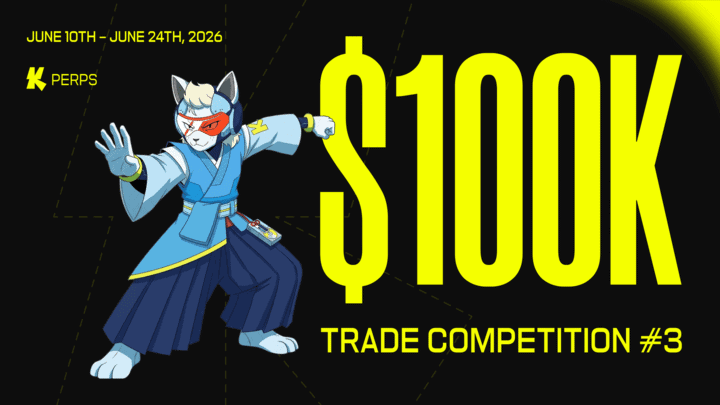
Trading Competition With Up To $100k Reward Pool
Do you trade perps? There’s $100k on the table.
Katana launched their 3rd trading competition yesterday: Up to $100k prize pool, running two weeks until June 24th.
Quick 80/20 on the venue: Katana Perps is the native perp platform of Katana, the Ethereum L2 built to optimize for DeFi at every level.
Vault Bridge is the clearest example. Assets bridged into Katana get deployed into low-risk strategies on Ethereum L1, generating a structural revenue source that Katana routes back into trader incentives and maker rebates.
That $100k pool? It’s powered by Vault Bridge yield, not token emissions waiting to be dumped. Gud tek.
The reward splits into two pools:
- PnL pool: a fixed $10k, distributed among the top 15 wallets.
- Volume pool: starts at $5k, scales up to $90k, distributed pro-rata based on your trading volume.
For every $5M that the community trades, $2500 will be added to the volume pool. More wallets = more volume = more rewards. You aren’t competing for a fixed pot, you’re increasing it.
You can dig into the full tournament details here.
Or you can just start trading.
Project
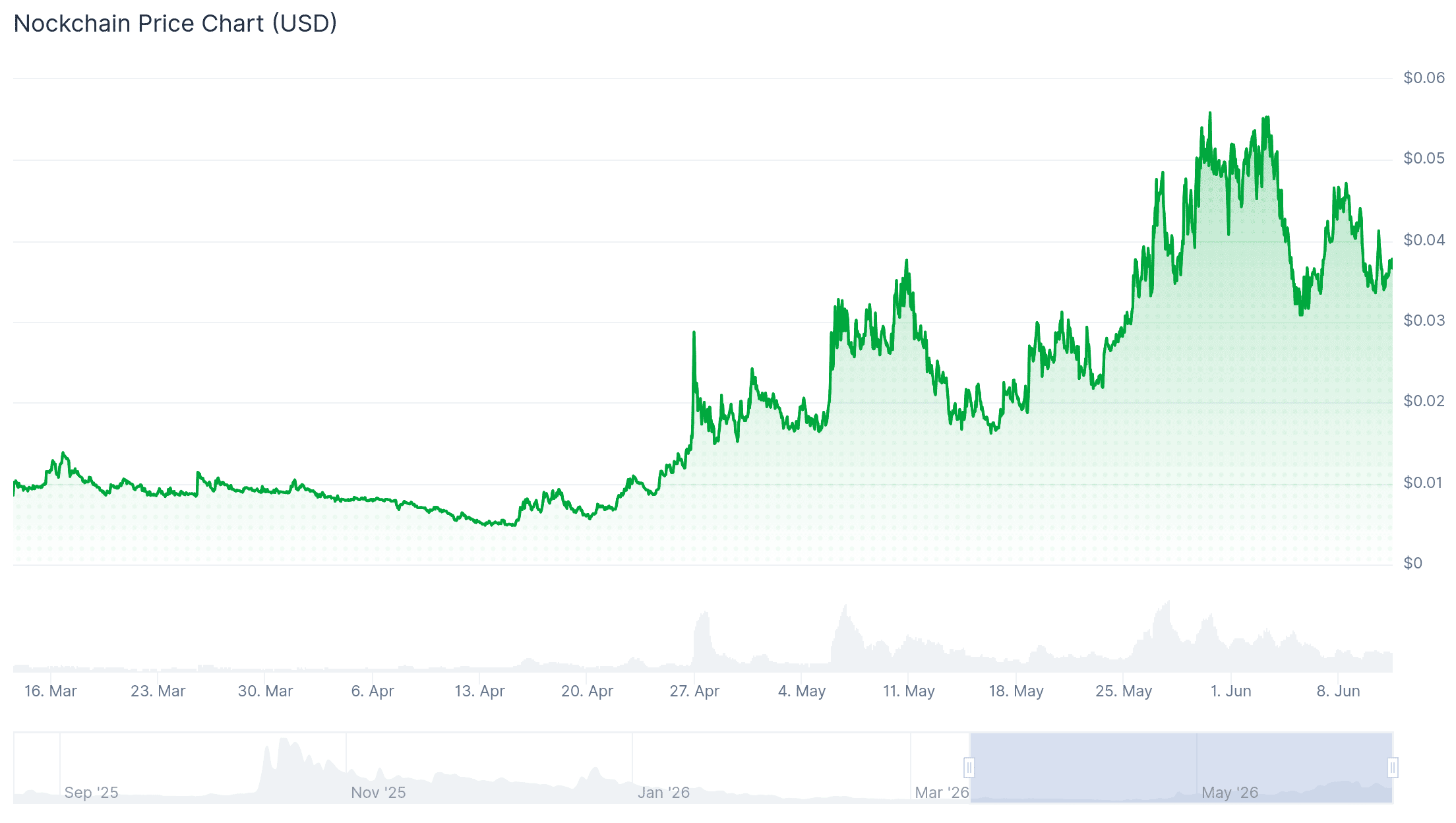
$NOCK Is Up 520%. But Here’s the Catch.
$NOCK is up 520% in two months.
That’s not supposed to happen. Everyone agreed the “new L1” trade was dead. The market has funded a hundred of them, and most are ghost chains with nine-figure valuations.
So what’s pumping this one?
One update: Proof of Useful Work.
What is it? Nockchain’s twist on proof-of-work.
In Bitcoin’s version, miners burn electricity solving puzzles that have zero value outside of securing the network. Nockchain’s miners generate proofs of useful computation instead.
An example of useful computation is AI inference, aka the computation that answers your ChatGPT questions. Inference providers can become Nockchain validators and earn $NOCK. They just have to do some extra work to prove the computation actually happened.
The masterplan: Nockchain builds up a standing army of proof-generators. Then it launches its real product, a distributed marketplace for verifiable computation. AI agents and apps that need their compute verified pay Nockchain miners to generate the proofs.
There are also plans for private economic activity, which would give it a “better Zcash” narrative. But that’s slated for Q4 2026, so file it under “nice story, check back later.”
The Tokenomics
On paper, it’s the cleanest setup you’ll see:
- Fixed supply of 4.29B
- 100% fair launch. No premine. No team or insider allocation
But there are two catches.
- “Fair launch” did a lot of heavy lifting here. The team and insiders likely mined most of the early coins, and the top 100 wallets hold around 64% of supply. Not great.
- 20% of every block reward goes to a “Protocol Fund” controlled by the Nock Foundation. (So there’s no insider allocation, except the perpetual one with a different name.)
The Team is also legit. They’re doxxed, they’ve been building for years, and Delphi Ventures is backing them. There’s also a bridge to Base, so distribution isn’t a problem.
Cool product + credible team + easy access = narrative potential.
The 80/20 of bullish narrative: In a world of AI agents and automated finance, demand for verified computation explodes. Nockchain becomes the only L1 with a built-in marketplace selling proof generation.
It’s a good story.
Now for the grain of salt.
Nockchain is trying to win two races at once: the L1 store-of-value race and the proof-generation market.
The SoV race is brutal. The market is exhausted by new L1 monies. Needless to say, they’re not even in the arena now.
And in proof generation, Nockchain isn’t even the favorite. Succinct ($PROVE) and Boundless ($ZKC) lead the sector, and EigenCloud is chasing the same customers. All of them have live products with real demand-side users.
Nockchain’s marketplace is still theoretical.
But here’s the real handicap. Any app that wants verification from Nockchain has to write code in Hoon, the language of Nockchain’s virtual machine. (They’re developing an easier language called Jock. But that’s a new language with no network effects as well.)
The number of devs on Earth who know Hoon is in the low hundreds. The number actively writing it is in the dozens. There are over 32k EVM devs.
That’s >320x lower potential customers for Nockchain marketplace.
There are many more players in the broader proof verification market. If you guys like to hear more about them, let me know by replying. If there’s enough interest, I’ll write about it.
🚀 DeFi Catalysts
TON community has voted to rename Toncoin ($TON) to $GRAM. The change will take effect at 12:00 UTC on June 15, 2026.
Aave passed the proposal from Babylon to integrate their BTC, which claims to be trustless, on Aave v4.
Morpho Association raised $175M from big VCs like a16z, Paradigm, and more. It looks like a token sale, which is better for $MORPHO than an equity sale.
Ethena has partnered with Janus Henderson, a $480 billion asset manager. Janus has bought $ENA and will explore avenues to distribute USDe to their client base.
Humanity Protocol‘s $H token was hacked for $30M. It went down >80%. Private key compromise of a foundation member was identified as the cause.
Aster has launched permissionless listing for Aster Spot. Any token on Binance Spot or Alpha can apply, and onchain validator vote, weighted by staked $ASTER, will decide on it.
Base App introduced limit orders. Now, the app users can just set the price at which they want to sell and have the app execute it when the price reaches it.
📰 Industry News
MetaMask has launched the MM Agent Wallet. It enables self-custodial agent wallet that reaches all of defi across all EVM chains.
Kalshi Perps crossed $1 billion in volume within the first week of launch. And the app isn’t fully available to the public yet.
Helius has acquired Light Protocol to build the canonical privacy layer for Solana. Light had authored Solana’s original Zero Knowledge (ZK) syscalls and built ZK Compression.
🐦⬛ X Hits
- Price discovery in crypto.
- The trust about agentic payments.
- An insightful reflection on a year-long $ZEC trade.
- It’s not about decentralization, but counterparty risk.
- Castle Labs’ report on the privacy ecosystem.
😂 Meme
Until next time,
Edgy
Today’s email was written by Edgy and Yayya.
DISCLAIMER: I’m NOT a financial advisor. This content is for education and information purposes only. Crypto and DeFi are risky and speculative. Please do your research before investing.
Whenever you’re ready, here’s how we can help you:
- 🚀 The DeFi Edge Ventures – We identify, invest, and help amplify DeFi Protocols that positively impact the Crypto space.
You’re receiving this email because you signed up for my newsletter. You can update your Preferences or Unsubscribe here.
600 1st Ave, Ste 330 PMB 92768, Seattle, WA 98104-2246