Protocol
FWA: New Gacha Model or Another Ponzi?
Fake World Assets.
That’s the name of CT’s new darling protocol. It’s an innovation within onchain gacha markets like Collector Crypto.
And it’s a cash-rich sector. Monthly onchain trading card gacha spend increased from $10.4 million in January 2025 to $230.1 million in May 2026. That’s a ~22x in sixteen months.
What is it? It’s a gacha marketplace with 3 participants.
- Depositors. Anyone can deposit an NFT with ETH, sorta like DEXes like Uniswap V2. (This ETH is very important. We’ll come to it later.)
- Buyers. These are the degens who buy the “lottery ticket” to win the NFTs. You can win any NFT in the pool, from CryptoPunks to some scammy trash.
- Protocol collects the fees for these “lottery tickets”.
There are more revenue streams: a 1% cut of the acquisition surcharge, a 1% settlement fee when a purchaser keeps the NFT, the settlement discount, and a separate 1% trading fee on $FWA swaps. We will skip over specifics for now.
The ticket price is the harmonic mean of total ETH in the pool plus a surcharge. If a buyer draws an NFT from the pool, they’ve two options:
- Keeping your NFT
- Selling it back to you for 85% of its ETH backing
In that case, why would you deposit NFTs & ETH-backing? You’ll earn fees for the time you deposit. The longer and larger you deposit, the larger your fees.
The probability of your NFT getting drawn by the lottery would decrease in relation to the size of your ETH-backing. So your CryptoPunks will be drawn much more rarely than some random worthless NFT.
That was a very rough summary of the protocol. If you’re still confused, this thread is a great explainer. Or you can directly dive into the project docs, which is the best option.
Why is this interesting?
Read this article for a bull case. Here are the top three reasons imo:
1. It lets users become “the house,” not just the player.
Traditional gacha systems only allow users to buy lottery tickets. FWA allows them to supply the NFTs and become “the house”.
Until now, there had been no permissionless way to be the house, aka provide NFTs and cards in Gacha systems.
2. Creates an organic market for NFTs.
Many have tried to build gachas for NFTs. But both NFTX and Sudoswap failed because they treated every NFT equally. Expensive NFTs were immediately extracted, and vaults naturally converged to floor assets.
FWA’s innovation is introducing ETH-backing. Now, instead of a centralized protocol trying to price the NFTs, depositors and lottery-buyers are valuing it.
And unlike traditional gachas, they don’t need to create or license desirable prizes. They’re leveraging existing NFT communities. Nor do they have to deal with physical operations like sourcing inventory, authentication, grading, etc.
3. Genuine chase items become economically viable
Because expensive assets receive extremely low pull probabilities, they no longer force ticket prices to become prohibitively expensive.
It also has a lot of potential.
- Already supports ERC-20 tokens like $PNKSTR to be wrapped into NFTs within the protocol.
- NFT creators can directly launch new collections exclusively through FWA instead of direct mints.
What Does Data Say?
If we look at absolute numbers, it’s amazing.
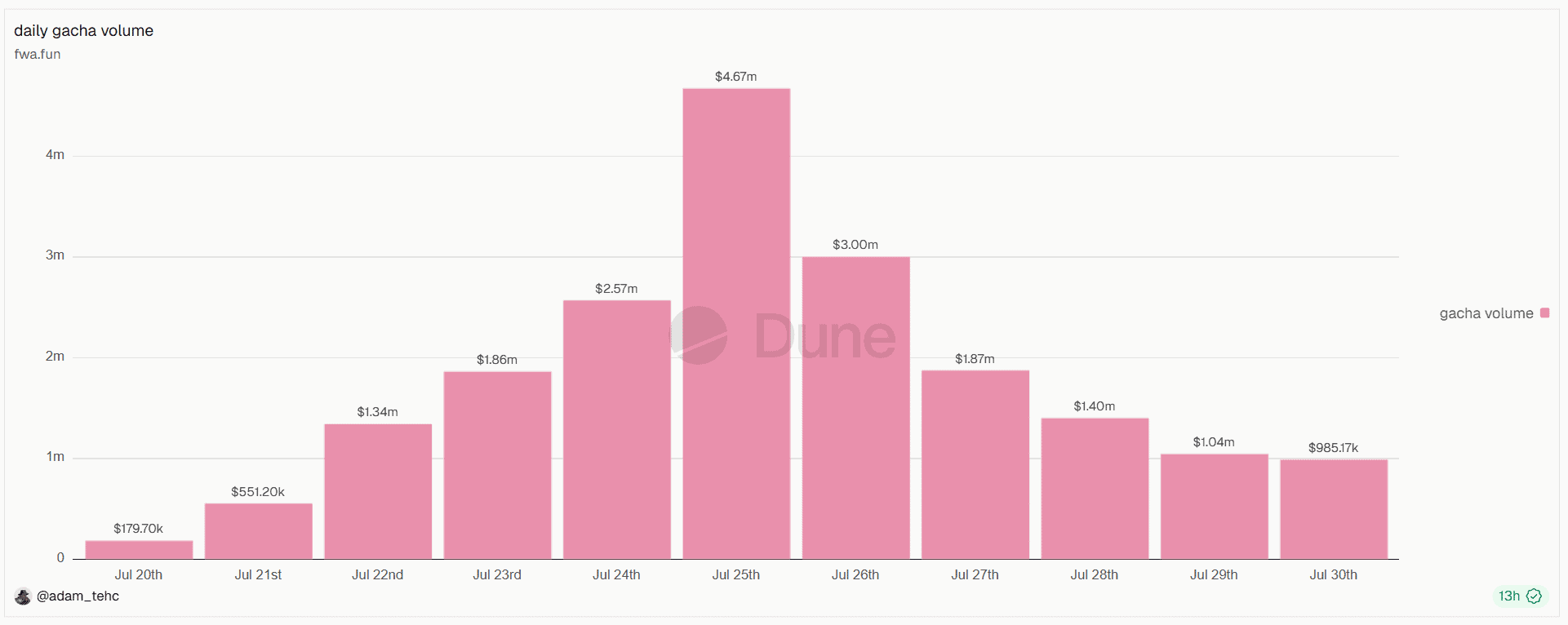
~9k NFTs, ~3.6k unique users, >96.6k lottery buys, ~$19.3M in gacha volume. Within 9 days, they’ve collected ~$7.74M in fees! ~$1.9M of that went to protocol as revenue.
But the trend direction of the volume tells the real story.
After the hype peaked on July 25th, every metric has been down only.
But I’m still keeping this on my radar for three reasons.
- Right now, the protocol usage is heavily incentivized by token inflation. It’ll end on August 4. We’ll have to see how many will continue to use it then.
- The problem seems to be with the parameters of the project, like how the lottery price should be calculated. The team has said they’ll tweak them for more success.
- The $FWA tokens cannot be bought from the market now. They can only be sold! Once it opens up for more people to buy $FWA, it might notably go up.
This was an interesting experiment that caught my eye as well. I have to dig into the onchain data a bit more to figure out how opening the $FWA token to public would play out.
Sponsored Deep Dive
Bitcoin Finally Has a Yield Curve
Every major asset has a yield curve.
Treasuries. Corporate credit. ETH. Even most stablecoins pay something. Bitcoin never did. For 17 years, critics called it a “dumb rock”.
If you wanted to earn on BTC, you had to take big risks. You had to hand your BTC to a lender promising 8% and hope they weren’t degening with your coins. But we all know how that story ended.
This week Bitcoin gets a yield curve (sorta, we’ll get to nuances later).
What changed?
On July 30, Stacks activated the PoX-5 hardfork on Bitcoin block 960,230. It sets up Bitcoin Staking.
That’s the payoff for a quarter of unglamorous work, all of it documented in the Q2 2026 ecosystem report Stacks put out last week. Worth reading in full if you hold BTC or STX.
Key takeaway: PoX-5 got built, pushed to private testnet, then public testnet, and is now live.
Native Bitcoin Staking (PoX-5) will be the cornerstone of a new economy. stBTC, the first Bitcoin liquid staking token on Stacks, is in audit and targeting August. And Zest Protocol just announced Stacks Vaults, automated strategies built on top of the whole stack.
I already covered how Bitcoin Staking works mechanically last week. TLDR: you timelock your BTC on the Bitcoin L1, under your own keys, and pair it with a small STX bond (~5% of your BTC position) for a 6-month term. In return, you get BTC yield from Bitcoin miners who bid to produce Stacks blocks.
The floor rate
Native Bitcoin Staking targets ~3% APY, paid in BTC.
That 3% is annualized on a Bitcoin-year basis, and a 6-month bond delivers roughly 1.44%. You also pair the position with STX worth about 5% of your BTC, though 100% of the yield accrues to the BTC side.
You might see bigger numbers on other platforms. Why pick Stacks then? Because of what it’s denominated in. Babylon pays 1-3% in BABY tokens, and CoreDAO pays CORE. Both hand you a governance token you’d have to sell to realize anything.
Stacks pays you in the asset you’re trying to stack. And the mechanism isn’t a whitepaper promise: Proof of Transfer has run continuously since January 2021 and pushed 4,200+ BTC to the ecosystem.
Practically, that’s Bitcoin’s “risk-free” rate. And once an asset has a risk-free rate, people start building on top of it.
The menu, from safest to spiciest
sBTC: 0%. The 1:1 Bitcoin-backed asset on Stacks. Supply reached 2,949 BTC at quarter end. Pays nothing by itself. But it’s a reliable BTC wrapper on their chain.
Native staking: ~3% in BTC. Cleanest risk on the board. Your keys, your coins. The cost is liquidity, because it’s a 6-month term and that BTC isn’t going anywhere.
stBTC: ~3%, liquid. Stacking DAO’s liquid staking token, planned to release in August. Same yield, except you hold something you can move, lend, or post as collateral. You’re taking on smart contract risk to buy back your liquidity.
Zest’s levered vault: 6-8% target. Deposit BTC, sBTC or stBTC, pick a strategy, and the vault runs the loop for you. (Remember: It’s the target, not realized. Nothing is live yet.)
BitFlow LP: 17.9%. That’s the 30-day average BTC APY across two sBTC pairs in Q2, which individually paid 26.6% and 9.2%. Real yield, real impermanent loss, and a 30-day window are not a forecast.
These instruments aren’t theoretical. The apps behind them already move size.
BitFlow has cleared $5B+ in cumulative volume across 29,677 users, Stacking DAO hit an all-time high of 110M STX, and Zest holds 800+ sBTC in deposits.
And demand is arriving ahead of the yield. Stacks crossed 1.6M cumulative wallets in Q2 and created 110K new ones, against 72K in Q1. That’s a ~50% jump in new wallets for a chain whose headline product hadn’t even shipped yet.
Where does the extra 5% in Zest come from?
Not a new revenue source. Leverage.
Zest’s vault posts your stBTC as collateral, borrows sBTC against it, stakes that into stBTC, and repeats. It’s the same 3% yield, stacked a few times over.
Credit to Zest for putting the risk in their own docs, in plain English: “If the sBTC borrow rate rises above the stBTC staking yield, the loop becomes unprofitable until the vault deleverages.”
That’s the entire trade in one sentence. Zest’s borrow rates climb with utilization, so a crowded sBTC borrow market can eat the spread that makes looping work. Add liquidation risk if the stBTC/sBTC ratio moves sharply, plus the contract risk of two protocols instead of one.
First principles: if you can’t explain why a spread exists, don’t get levered into it.
On the other side of the ledger: Zest’s Stacks market has been live since March 2024 and processed 1,500+ liquidations with zero bad debt. The vault is non-custodial, and the contract can only act on Zest’s own lending markets. Nobody, Zest included, can touch your funds.
Why it matters
An asset without a yield curve is a rock. Capital just sits on it.
An asset with one gets allocated, because now there’s a floor to price against and a spread to trade. It’s a productive asset.
The institutions are already positioning. Fireblocks, which has moved over $10 trillion in digital assets, signed on as Bitcoin Staking infrastructure. UTXO Management, the Nakamoto Inc. subsidiary (NASDAQ: NAKA), came in as the inaugural staker.
And the prize is enormous. The top 100 Bitcoin treasuries hold 1.2M+ BTC, roughly 5% of all the Bitcoin that will ever exist. Every satoshi of it currently earning zero. Stacks can potentially attract all of it.
Bitcoin spent 17 years as the best asset nobody could earn a yield on. That ends at block 960,230.
Just know which rung you’re standing on.
🚀 DeFi Catalysts
Hyperliquid testnet has a new HIP-3 function that’ll allow deployers to set an allowlist for their markets, restricting trading to approved addresses.
Kaito launched a performance-based creator-reward layer (projects pay for measurable outcomes, not flat sponsorships).
Fluid rebranded as “the Liquidity Layer for All Finance” and brought on Bitwise as its first curator, which has already drawn ~$500M in two months.
Ondo Finance introduced Ondo Network, their new execution layer (hardware-enclave execution + attestor verification + Ethereum settlement).
BRIX introduced the first onchain FX carry market: wiTRY-USDM. wiTRY is a Turkish Lira yield-bearing coin that enables access to the carry trade.
Zcash’s Ironwood shielded pool has been formally verified with machine-checked proofs. It is replacing the Orchard pool.
Reflect introduced Reflect Tranches, which claims to be the first universal tranching layer on Solana. They split any yield-bearing asset into a protected side and a high-yield side.
Hylo launched xBTC, a 3x leveraged BTC token on Solana with no margin account and a 0% minting fee this week.
Elfa AI shipped Iris, a real-time intelligence stack that feeds live market events into structured context for AI trading agents.
Oku Trade, a non-custodial DeFi trading platform, launched perps with up to 50x leverage on Hyperliquid.
Curve governance is voting on a new syrupUSDC lending market. Maple’s yield-bearing stablecoin is finding its way into more DeFi money markets.
1inch shipped Aqua, a non-custodial shared liquidity layer that lets multiple positions draw on the same capital without locking it up. A 10M 1INCH + 500K USDC incentive program is backing the launch.
📉 Down Bad
Phantom will stop support for the Monad chain on August 26. Users can migrate assets or swap to wrapped MON on Solana. It’s a major loss for Monad.
Aave is deprecating 50 low-adoption asset reserves and winding down deployments on Sonic, Scroll, zkSync, Metis, Soneium, and Aptos.
LayerZero is stopping support for Botanix, Canto, Moonriver, Moonbeam, and Nexera. Stargate Hydra users on those chains need to redeem their USDC.e, wETH, and Hydra USDT before support ends.
Odos is shutting down, going read-only on July 27 and ending all services three days later. Non-custodial users are unaffected, but anyone on a social or email-login wallet needs to export their keys before the cutoff.
🪂 Airdrop Alpha
Grass‘s Stage 2 USDC reward claims are live.
Ondo‘s new Perpetuals arm is running a reward program.
Mezzanine teased a pre-launch points program: mint mzUSD, LP, or lend USDC now to farm allocation ahead of the token launch.
📰 Industry News
Base‘s new Verify Onchain tool lets apps confirm a real X, Instagram, TikTok, or Coinbase account behind a wallet without exposing personal data, cutting down on Sybil farming.
Galaxy launched a credit vault for AUSD on Monad, another institutional player wiring itself directly into the chain’s stablecoin rails.
Ethereum Institutional announced the close of the initial ecosystem funding round and supporter coalition.
US SEC Chair Paul Atkins said the SEC is prepared to issue its own crypto rules if Congress fails to pass the CLARITY Act.
Hyperliquid Policy Center & Multicoin publicly backed the CFTC’s proposed regulatory framework for prediction markets.
🚨 Rekt Report
Triple-A, a payments platform, had wallets drained of over $9.7M across multiple chains.
VerusCoin‘s Ethereum bridge was drained of ~$7.5M after an attacker submitted a forged proof to its submitImports() function.
Zilliqa disclosed a critical Ledger app bug dating back to 2019 that could let attackers recover private keys from onchain signatures. Any wallet with 5+ native transactions via Ledger is considered at risk, and native transactions are suspended until it’s patched.
🐦⬛ X Hits
- The state of neobanks.
- A list of solid projects on Robinhood.
- The tokenized stocks problem: fragmented growth.
- Is Trade.xyz gaining more leverage over HyperLiquid?
- Will China overtake the US in the AI race?
😂 Meme
Until next time,
Edgy
Today’s email was written by Edgy and Yayya.
DISCLAIMER: I’m NOT a financial advisor. This content is for education and information purposes only. Crypto and DeFi are risky and speculative. Please do your research before investing.
Whenever you’re ready, here’s how we can help you:
- 🚀 The DeFi Edge Ventures – We identify, invest, and help amplify DeFi Protocols that positively impact the Crypto space.
You’re receiving this email because you signed up for my newsletter. You can update your Preferences or Unsubscribe here.
600 1st Ave, Ste 330 PMB 92768, Seattle, WA 98104-2246