Catalyst
The Death of “Private BTC” Narrative
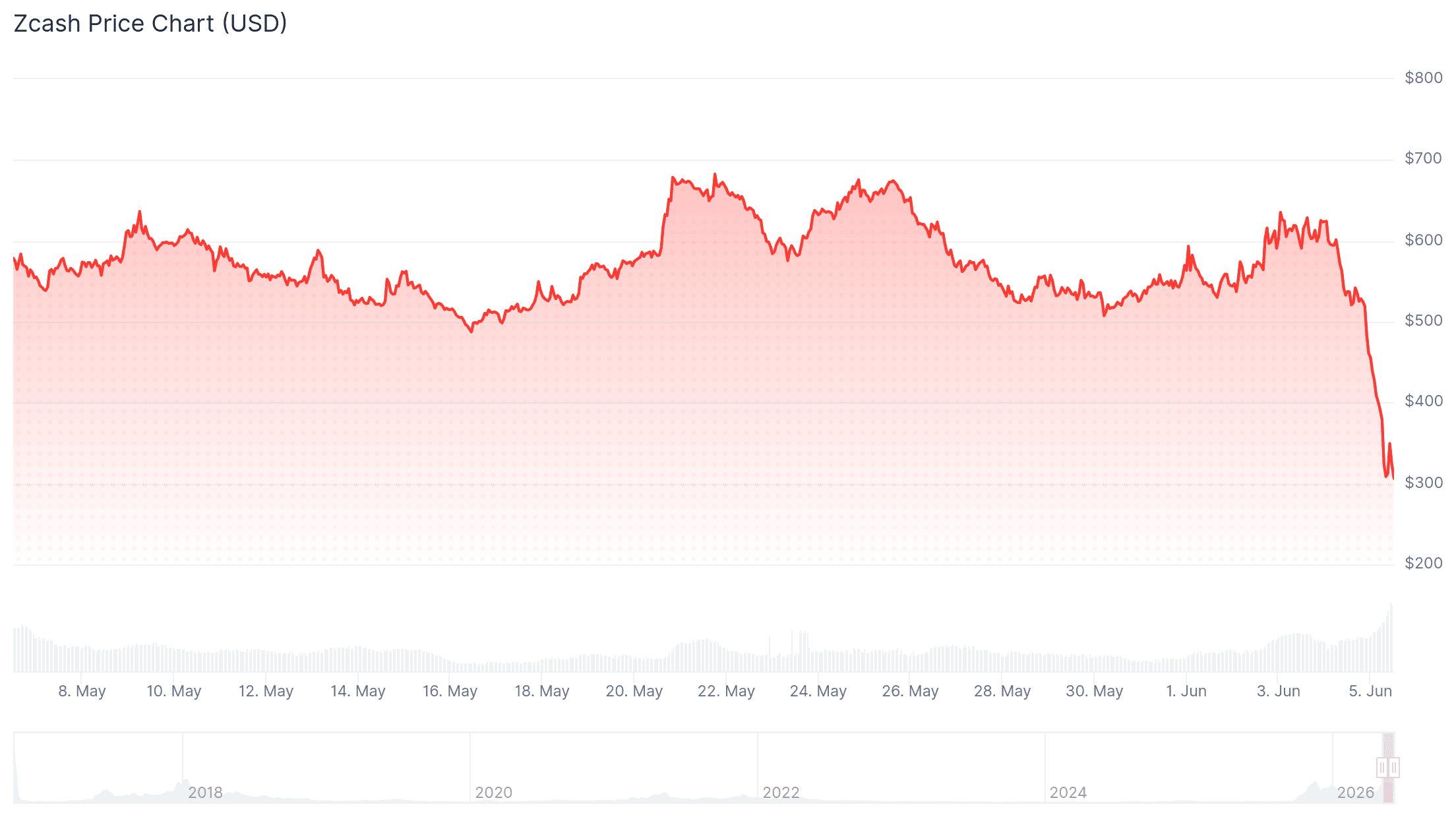
On the news of a vulnerability fix, $ZEC crashed >30% in a day. It’s down >50% on the 14-day chart.
Normally a patched bug means relief. Price recovers, everyone moves on. Not here.
Why not? Because “we patched it” doesn’t answer the only question that matters for a privacy coin like $ZEC: did someone already mint counterfeit ZEC before the fix, and can we ever prove they didn’t?
No. We can’t. And that “no” is scarier than any relief from the bug fix.
What actually happened?
On May 28, 2026, Anthropic shipped Opus 4.8. On May 29, Taylor Hornby, a security engineer hired by Zcash used that model and a custom auditing framework, found a soundness bug in Zcash’s Orchard shielded pool. One day after the model dropped.
The flaw was two under-constrained lines in the circuit’s elliptic-curve multiplication gadget. In plain terms: a crafted input could slip past the validity check and forge an unlimited number of undetectable counterfeit ZEC inside the private pool. No on-chain signature. No trace.
It had been sitting there since Orchard launched in May 2022. Four years. Multiple audits by expert cryptographers. Nobody caught it. A one-day-old AI did.
Shielded Labs disclosed it and the fix shipped fast via the NU6.2 hard fork that activated June 3. Credit where due: that’s a clean emergency response.
So why’s the problem bigger than a patched bug?
Because of what privacy costs you here. Orchard’s entire selling point is that balances and transfers are shielded. Nobody can see the supply. That’s the feature.
It’s also why you can’t audit your way out of this. On a transparent chain, if someone minted fake coins, you’d see the supply break and you’d know. On a shielded chain, counterfeit ZEC looks identical to real ZEC. There is no cryptographic way to prove the bug wasn’t exploited before June 3. The thing that makes ZEC private is the same thing that makes the supply unverifiable.
And we’ve been here before. In 2018, cryptographer Ariel Gabizon found a near-identical flaw, undetectable infinite counterfeiting, baked into Zcash’s original zk-SNARK setup. A handful of insiders quietly patched it in the Sapling upgrade and told the public only months later, in February 2019. Same vulnerability class. Same disclose-after-patching playbook. Twice now.
The part that should keep you up at night:
New AI frontier models are getting insanely good at finding vulnerabilities that hackers wouldn’t learn otherwise. Here, Opus 4.8 found a soundness bug that four years of human audits missed.
There’s no rule that says the next person pointing an AI at the Orchard circuit, or any ZK system, is a friendly researcher. Could be a hacker. And on a shielded chain, you’d never know they succeeded.
Crypto ZK systems and AI auditing are now on a collision course. Every privacy chain with a complex circuit is a target, and every exploit against one is potentially invisible. There could be more landmines in there.
The only solution for this problem is formal verification. Most crypto zk-projects are working towards this, but it’ll take a long time to get everything formally verified.
What it means for your bags:
People who shilled $ZEC have stopped promoting it. Arthur Hayes even announced that he has dumped his entire ZEC position.
And the “private Bitcoin” thesis is dead. BTC’s codebase is simple and battle-tested, probably fine against this current wave of AI-powered attacks. ZEC’s ZK surface area is enormous and, as we just learned, not as bulletproof as we’d like. You can’t sell “the private store of value” when nobody can verify how much of it is real.
I’m not saying ZEC is dead forever. It survived 2018 and recovered. But in the short term, the trust is broken, and trust is the only collateral a privacy coin has.
If you think privacy narrative still has legs, I’d recommend looking into privacy protocols like Railgun and Privacy Pools. With Kohaku, Railgun has a big catalyst ahead.
News
Circle’s Freeze Button Just Found Smart Contracts
Circle has frozen plenty of wallets. Hackers, scammers, OFAC addresses.
It’s old news; nobody cares. But on May 30, it did something new. It froze an entire smart contract.
Circle blacklisted Zama’s confidential USDC contract and locked ~$12.6M in one move. Not one person’s bag. The whole pot. Every dollar in that contract, no matter who deposited it or why.
(The funds got unlocked three days later. But it’s still worth covering.)
How’d the money get there?
Overnight Finance, a DeFi yield platform, had a treasury fight. OVN holders voted to liquidate the treasury and pay themselves out. Just before the vote passed, founder Maxim Ermilov allegedly moved $15.77M out of the treasury wallets, and about $12.5M in USDC landed inside Zama’s contract.
Three funds sued. On May 29, a judge signed an ex parte order, no hearing, directing Circle to block the USDC. And Circle pulled the trigger.
(Ermilov disputes all of it and says the wallets were personal. The court will sort that out. Not our story.)
So what is Zama, and why does it matter?
Quick 80/20: Zama is a privacy company. It lets you hold and move USDC without broadcasting your balance to the world. You deposit USDC, you get a confidential version back, and the real USDC sits pooled in one contract backing everyone’s wrapped tokens.
That detail is the whole ballgame. One contract, holding everybody’s collateral.
So when the disputed $12.5M flowed into that pool, it sat right next to everyone else’s deposits. When Circle blacklisted the address, it didn’t freeze a wallet. It froze the room.
Everyone knew Circle could do this. So why’s CT losing it?
Two reasons.
First, the target wasn’t a wallet/person. It was a contract holding pooled funds for unrelated users. (Per Zama’s CEO, more than 99% of the contract was that one disputed deposit, so the damage for innocent victims was small this time, maybe $100K-$200K. But that’s beside the point.)
The freeze didn’t differentiate the flagged $12.5M from the clean $150K. It just froze all of it. The fact that the clean dollar amount was relatively small doesn’t matter.
Second, it proved the ability and willingness to freeze entire smart contracts/applications.
We always knew Circle could do this. Now we’ve watched it happen on a court’s say-so, in a civil dispute, against an application who did nothing wrong. That’s a valid cause for a freakout.
Whose fault is it, really?
Worth being fair to Circle. It got handed a federal court order and complied, which is what any regulated US issuer does every single time. Refusing a judge isn’t an option for a public company.
We can’t blame Zama either. The exact same mechanism applies to every protocol that pools USDC. Aave’s USDC markets. DEX liquidity. Vaults, bridges, etc.
I’m not saying Circle will torch a major protocol, that’d be commercial suicide. But the button exists, and it only takes the right court order to press it. A bigger lawsuit. A sanctions designation. We’ve seen the mechanism work. We’re just haggling over the trigger.
Every time this happens, the same wish resurfaces: a dollar nobody can freeze. But the censorship-resistant options (BOLD, crvUSD, GHO) are all tiny, and the market keeps voting for convenience.
So the near-term fix isn’t a new dollar. It’s boring compliance plumbing: new protocols can segregate funds so one flagged address can’t freeze the whole pool.
🚀 DeFi Catalysts
Pump.Fun introduced pump fun GO. It’s a bounty platform where anyone can create or complete bounties for ANY task for unlimited rewards.
Cap is conducting a token auction this month using Uniswap CCA for real-time price discovery. They’re selling 4.5% of the $CAP supply to the public.
Sky (formerly MakerDAO) launched Fixed Yield built on Pendle Protocol v2. It gives the sUSDS depositors a locked rate to a named maturity date.
TrueNorth, a protocol on top of HyperLiquid, has introduced itself as the world’s first agentic brokerage.
Plasma launched Offramps. USD, EUR, MXN, and BRL users can now send money between Plasma One and their bank account.
Virtuals Protocol migrated its cross-chain Stack from LayerZero to Chainlink CCIP. LayerZero was criticised for enabling the massive rsETH hack.
Radiant Capital is shutting down. The decision comes after they couldn’t recover the October 2024 exploit fund despite 18 months of sustained effort.
Backpack is launching Backpack Securities. It combines real stock ownership, blockchain tokenization, and unified portfolio infrastructure.
Dune shipped EVM Balances. It’ll provide historical and current balances for crypto wallets across 21 EVM chains.
BitMine files for $300M Preferred Stock Offering at 9.5% yield to expand ETH Treasury. They’re following Strategy’s STRC playbook.
📰 Industry News
Strategy, Saylor’s treasury company, sold 32 BTC for $2.5 million. And that has shaken confidence in BTC cuz he was never supposed to sell.
Galaxy launched Institutional OTC Prediction Markets Trading. It’ll provide access to prediction market liquidity at sizes and discretion.
MoneyGram introduced MGUSD, its native US dollar stablecoin. It’s issued on Stellar with support from M0, Fireblocks, and Bridge (from Stripe).
Bitwise introduces Crypto Carry Fund (USCC). A $259M tokenized fund built to provide yield through a market-neutral “crypto basis” strategy.
Binance launched Stock Trading with access to real U.S. Stocks and ETFs. It’ll be available 24/5.
🐦⬛ X Hits
- Morpho Midnight deep dive.
- Is FDV the wrong lens for $HYPE?
- What’ll drive the next big DeFi wave?
- Build your own Hermez onchain analyst.
- Potential of Pre-IPO instruments.
😂 Meme
Until next time,
Edgy
Today’s email was written by Edgy and Yayya.
DISCLAIMER: I’m NOT a financial advisor. This content is for education and information purposes only. Crypto and DeFi are risky and speculative. Please do your research before investing.
Whenever you’re ready, here’s how we can help you:
- 🚀 The DeFi Edge Ventures – We identify, invest, and help amplify DeFi Protocols that positively impact the Crypto space.
You’re receiving this email because you signed up for my newsletter. You can update your Preferences or Unsubscribe here.
600 1st Ave, Ste 330 PMB 92768, Seattle, WA 98104-2246