News
Tether FUD: Is There Fire or Just Smoke?
Rumor of another crypto contagion is spreading.
What happened? S&P Global Ratings downgraded USDT’s ability to maintain its peg from “constrained” to “weak”. This is the lowest category on their scale.
Why is it a big deal?
• USDT market cap is ~186B USD
• That’s ~60% of the total stablecoin supply
• It’s the backbone of trading and DeFi
If USDT breaks, the shockwaves hit the entire ecosystem.
S&P Global Ratings evaluates the reliability of financial institutions. TradFi pays attention to their ratings, so this isn’t something to ignore.
Here’s why S&P thinks USDT is risky:
- Limited transparency on counterparties, custodians, and bank account providers.
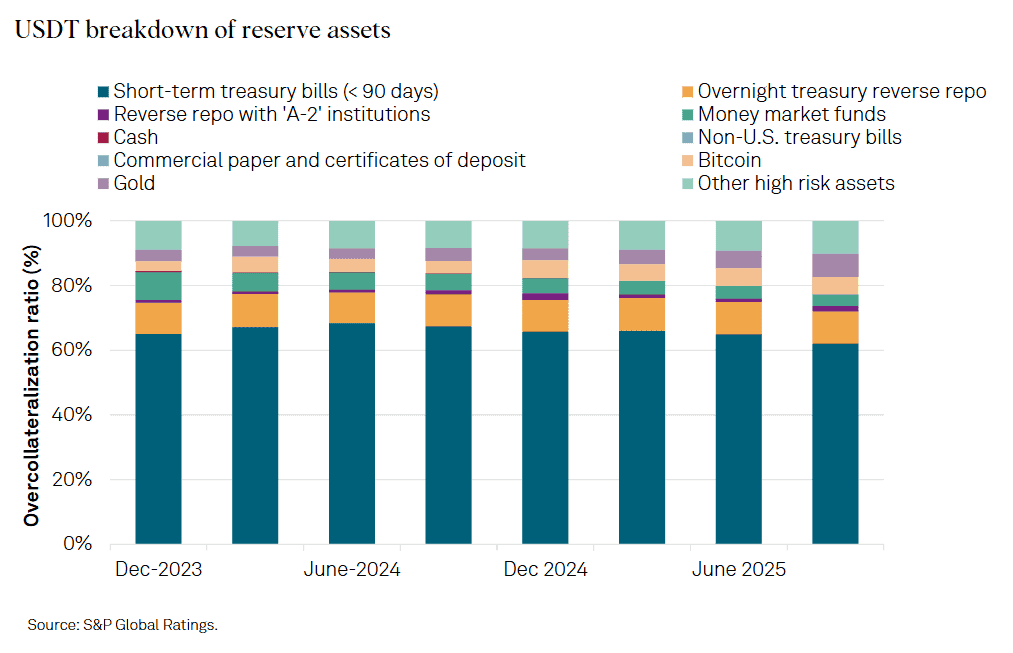
- $BTC backs 0.6% of USDT in circulation. A further drop in its price can make USDT undercollateralized.
- Tether has increased the % of higher-risk assets backing USDT’s reserve. Last year, it went from 17% to 24%.
While some are concerned about the rating, it is possible to understand Tether’s reasoning behind increasing the share of assets like BTC & Gold.
Tether is expecting the Fed to cut rates. So their T-Bill revenue will decline.
Since Gold & BTC are theoretically supposed to go up in that environment, they can make up for the revenue decline.
My Take. The Tether Fudders have been “predicting” the USDT collapse for years. But it has never happened.
I’m not worried about a USDT collapse yet.
- USDT has proven itself over many black swan scenarios, from the FTX collapse to the recent 10/10 crash. It’s the largest and longest-standing stablecoin in circulation
- The methodology used by S&P is very strict and biased in favor of TradFi firms. For them, U.S. Treasury bills and U.S. Treasury-bill-backed overnight reverse repos (75% of collateralization ratio) represent low-risk assets.
- Apart from the disclosed assets that back USDT, they have a separate equity balance sheet with more assets. They don’t report them publicly, tho. These equity investments, mining operations, etc., can potentially support USDT if required.
So the FUD is mostly noise. You don’t have to do anything.
To be fair, stablecoins are significantly riskier than cash or bank deposits. So we should be getting yield for taking increased risk. But Tether is keeping all the yield for itself.
Tether’s massive distribution advantage allows it to keep the yield for itself. In the endgame, we’ll see most stablecoins sharing “risk-free yield” with holders to compensate for additional risks.
Sponsored by Solstice
Solstice: Solana’s Institutional Grade Stablecoin
Markets are red. Everyone is stabling up and chasing yields.
But many stablecoins promising high yields are traps. Here’s a list of big stables that crashed in the last two months: Stream’s XUSD, Elixer’s deUSD, Yala USD, and Treeve’s scUSD.
You need safe stablecoin opportunities with a proven track record.
Enter Solstice Finance.
- USX is their 100% collateralized USD stablecoin.
- eUSX is the yield-bearing version of USX. You get it by depositing USX into YieldVault.
- SLX is their upcoming protocol token. (Here’s my code: SDoYPPvDU8)
They’re earning yield using a delta-neutral strategy that they’ve been privately executing for the past ~3 years. That’s a proven track record.
If you want to earn even more yield and airdrop points, there’s a lot you can do with USX in the Solana ecosystem.
- The best opportunity is PT-USX (matures on February 9th). Right now, it offers a net fixed APY of ~14.34%.
- Kamino supports the PT-USX. So you can borrow against it and leverage your position for more exposure.
There are many more ways to earn additional yield and airdrop points on USX & eUSX. You can find them in the “Deep DeFi” section on Solstice.
Tips
Why You Should Stay in Crypto?
The markets are terrible and the short term isn’t improving.
Many people are leaving crypto. This is obvious in the engagement metrics of Twitter posts, views on YouTube videos, and such social metrics.
But that’s a mistake.
#1. The Infrastructure & Adoption Story Is Not Going Backwards
This is not the same asset class we had in 2017 or even 2020.
Look at what has been built this cycle:
- Spot ETFs for BTC, ETH, and others. This is attracting billions in flows to crypto.
- Treasury companies like Strategy and BitMine have enabled the leveraging of the cheap cost of capital in TradFi to pump crypto.
- The regulatory environment has improved significantly since Trump won the presidency. Founders will be able to build crypto companies without fear of punishment.
- Abundant blockspace. Last cycle, developers were limited by slow blockchains with limited capacity. Now we have chains that can support all the demand.
- Many new sectors, like Restaking, DePIN, AI agents, RWAs, etc., didn’t exist in the last cycle.
Even if we get corrections and bear phases, the direction of adoption is still up.
These new positive developments will attract more builders, which’ll attract users & liquidity, which will incentivize more jurisdictions to support crypto, and so on.
We have reached escape velocity.
Crypto cannot be shut down anymore. We’re not early like in 2013, but we’re still early enough that being here is an edge.
#2. Leaving Completely Is Often the Worst Move
We’re not in the traditional 4-year cycle anymore. You cannot just leave today, come back in a year, and hope to catch the start of the bull run.
When people fully leave crypto due to fear:
- They stop following the market.
- They miss key inflection points.
- They usually only come back when influencers start screaming ‘altseason’ and ‘new ATH’.
The industry has matured.
We didn’t have an “everything pumps altseason” this time around. It won’t happen again. If you want to know when crypto comes back, stay plugged in.
This newsletter is a great place to keep up with the 80/20 of the industry.
If you want to find more detailed opportunities, TDE Pro is the best place for you. You can join here.
3. How to Be in the Market Without Losing Your Mind?
If you’re still all-in and using 100x leverage, you’re doing it wrong.
Here are some tips to survive this market:
- Have a clear time horizon. For example: ‘I’m here for the next 2–3 years, not 2–3 weeks.’
- No leverage in this environment. The market is too choppy and too headline-driven. Leverage right now is like playing Russian roulette.
- Size positions so you can sleep peacefully. If one red candle ruins your mood or your month, the position is too big.
- Use this phase to upgrade your strategy. When the market recovers (and it always does in some form), you’ll be much more prepared.
- Focus on learning and edges, not gambling. Learn Airdrop farming, onchain analysis, how liquidity farming works, how BTC leads, how alts lag. That knowledge compounds even when your P&L doesn’t.
There isn’t much happening in the market. So you will be tempted to just leave. But that’s a mistake. Use the above tips to survive this phase.
🚀 DeFi Catalysts
Ethereum will undergo the Fusaka upgrade tomorrow. PeerDAS is the headliner upgrade. It’ll scale its data availability service.
Jupiter Lend introduced Refinance. Users can now move their active borrow/lend positions from other protocols to Jupiter in just a few clicks.
Lighter has enabled perp trading for equities on its platform. It’s starting with $COIN and $HOOD, both at 10X leverage.
Kalshi has tokenized its prediction market positions on Solana. Developers will be able to build on top of them as well.
Zama announced a sealed-bid Dutch auction to sell 10% of the $ZAMA supply. The protocol aims to be the confidentiality layer of existing L1s & L2s.
Fogo has initiated its genesis. This isn’t a public launch. But infrastructure and validators are able to position themselves for the public launch.
Avail launched the Nexus Mainnet. It’s a cross-chain layer that aims to unify liquidity and routing across major ecosystems.
ETHGas Realtime is the new block building sidecar that allows validators to give preconfirmations or synthetic block times of 100ms.
Solv Protocol went live on Solana. It’s launching an onchain BTC reserve with a boosted campaign offering up to 13% APR on Solv Strategies.
📰 Industry News
Yearn Finance was drained for $9M. It affected the project’s yETH liquid staking pool token.
Vanguard will open trading for Crypto ETFs and Mutual Funds starting today. This is a good source of new demand.
BlackRock‘s bitcoin ETFs have reportedly become the firm’s top revenue source. The company has 1,400+ ETFs and $13.4 trillion in assets under management.
🐦⬛ X Hits
- HumidiFi explainer.
- Top projects with buybacks.
- Explainer of all EIPs in the Fusaka upgrade.
- Interoperability framework from compose.
- Onchain price discovery.
😂 Meme
Until next time,
Edgy
Today’s email was written by Edgy and Yayya.
DISCLAIMER: I’m NOT a financial advisor. This content is for education and information purposes only. Crypto and DeFi are risky and speculative. Please do your research before investing.
|
|
|
Be Early to the Next Opportunities
TDE Pro gives you direct access to our research, our portfolios, and the gems we’re betting on.
It’s your unfair advantage to move before the crowds.
|
Whenever you’re ready, here’s how we can help you:
- ⚙️ The DeFi Edge PRO – Designed for busy people who want to stay ahead of the curve. Leverage our research to save you hours each week, and to see what we’re personally investing in. Join today.
- 🚀 The DeFi Edge Ventures – We identify, invest, and help amplify DeFi Protocols that positively impact the Crypto space.
You’re receiving this email because you signed up for my newsletter. You can update your Preferences or Unsubscribe here.
113 Cherry St #92768, Seattle, WA 98104-2205