Debate
Devs Want to Reduce ETH Staking Rewards.
~Every Etherean in CT is pissed off right now.
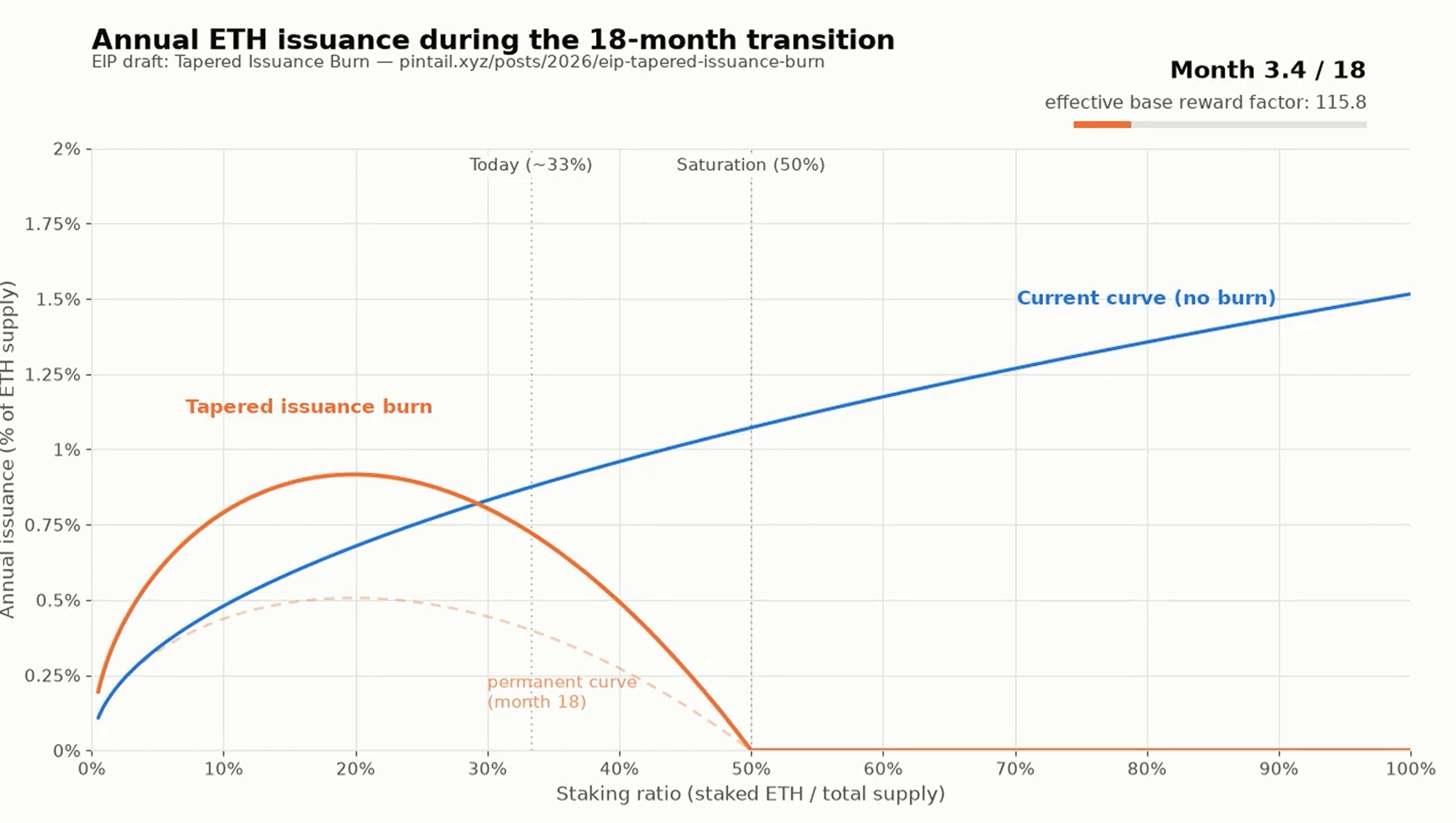
Why? The latest EIP, called Tapered Issuance Burn, wants to change ETH staking rewards.
Today, no matter how much ETH gets staked, Ethereum will give them staking rewards. There’s a floor of around 1.5%.
This EIP kills that floor. As the staking ratio climbs toward 50% of supply, the protocol burns a growing share of validator rewards. At 50% staked, net issuance hits zero. Rewards go from ~2.6% to an estimated ~1.1%, phased in over about 18 months.
Personally, I’m against this. But before I get into why, the other side deserves a fair hearing. The proposal itself is okay-ish.
Steelmanning the pro-EIP case
- Inflation. A floor that never hits zero is a standing ~0.85%/year tax on every non-staked ETH, forever. High inflation = bad money.
- LSTs will replace ETH. Because of high staking rewards, every ETH will eventually be staked for LSTs. This will lead to LSTs like stETH replacing raw ETH as money.
- The incentive to keep staking never turns off, and that’s a bug. Past a certain point, more staked ETH doesn’t buy more security. It increases concentration, because the only players who can keep piling in at low yield are the ones with the deepest pockets: exchanges, custodians, BlackRock-scale operators.
So, I get why researchers who care about ETH’s long-term monetary integrity are drawn to this. The current reward curve was designed without much research or data.
But they’re out of touch with reality.
- This is disastrous for DeFi. Staking yield is the base rate everything in DeFi prices off. Lending rates, the wstETH/ETH loop, the cost of borrowing against ETH collateral, all of it references that rate as the floor. Taper it to zero, and the loops that generate most of ETH’s borrow demand invert overnight. Borrow demand collapses, LSTs lose their edge over holding plain ETH, utilization drops, lenders earn less.
You’re not adjusting an isolated rate. You’re pulling the floor out from under every product built on top of it. The proposal never considers DeFi.
- Institutions are betting billions based on the current staking rate. BlackRock, Fidelity, Grayscale, and treasuries like Sharplink and BitMNR put real capital into ETH staking products based on assumptions about its staking rate. Changing those rules in a contentious proposal will add uncertainty to ETH.
In general, institutions like getting yield on their assets, even if it’s from inflation. Reducing yield will repel institutional capital.
- The concentration argument doesn’t make sense. A 0% floor doesn’t spread out the validator set; it consolidates it.
A CEX staking desk or an institutional custodian can run near break-even and wait out low yield. A home staker paying retail power and hardware costs can’t. This prices out exactly the solo operators the EIP claims to be supporting.
You end up with a handful of institutions running Ethereum. That’s a security nightmare.
Even if there’s a real argument for changing the issuance curve eventually, timing isn’t right. Rushing a monetary policy change of this size now, right as crypto and TradFi are finally converging, is just shooting yourself in the foot.
There are a million problems Ethereum needs to fix now. Staking reward isn’t one of them.
Update
Eliza Is Dead. The Lawyers Got Paid.
The lawsuit worked.
Lawyers and a group of tokenholders walked off with what was left of the project treasury. Everyone else got a dead token and a tweet telling them to sell.
What happened? Burwick Law filed a class action against Eliza Labs and founder Shaw Walters in April. False advertising, deceptive practices, negligent misrepresentation, unjust enrichment.
Quick 80/20: ai16z was a token launched in October 2024 as a parody of a16z, an AI agent that would run a venture fund while token holders pitched it deals. We had talked about it in the newsletter before it did the 80x to $2.39B in January 2025.
The real product underneath was Eliza, an open-source framework for building always-on AI agents. It became the flagship of the entire AI agent meta. It was the precursor to the current agentic AI frameworks like OpenClaw.
The team settled the lawsuit by handing over everything. “The rest of the treasury and all the money we had,” in Shaw’s words. The amount is undisclosed.
But the token’s fate is clear:
The token is dead. Completely. The foundation is winding down.
Shaw keeps the IP. He says he’ll never let a token near Eliza again.
Crypto’s ambulance chasers
Burwick has been called crypto’s “ambulance chasers” many times.
They take cases on contingency, so they earn nothing unless something settles. Winning in court is slow and expensive. Settling is neither. So the incentive isn’t to be right; it’s to file a lot of cases irrespective of wrongdoing.
Burwick currently has 60+ open investigations and at least 11 suits, including Pump.fun, LIBRA, Meteora, and Hawk Tuah.
You don’t need to win any of them. You need the defendant too broke to fight.
According to Shaw, “Their claim was ridiculous, but we didn’t have the capital to legally fight it.”
So the money for Eliza development walked out the door. Few holders got a one-time distribution instead of a project. Most holders just lose their money.
But Burwick’s targets usually aren’t saints
Here’s where it gets uncomfortable.
ai16z sold itself as an autonomous AI-run venture fund. Protos reported within a week that humans were making the calls. Nobody issued a correction.
Then the communication got worse. Nine days after saying publicly that the project would “not create a coin,” Shaw posted a contract address. The complaint alleges the original token fell 87% in fifteen minutes, and that a wallet tied to the team made millions.
There are many insider trading accusations against Shaw. The case settled with no ruling on the merits, so none of it was ever tested in court. But the pattern was enough that people stopped giving him the benefit of the doubt.
What we do know is that the project diluted the token holders in the 2025 token migration. The holders were only given 60% of the tokens. The other 40% went to the team, the foundation, and reserves the holders didn’t control. (There could be nuance here, arguing about the structure of Daos.fun and such, but that’s beyond the scope of this article.)
Even in the latest post, Shaw blamed the community: “a culture of people who don’t take responsibility for their gambling habits.”
He’s not entirely wrong.
Tokens are a bad container for this
The tech wasn’t a complete failure. The capital structure is what broke.
Current crypto token holders have no real rights over the project. This is bad for both investors and developers. Investors will always be paranoid and ask for 100% buybacks. Devs will have to deal with the mob and a volatile chart.
Burwick is a symptom, not the disease. Ideally, holders should have rights over the project. And some rogue lawyers shouldn’t be able to walk away with a project’s treasury.
MetaDAO points at a better direction: the treasury sits under market control, and supply changes need holder approval. Both of ai16z’s failures become structurally impossible.
Until such tokens are the norm, tokens will be unreliable.
🚀 DeFi Catalysts
Uniswap launched Trade Pools, a new token launchpad on Robinhood chain. It’ll have features like permanent and autocompounding liquidity.
Superstate is bringing its security assets to Uniswap using the Permissioned Pools standard on v4.
Solana has pushed the first slot time reduction feature into testnet. They want to reduce slot time from 400ms to 200ms in four steps.
Sushi shipped Sushi Launch, a native launch layer exclusively for the Robinhood chain.
BlackRock launched the BlackRock Daily Reinvestment Stablecoin Reserve Vehicle (BRSRV) on Ethereum.
BitGo is migrating away from their LayerZero solution and selecting Chainlink CCIP as its exclusive cross-chain infrastructure provider
Jupiter launched Spot v2. With it, they’ve merged Swap and Terminal into one page.
Dinari launched tokenized trading for 724 US stocks for eligible US investors using USDC.
Circle has announced the launch of the Arc mainnet on September 16. Founding validators include many institutions, from BlackRock to Visa.
Base has announced the next upgrade for September. It is set to have Native account abstraction, B20 improvements, and more.
POAP, one of the few non-financial crypto protocols with high adoption, announced its shutdown.
🪂 Airdrop Alpha
Solstice launched Season 3 on Solana with 5,500+ funded users. They’ll launch strcUSX next.
Caps has started the Homestead claims. It will be open for the next 90 days and will close on November 1st, 2026.
📰 Industry News
Cloudflare introduced Cloudflare Wallets. They will allow AI Agents to store stablecoins, purchase services, and receive funds across the web.
Binance has launched Lite Loan, a fixed-term crypto-backed lending product that makes crypto-backed borrowing simple and accessible.
DefiLlama introduced a Market Maker Performance Index Leaderboard. 40+ institutional liquidity providers graded by depth, spread, and more.
Trump Media launched a paid data service providing Wall Street firms faster API access to Truth Social posts from President Trump and other top accounts
Emirates, UAE’s largest airline, now accepts cryptocurrency for flight bookings, signaling mainstream travel sector adoption.
🐦⬛ X Hits
- State of tokenization in July.
- Will the Clarity Act pass this year?
- Why crypto? To export institutions.
- Crypto is the training ground for the memecoin world.
- Arthur Hayes’s new essay: Situationship
😂 Meme
Until next time,
Edgy
Today’s email was written by Edgy and Yayya.
DISCLAIMER: I’m NOT a financial advisor. This content is for education and information purposes only. Crypto and DeFi are risky and speculative. Please do your research before investing.
Whenever you’re ready, here’s how we can help you:
- 🚀 The DeFi Edge Ventures – We identify, invest, and help amplify DeFi Protocols that positively impact the Crypto space.
You’re receiving this email because you signed up for my newsletter. You can update your Preferences or Unsubscribe here.
600 1st Ave, Ste 330 PMB 92768, Seattle, WA 98104-2246