Markets
Bottom, or the Best Bull Trap of 2026?
Bitcoin just had its best August since 2017. But it’s still 37% below its all-time high.
Both of those are true, which is why the timeline currently contains two groups of people yelling opposite things at each other.
What happened? BTC broke a six-week range and ran to $79.3K, settling at $79,027 on Wednesday. Up roughly 25% this month. ETH ran ~30% on the week to ~$2,435. 87% of the top 100 coins are back above their 50-day trend, when a month ago that number was closer to 36%.
The move started as a textbook squeeze. Short liquidation levels were stacked right above price, buyers came in hard around the low $60Ks, and the forced buying did the rest. August 19’s $1.74B in short liquidations was the second-largest in crypto history, behind only the October 10, 2025 crash.
The question isn’t whether the bounce happened. It’s whether anything real is underneath it.
So let’s argue both sides properly, then I’ll tell you what I actually think.
The case that this is the bottom
1. The bid stopped being forced
A squeeze can start a move. It can’t fund one for two weeks.
Since August 17, both BTC & ETH ETFs have been attracting hundreds of millions in net flow. And the trend doesn’t seem to slow down.
Galaxy also adds the technical confirmation: reclaiming the 50-week moving average on a weekly close marked the bottom in 11 of the last 13 bear markets. BTC was testing that level at ~$82K.
2. Onchain money is expanding, not just rotating
Aggregate stablecoin supply grew $2.42B to $303.2B, the first real expansion in months.
Stablecoin expansion can indicate that capital is showing up to do something: lend, farm, provide liquidity, trade. It’s visible in the fee metrics of the applications as well. From Jul 8 to Aug 18, protocol fees were flat at $55.1M/day. Since the 19th, it has increased 27% to $69.9M/day.
3. The macro regime turned
The Treasury doubled its long-dated bond buyback on August 19, with repurchases scaling to $4B+ per operation from September 9. That’s good for crypto prices.
At an August 19 White House meeting, Trump pushed Congress on a “fair version” of the CLARITY Act and said CFTC Chair Michael Selig is working to bring Hyperliquid onshore in a fully compliant fashion.
4. Nobody is positioned, which is the fuel
Most of the world is massively sidelined on crypto. Even the career participants have capitulated or checked out after quarters of underperforming equities. Memecoin casinos, the October 10 liquidation event, leverage chop, and holding bad alts had drained even the crypto-natives.
So, the sell side is exhausted. Sidelines will chase this pump, and if the reflexivity from the four-year cycle takes over, we’ll be in for a good time.
The case that this is a bull trap
1. Leverage is rebuilding faster than the demand under it
Traders went from scared to aggressive in about three days, and the derivatives market is showing it.
The funding benchmark jumped 0.36pp to 7.84% annualized, its highest reading on the three-month range and a third straight weekly climb from 4.58%. The spread over borrow rates widened to ~3.6pp. Open interest is climbing. The futures premium is widening. HYPE’s 7-day implied vol went from 50% to 87%.
When the long side gets this crowded this fast, one bad headline is all it takes to start a cascade in the other direction.
2. The bid is only ETF deep
The move was squeeze-driven. The retail isn’t here yet.
The ETF flows have to sustain for the rally to hold. If ETFs stop, the market can panic again.
3. We’re getting hacked every week!
In just last week, I noticed five attacks: Term Finance governance attack, PT-reUSD oracle attack, bug in Cosmos EVM precompile, Sandbox attack, and Allbridge draining.
If people keep losing money in crypto, they won’t keep pouring it into crypto.
So what do I actually think?
First, where we are. Bitcoin topped at $126,198 on October 6, 2025. According to the four-year cycle, the historical top-to-bottom window from that date lands the trough somewhere in September to November 2026. Which is now.
But the cycle is also weakening. BTC was roughly 47% off the high at its worst, when every prior cycle bear took 75% to 80%+. There are structural changes as well. For example, the halving’s supply effect is a rounding error next to ETF flows.
But plenty of people are still trading it. That makes the market reflexive. If we keep the momentum without a significant lower low, sidelined people will follow the reflexivity of the 4-year cycle.
If stablecoin supply keeps expanding while funding cools off, the bulls will be right. That combination of unlevered capital and onchain activity can build a durable floor.
But if BTC loses the $60Ks in the next few weeks, bears will win, and this bounce becomes a textbook bull trap.
If ETF inflows fade under ~$1B a week while funding holds above 7%, the bears are right. That combination is a shrinking bid holding up a growing pile of borrowed money, and it resolves one way.
For now, I’m optimistic on the market.
Here are things that’ll increase my confidence:
- ETF inflows holding near that $2.5B weekly pace instead of fading
- Funding and the futures premium cooling off while price holds
- Increasing stablecoin supply and onchain metrics.
What I’m doing: accumulating majors, slowly. Leverage is too hot for me now. Holding spot is safer.
The whole reason these prices exist is that retail isn’t back yet, so waiting for them to show up before you bid kind of defeats the point.
Analysis
I Screened Top 300 Coins for Growth Without a Pump
The market is back. Everything is green.
I wanted to know which of these is actually recovering and which is just floating with the tide. So I used Claude to build a screen that ran the top 300 projects by market cap on CoinGecko, and only a handful cleared the bar.
Methodology
Firstly, I removed all projects without fee data on DefiLlama.
Why use fees? User count and transaction count can be faked. Even if nobody deposits a dollar, TVL rises when token prices rise. Fees are different: someone has to actually pay them. Only 115 survived.
Then I removed everything that didn’t have at least 1 year of price history. New tokens work differently from older tokens. And I wanted projects that are “recovering”.
Must have existed through the entire crash, because a token that launched in March can’t “bounce back” from a drawdown it was never in (99 survive). This excluded many top protocols like Pons, Canton, and Collector Crypto.
The last condition was that apps must earn at least $1M a month, or one whale trade swings the percentages. In the end, only 32 survived.
The window: Aug 19-27 versus Jul 8 to Aug 18. The six weeks before the break were ~flat on fees and prices. Nothing much was happening. Then one thing changed. Measuring against a dead-flat stretch means the jump you see is the phase shift, not just noise.
The fees are counted in dollars. If SOL doubles, the dollar value of Solana’s gas fees roughly doubles too, even if not one extra person used the chain. So “fees up 60%” can mean absolutely nothing.
Which is why I don’t ask whether fees went up. I ask whether they went up more than everyone else’s.
Across all 32 projects, fees rose +36.9% after Aug 19. That’s the tide. A protocol at +40% barely moved relative to its peers. A protocol at +150% took share. Same logic on price: BTC is +24.2% since the Aug 19 close, so that’s the bar a token has to beat.
But there was one more issue: outlier days misleading the data. Aethir showed +290% fee growth, easily the best number in my raw data. Then I checked which days it came from. One single day was 93.6% of the entire window. Strip that day out and Aethir is at −72%.
So, I added the spike filter.
Any protocol where one day is more than 40% of its window gets cut. Five of 32 failed: Aethir (94%), Chainlink (88%), Ethena (70%), Maple (46%), and Aave (whose growth flips from positive to negative once its biggest day comes out).
That’s the difference between a screen and a list of accidents.
Two scores: fees and price, each versus its benchmark. That gives three groups worth talking about.
Group 1: already bouncing
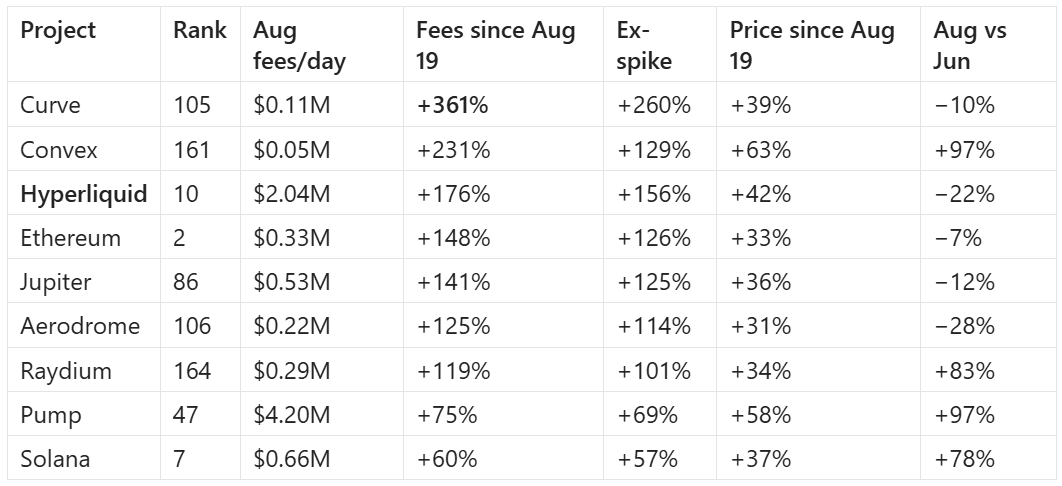
These are projects whose fees beat +36.9%. And the price beat BTC’s +24.2%.
That last column compares August to June. Trading-driven protocols look weak there because June was a crash month, and crashes are profitable for anything earning on volatility. So keep it as context while reading that.
Hyperliquid is the standout. $2.04M a day in fees, and it’s the only project in this entire screen trading within 1% of its all-time high. The median name in this cohort is 89% below its high. Everyone else is climbing out of a hole. Hyperliquid never really got in one.
Group 2: momentum winners
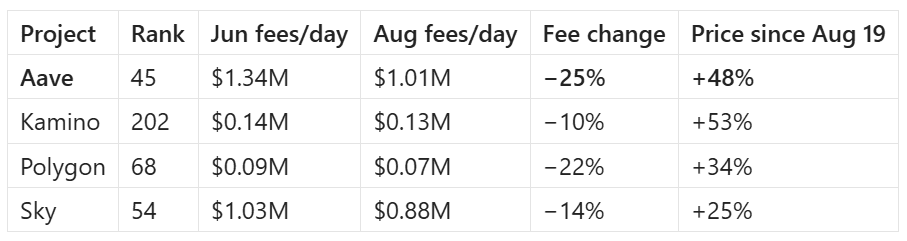
Price beat BTC. Fees went the other way. Relatively, prices of these projects have ran ahead of their fees.
Why this group uses a different window. “Price ran ahead of fees” is a claim about a trend, not about nine days. So I measured these month-over-month instead. All four are clean on that window, no spikes hiding anything. Aave in particular has its biggest day at just 4.8% of the month.
Group 3: potential opportunities
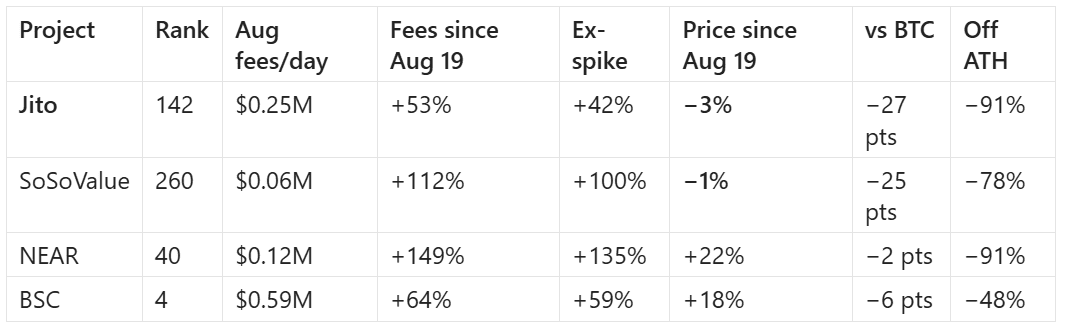
Fees beat +36.9%. Price lagged BTC. This is the group I actually built the screen for.
All four also clear the August-versus-June check, against a +12.5% benchmark. None of the trading-driven names in Group 1 did that. So, these projects aren’t purely dependent on crashes.
Now, it is not guaranteed that these projects will outperform the market. It depends on many more factors: sustainability, competition, unlocks, moat, etc. I don’t even know anything about SoSoValue.
But this is a good shortlist of projects to dive deeper into.
PS. This analysis was done using Claude and APIs from CoinGecko and DefiLlama. Do not blindly ape based on this.
🚀 DeFi Catalysts
Hyperliquid stands to capture up to 90% of the reserve income on the ~$5.6B of USDC sitting on the exchange once its fee switch goes live, an estimated $200M a year.
LayerZero is launching ATLAS, a “headless exchange” that promises CEX performance with DEX verifiability.
Base went live with Coinbase-issued tokenized equities using the B20 standard, 1:1 backed by shares in a regulated trust.
Solana holders are voting on doubling the network’s disinflation rate to -30% from -15%, with the proposal live until Thursday ~15:30 UTC.
Kinetiq launched Elysium, an OP Stack L2 using HYPE as its gas token with native HyperCore orderbook access, aimed at HyperEVM’s throughput limits.
Trade.xyz, an HIP-3 deployer on HyperLiquid, keeps shipping equity perps: Moderna went live as MRNA, the fifth name added in two days.
Morpho shipped Lend Callbacks, a new primitive that lets fixed-rate limit orders earn variable yield while they wait to be filled.
Phantom is ending support for Sui on September 24. Funds stay safe, but users need to move to a Sui-native wallet or swap out before the deadline.
Superstate‘s USTB, backed by Invesco’s $950M Short Duration US Government Securities Fund, went live as collateral on Kamino.
Ethena is further diversifying USDe’s backing, signing a $1B facility with FalconX that routes reserves into overcollateralized institutional loans. USDe open interest has roughly doubled since.
Concrete launched concUSD, a new stablecoin powered by M0’s issuance infrastructure.
Kamino launched a USDC Earn Vault that lets Solana Mobile Seeker owners deposit straight from their phone.
Oku Trade launched Poppie Finance, letting holders borrow without selling their exposure to Ondo tokenized assets.
Velocity, formerly Drift, opened the second round of private beta for onchain perps at 0.02% trading fees and 20% referral rewards.
Aster went live with its first USD1-denominated RWA perp markets, covering names like SpaceX. World Liberty is seeding liquidity with $250M in WLFI, plus another $12.5M USD1 from Aster itself.
Entropy is now trading pre-IPO Anthropic exposure onchain, its first frontier private-asset perp. Pricing runs on liquidity-weighted oracles that progressively lean on Entropy’s own book as it deepens.
🪂 Airdrop Alpha
Arthur Hayes is leading Flop Labs, building FLOP as a payment token for AI agents buying compute, inference, and storage. He has announced an airdrop in Q4 2026.
Aligned‘s ALIGN claim is live for eligible wallets. 8.74% of the 10B supply goes to the community, with 44.36% unlocking at TGE.
TermMax opened its airdrop checker for wallets that used the protocol, with an August 23 deadline to lock in a claim plan.
C8ntinuum, a cross-chain secure-communication protocol, launched “Network Score“, a leaderboard with points.
Ethos opens an auction for 20% of WHUF supply on September 1, with an 85% price guarantee, a $1M starting FDV, and a $99M cap.
🚀 New Launches
The Interfold shipped Network Alpha, letting independent parties compute over encrypted data via ciphernode committees, no custody handoff, and no trusted hardware required.
Longbow Lend launched as the credit layer for Robinhood Chain, letting users borrow USDG against tokenized stocks like NVDA, GOOGL, SPY, and CRCL.
Osero launched publicly, auto-routing stablecoin deposits into Sky’s sUSDS savings rate behind a simple deposit-and-earn UI.
📰 Industry News
Trump said the CFTC is working to bring Hyperliquid onshore, and Hyperliquid Strategies stock spiked 31% intraday.
Twitter/X users can already embed Solana and Ethereum charts in posts. According to Nikita Bier, trade buttons are “coming soon”.
BitMart, which had begun winding down and urging withdrawals, now says it will restructure instead of fully shutting down.
Fasset, the stablecoin neobank, raised $68 million at a $1 billion valuation with SBI backing.
🚨 Rekt Report
Term Finance was drained of $8.5 million on Ethereum after an attacker bought a majority of a sparsely held DAO governance token for just 2 $ETH, and then passed malicious proposals to seize control of Term’s vaults.
Tornado Cash domain that had expired was rebuilt as a phishing clone and just took 1,010 ETH (~$2.3M) from one investor, part of an estimated ~4,000 ETH stolen through it over the past year.
Pendle‘s PT-reUSD oracle was misconfigured and exploited, resulting in two Morpho markets and wiping out ~$36.39 million in leveraged PT positions. No bad debt resulted, and reUSD’s peg held.
Maya Protocol lost $1.7 million after flaws in trade accounts and pool math let an attacker inflate a pool and extract CACAO, then swap into BTC, ETH, RUNE, and stablecoins.
Cosmos EVM‘s precompile module, shared across multiple chains, had a vulnerability. An attacker exploited it to drain ~2.9 billion TAC (~$7.5M) from escrow.
😂 Meme
Until next time,
Edgy
Today’s email was written by Edgy and Yayya.
DISCLAIMER: I’m NOT a financial advisor. This content is for education and information purposes only. Crypto and DeFi are risky and speculative. Please do your research before investing.
Whenever you’re ready, here’s how we can help you:
- 🚀 The DeFi Edge Ventures – We identify, invest, and help amplify DeFi Protocols that positively impact the Crypto space.
You’re receiving this email because you signed up for my newsletter. You can update your Preferences or Unsubscribe here.
600 1st Ave, Ste 330 PMB 92768, Seattle, WA 98104-2246