Oops. The earlier email didn’t have the second article. So, I’m sending out this fixed version.
On to this week’s email…
This week, Hyperbridge was hacked. Someone minted bajillions of $DOT & other tokens on their bridge.
Almost prophetically, they had posted this on April Fool’s Day:
Two weeks ago: “Haha guys, we got hacked, April Fools!”
Now: “So about that… this time it’s not a joke.”
Crypto never disappoints.
Here’s what we got today:
Hyperliquid updates. What you need to know about HIP-4.
The Bittensor Drama. The biggest subnet creator is leaving the eco.
Around the web. Polygon launched native LST sPOL, Morpho Midnight is coming, and more.
Today’s email is brought to you by Katana — the DeFi optimized chain.
Here’s your Edge 🗡️!
Subtopic
HIP-4: Hyperliquid’s War on Polymarket
HIP-3 is why HyperLiquid has recently been on a tear.
26% of total open interest on HyperLiquid is from HIP-3 markets
~48% of HL’s volume share hit HIP-3 on April 8th, and it consistently holds above 20%
It cracked open non-crypto markets (commodities & stocks). But it’s still just 0.04% of CME’s volume. Plenty of room left to grow.
HIP-3 was a step-change upgrade. HIP-4 is shaping up to be another one.
What HIP-4 Actually Is
HIP-4 makes every event tradable. Like prediction markets.
It introduces event futures (aka binary markets) that resolve to either 0 or 1. Until resolution, the price reflects the market’s real-time probability. Think “Will the Fed cut rates in December?” trading at $0.62, meaning the market prices a 62% chance.
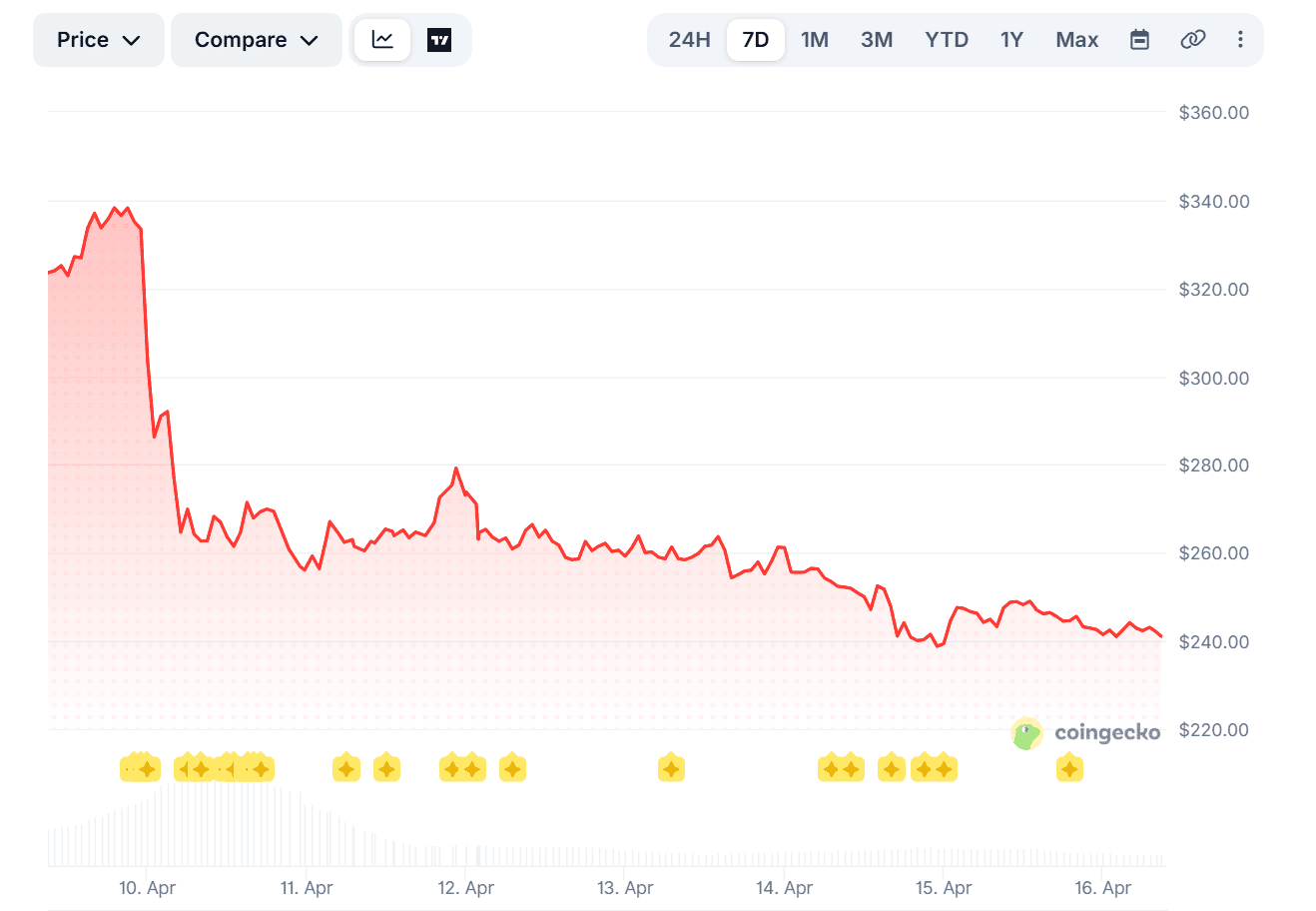
Permissionless, too. Anyone can spin up prediction markets — but there’s a catch. You need to stake 1 million $HYPE (~$35M at current prices) to deploy an event DEX. In return, you get reusable market slots and up to 50% of the trading fees generated on your markets.
Why This Is a Big Deal
1. Massive $HYPE demand sink. Every HIP-4 market creator has to lock up 1M $HYPE as a bond. That’s massive structural buy pressure.
2. Potential revenue that dwarfs HIP-3. Prediction markets did $25B in notional volume in March alone. Assume HIP-4 captures 10% of that, charges 1% taker fees, and HL takes its 50% cut:
$25B × 10% × 1% × 50% = $12.5M in revenue. In a single month.
Granted, it might take some time to reach that stage. Still, that’s already more than HIP-3 has generated since mainnet launch.
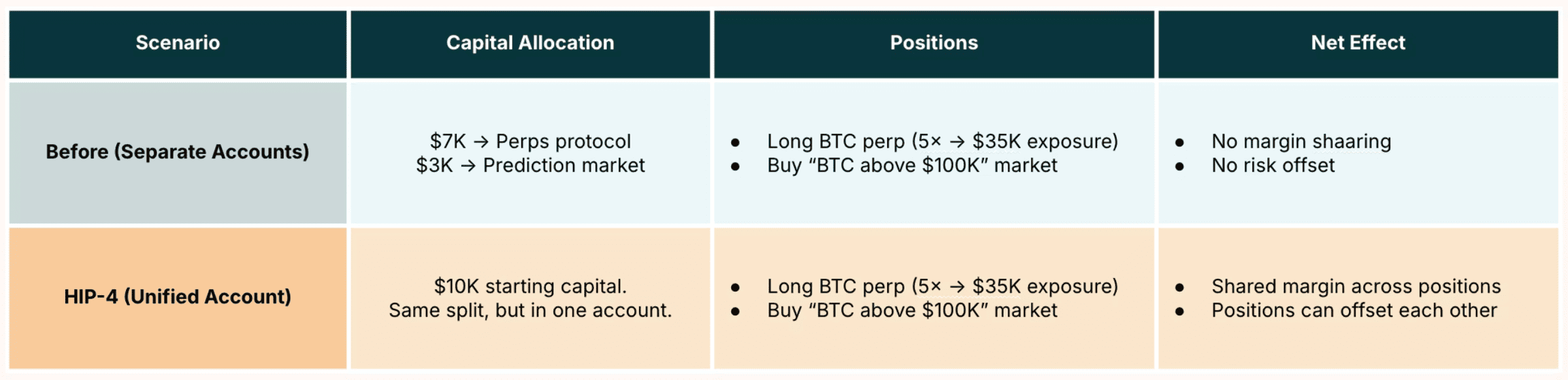
3. Capital efficiency that Polymarket can’t match. Outcome contracts run natively on Hypercore, the same as perps and spot. That means the risk engine sees them all as one account.
Here’s why HIP-4 is more efficient.
With HIP-4, you still need $10K in total. But because both positions sit in the same account, they can offset each other when the market moves against you. This reduces the effective collateral required, allowing you to achieve higher leverage and greater capital efficiency with the same $10K.
New Use Cases
This is the part that gets interesting and a bit speculative.
Crypto-native Credit Default Swaps. (Credit to Decentralized.co for this framing.)
Someone spins up a market: “Will Aave be exploited for more than $10M in 30 days?”
A fund with exposure buys YES at $0.03 — $300K hedges $10M. Audit firms who’ve actually read the contracts take NO at $0.97. If nothing happens, NOs pocket ~37% annualized. Funds get real smart contract insurance. Auditors finally get paid for what they know.
Parametric insurance. Same primitive, different application.
Trigger event → instant payout. No adjusters, no paperwork.
A shipping company can buy YES on “Will fewer than 20 vessels transit Hormuz?” as a hedge.
These can technically be done on existing prediction markets. But on Polymarket, their capital is locked until resolution.
On HyperLiquid, it cross-margins against their long crude perps — two correlated positions in one account, way less collateral required.
That’s the real unlock. HyperLiquid’s risk engine becomes a coordination layer across perps, spot, and event outcomes. Completely novel strategies will become possible on HyperLiquid
Fair question. They’re the 800-pound gorillas in prediction markets.
But HL doesn’t need to win on market count or UX. A stat that should worry Polymarket: 14% of Polymarket’s top traders are already active on HyperLiquid, using the same wallets on both platforms.
Capital efficiency is the wedge. HIP-4 just needs a handful of markets that pair naturally with assets already trading on HL — Fed decisions, major crypto price thresholds, geopolitical triggers, and macro events. The long-hold positions, where locking up capital hurts most.
Cherry-pick the whales. That’s enough.
One More Update: Priority Fees
Separate from HIP-4, HL is rolling out priority fees. Quick version: right now, every trader uses the same public API endpoints. Execution speed comes down to hardware and co-location with validators.
Priority fees change that. Traders can pay to jump the queue, and HL internalizes the revenue instead of leaking it to co-location arms races. Big deal for HFT, market makers, arbitrageurs, and liquidators.
Long-term, these updates are clearly bullish for $HYPE.
But short-term? I’m not sure there’s much upside. One chart tells the story.
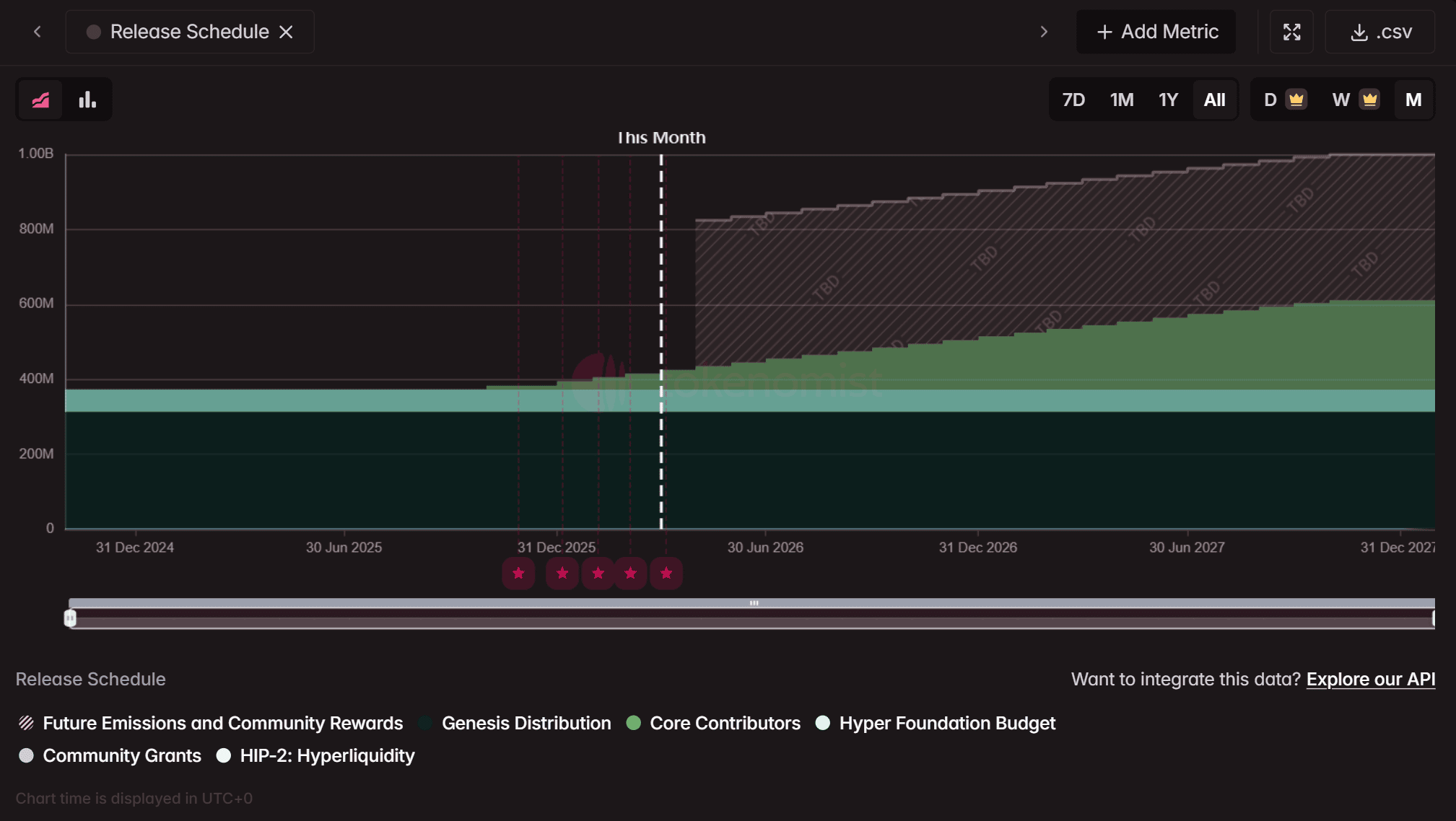
There’s a massive unlock next month.
Next month, future emissions and community rewards unlock, representing nearly 39% of supply.
That’s a massive amount of supply hitting the market. There’s not much clarity on how it’ll be deployed, but “39% unlocking in a month” is the kind of thing that caps short-term upside no matter how good the roadmap looks.
There’s more I could share on the HYPE outlook, but this piece is already chunky. Full $HYPE breakdown in TDE Pro.
Stocks, commodities, forex — they’re all gonna be traded as perps.
Retail speculators will prefer perps over instruments like options. Easy UX, high upside, no expiry dates, no settlement complexity. It’s inevitable.
Options, futures, and CFD markets generate over $8 trillion in combined daily notional volume. Even capturing a sliver of that is a trillion-dollar opportunity.
Katana Perps was built for that shift.
They didn’t start from scratch either. They acquired IDEX, which spent nearly a decade building decentralized exchange infrastructure: refining matching engines, execution quality, and trading infrastructure for serious traders. GSR, Selini Capital, and Auros are already market-making on the platform.
They also have a unique edge: Vault Bridge yield. This is a structural yield source that Katana can use to incentivize users on Katana.
The result? $1.47B in volume and ~$636k in fees since launching in late March.
Points Period 6 just went live on Katana. So 250,000 points are up for grabs.
If you’re already trading perps, give Katana a spin.
Covenant AI ran 3 subnets: Templar (SN3, pre-training), Basilica (SN39, GPU compute), and Grail (SN81, post-training/RL). They trained the largest decentralized LLM ever. 72 billion parameters across 70+ independent nodes.
Jason Heung acknowledged it. Anthropic’s co-founder cited it. It drove the ~90% $TAO rally earlier this year.
Now, they’re leaving.
What happened? Samuel Dare, the founder of Covenant, accused Bittensor of being a “decentralization theater.” He accused the $TAO founder, Jacob Steeves of centralized control.
His accusations against Jacob: suspending Covenant’s subnet emissions, stripping moderation rights over their own community channels, and timing token sales as economic punishment during disputes.
Heavy charges. The kind that actually crashed the $TAO price 25% in one day. Subnet alpha tokens for Templar, Basilica, and Grail crashed 55-70%.
Jacob fired back point by point. He didn’t suspend emissions. He sold some alpha holdings on Covenant’s subnets (less than 1% of his position) because they weren’t running and were on near-100% burn code. Normal market mechanics, not targeted sabotage. On the moderation thing? He says Samuel was deleting genuine criticism, so he temporarily removed that ability. Not the moderator role itself.
Samuel also had accused Jacob of depreciating Covenant’s subnet infrastructure. But as Jacob pointed out, this is clearly false.
Jacob said Samuel is likely having a “psychotic breakdown.”
Yeah. It got personal.
So who’s right?
Look. Decentralization is a spectrum. Bittensor’s upgrade governance runs through a triumvirate structure, with three individuals managing the multisig for network upgrades. That’s not exactly Bitcoin-level decentralization. And when a founder holds massive bags and sells them during disputes, the optics are terrible regardless of whether the mechanics are “normal.”
But Samuel’s framing went beyond legitimate criticism. Calling it “decentralization theater” is FUD and misrepresents BitTensor.
So, I’m leaning towards the Jacob camp here.
What’s next for Bittensor?
The community isn’t sitting around mourning. Miners and potentially ex-Covenant team members are already organizing to continue work on Covenant’s subnets (SN 3, 39, and 81).
Jacob also proposed a new protocol-level feature: Locked Stake to ensure that teams like Covenant cannot leave holders like this again. The idea is to let subnet operators commit tokens with a defined lock-up period. Think of it as a trust signal. If an operator locks their stake, investors get assurances against exactly this kind of rug. Teams can compete on conviction, not just promises.
The situation is still evolving. We’ll have to wait a couple more days to see how everything settles.
Bittensor will recover from this. The $TAO cult is real.
DISCLAIMER: I’m NOT a financial advisor. This content is for education and information purposes only. Crypto and DeFi are risky and speculative. Please do your research before investing.
Be Early to the Next Opportunities
TDE Pro gives you direct access to our research, our portfolios, and the gems we’re betting on. It’s your unfair advantage to move before the crowds.
Whenever you’re ready, here’s how we can help you:
⚙️ The DeFi Edge PRO– Designed for busy people who want to stay ahead of the curve. Leverage our research to save you hours each week, and to see what we’re personally investing in. Join today.
🚀 The DeFi Edge Ventures– We identify, invest, and help amplify DeFi Protocols that positively impact the Crypto space.
You’re receiving this email because you signed up for my newsletter. You can update your Preferences or Unsubscribe here. 600 1st Ave, Ste 330 PMB 92768, Seattle, WA 98104-2246