
The best way to go private in crypto
Sponsored By

Ethereum shipped the Fusaka upgrade.
If you’re deep in the weeds, dive into details on Forkcast.org. For everyone else, here’s the quick version:
- Many improvements for scaling L1.
- Fixed the Blob (the data layer for L2s) market pricing.
- Used PeerDAS to scale blobs. Good for cheap txns on L2s.
- Did groundwork for Preconfs, which’ll allow Ethereum to provide 100ms sub-blocks for users. That’s 120x faster than the current blocktime.
Did you fall asleep halfway through that? Honestly, with how ETH trades, I get it.
Still, it’s a reminder that fundamentals keep improving even when charts look sleepy.
Here’s what we got today:
- HumidiFi ICO. Intro to PropAMMs and HumidiFi.
- Privacy Deep Dive. Looking for the best onchain privacy tool.
- Around the web. Polymarket app for US users, Fee Switch from YieldBasis, Transaction Shield from MetaMask, and more.
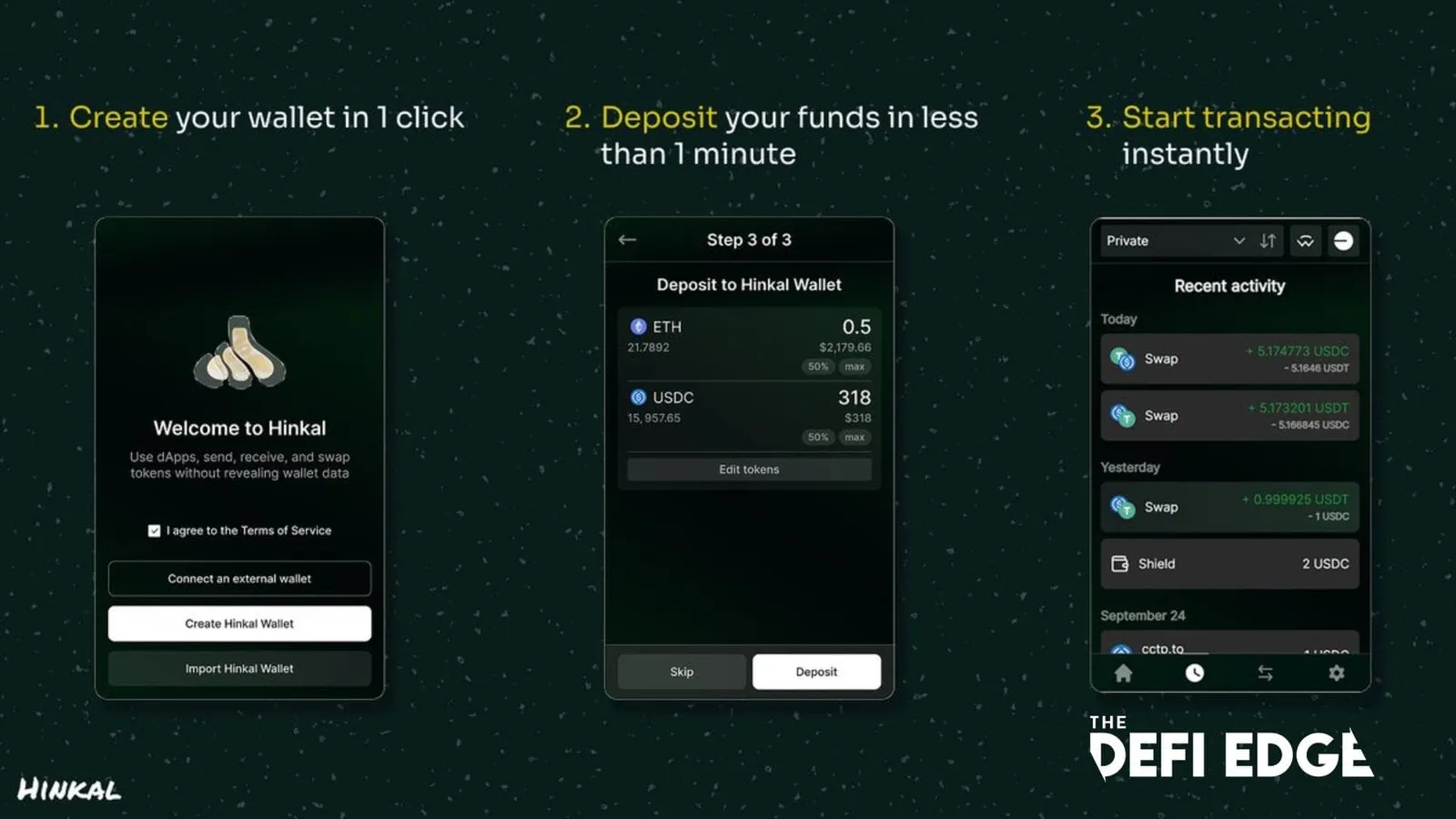
Today’s email is brought to you by Hinkal — the seamless privacy wallet.
Here’s your Edge 🗡️!
Token Sale
HumidiFi ICO: Everything You Need to Know.

Token sales are where most opportunities are right now, and HumidiFi was the big one this week.
What is HumidiFi? It’s a PropAMM that does >50% of spot volume on Solana.
PropAMMs are the cutting edge of onchain markets. They power the early version of Solana’s “internet capital markets,” so it’s worth understanding how they work.
Traditional DEX pools have big issues:
- Impermanent Loss. Price divergence between paired assets erodes LP value upon withdrawal, often worse than simply holding.
- Slippage and Poor Execution. Pools often do not have enough liquidity to support massive trades from whales.
PropAMMs flip the model. They act more like professional market makers who stream quotes directly to aggregators like Jupiter.
Using proprietary models, PropAMM will constantly provide quotes for assets. These will update faster than block times (400ms in the case of Solana). When a user trades on aggregators like Jupiter, the aggregator will route it to the best PropAMM.
This allows PropAMMs to give real-time pricing, to offer tighter spreads, lower slippage, and faster execution. In the recent $MON launch, there were time periods where Solana gave better pricing than others, even better than CEXes.
Aka, they enabled Solana’s “Internet Capital Markets”.
So right now, “propAMM is a narrative” that’s gaining traction. In the chart below, you can clearly see them taking away volume from traditional public dexes.
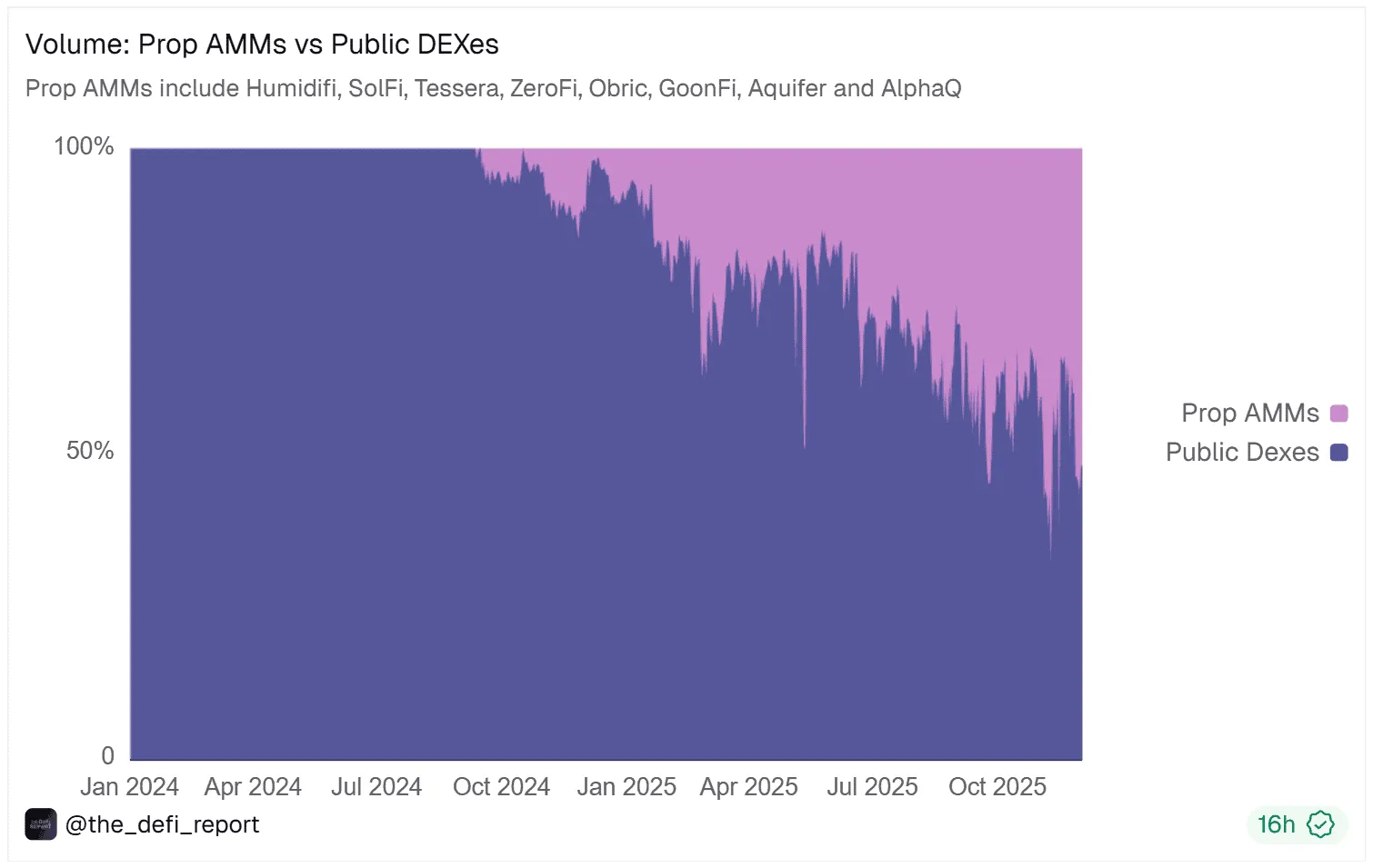
If you want data about PropAMMs in general, this dashboard is great. Another good one is this.
And among PropAMMs, HumidiFi is leading by quite a margin. In the chart below, they’ve been doing >60% of the volume among PropAMMs.
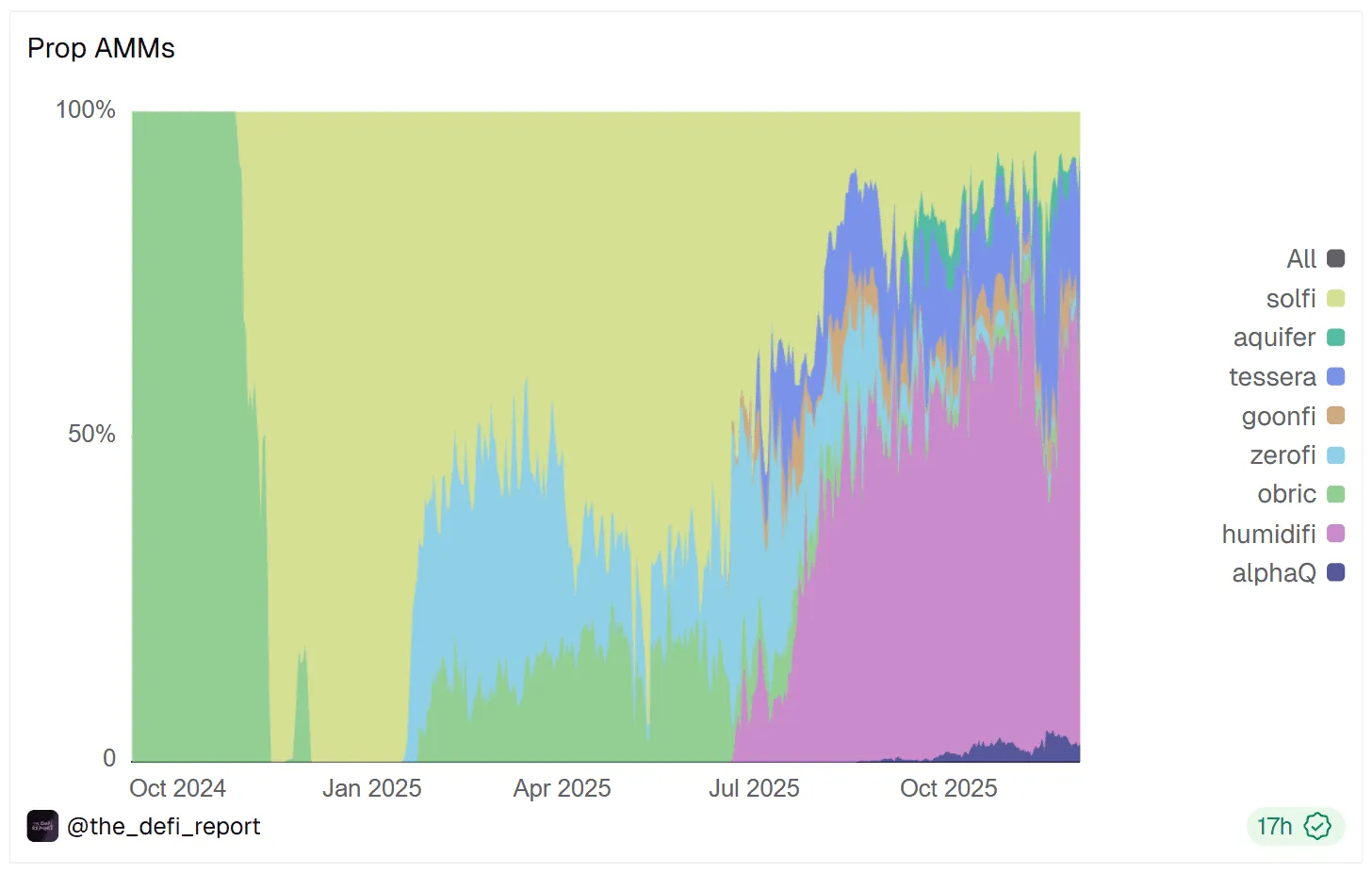
Since its launch six months ago, HumidiFi has already done ~$150B in trading volume. Their metrics are trending upwards. You can see more HumidiFi data here.
So the HumidiFi’s $WET token sale was potentially a good opportunity.
- They sold 6% of the supply to the HumidiFi community at $50M FDV
- JUP stakers bought 2% of the total supply after the HumdiFi community.
- 2% of the token supply was available for the public at $69M FDV.
But there are some headwinds as well.
- The general market conditions weren’t great for altcoins.
- We don’t know about the profitability of HumidiFi. Their pole position among PropAMM’s could be powered by unsustainable methods.
- The tokenomics of the project are terrible. It’s a fee-rebate token for $WET stakers. The token has no claim over the revenue of HumidiFi. The distribution was also really bad.
These headwinds made me view $WET as a narrative flipping play rather than a long-term holding play.
Anyways, when the public sale happened, a single bot was able to corner a lot of supply by setting up thousands of wallets.
So the HumidiFi team has decided to remove the botter and conduct another public sale on Monday. So you might still be able to get in and flip on Monday.
Sponsored Hinkal


Latest issue
Everything-dashboard for tokenized stocks + $6.3 B Binance hack
Tokenizedstonks.io is a must-know tool if you do anything with tokenized stocks. Here are the top features from it that I really like.
- $6.3 B Binance hack. Everything you need to know about it.
- Tokenizedstonks.io 101. The website for all your tokenized stocks info.
Next issue:
Free · every Thursday
Get the next issue by email
Each Thursday Edgy explains what happened in DeFi and what it means for you. About 7 minutes. No shilling.
“No BS, solid analysis, not pressing me to buy.”
Reader survey
Written by Edgy · 15,000+ readers




Hinkal: The Best Way to Go Private Onchain.
Nobody wants their financial life displayed to the public.
This is especially true for your crypto activity. In the past few years, >50 kidnap attempts targeted crypto holders.
So crypto needs to go private as well. Zcash jumping to 10B FDV is market validation of the privacy thesis.
Alright. But how do we get privacy in practice?
There are a couple of ways. But they’re not made equal.
I’ll go through all the available methods I know and compare them. Spoiler alert: private wallets on public chains are the best option. And Hinkal is leading in that category.
Now, let’s go through each method individually.
The first option is privacy chains like Aleo.
It’s blockchain where your activity is private. Sounds great, right?
Well.. no. It doesn’t have utilities like DeFi. The reason why we use crypto is to access the ecosystem built on top of blockchains. Despite being very slow and costly, Ethereum still leads L1s by TVL. Why? Vibrant and diverse ecosystem. Users need that.
Alas, these privacy chains don’t have an ecosystem.
Aztec has also been cooking something for the past 7 years. It’s aiming to be an Ethereum L2. But it isn’t fully operational yet. Plus, the L2 won’t be an EVM. Aka, it cannot tap into Ethereum’s developer ecosystem.
Privacy chains have to build a new ecosystem from scratch. But it’ll take multiple years, and it’s REALLY, REALLY difficult to do so.
In other words, since private chains don’t have an ecosystem, they’re useless for the average crypto user.
Privacy coins like ZEC and Monero are the second option.
It has the same issue. You have to bridge to a separate, limited ecosystem. Even worse, they don’t support privacy for full applications.
If you ask someone to go install a separate wallet just to hold a “private coin”, they won’t do it.
This is done only by desperate users — basically, their own community praying for the coin to succeed. We’re looking for accessible privacy for everyone, and this ain’t it.
Privacy Dapps and mixers are a very common option.
There are many examples: Tornado, Privacy Pools, and Veil Cash. They allow users to break the link between two wallets by placing a mixer in between the two.
The idea sounds good. But the UX for these is very terrible.
- You have to convert into the pool’s liquid asset.
- Then split the number.
- Then deposit.
- Then wait.
- Then withdraw.
In other words, this is a UX nightmare. Calling it terrible is being polite.
Honestly, I used to do this. But it was during the dark ages when I hadn’t found the best way to do it.
Private wallets on public chains are the best option. Among these, Hinkal stands out — but more on that in a minute.
With private wallets, you can just continue using your ecosystem. Nothing will change from the usual UX. No one sees what you have or what you do with any asset.
Railgun is often promoted as an example of a private wallet. It has a 100M anonymity set. Even Vitalik promotes it. It should be a great option, right?
Ehh… When I downloaded and used the app, it was a UX nightmare.
It’s a separate app, so I’m isolated from what I actually do in the browser. Then I had to wait an hour before I could shield the asset. And that’s it — I’m limited and isolated.
The average person cannot handle the current crypto UX. If we promote that as the ideal privacy option, they won’t ever enter crypto.
Thankfully, we have a much better solution.
Hinkal is my favorite option.
- It has a dual-account mode: public or private, with unlimited public accounts.
- It’s a private wallet extension. You can stay private while using your favorite dApps, so no one sees what you have or what you do with any asset.
- Very good UX. Just download the extension, shield assets, and use it. Any asset, any transaction. And boom. You’re now private.
- Fully confidential payments. You can move assets without revealing the value of the asset. If you think about payments moving to blockchains, this is a great option.
- Plus IP privacy with Tor.
This product is endorsed by Vitalik as well. So it’s not some niche, untested product. It’s used by the leaders in our industry.
In my humble opinion, they have the best privacy experience on the market right now.
🚀 DeFi Catalysts
Polymarket is launching an app for US users. It’s being rolled out to those on the waitlist. They’re launching with sports.
Aave is discussing the removal of Sky‘s USDS and DAI as collateral, per recommendations from its risk teams.
Kamino Finance blocked Jupiter Lend’s Refinance, which’ll allow Kamino users to migrate to Jupiter, at the program level.
YO introduced yoGOLD. It’s a yield vault for tokenized gold powered by Tether Gold.
YieldBasis announced the Fee Switch. The DAO will distribute the captured fees to veYB holders. There’s 17.13 BTC (~$1.578 M) waiting to be distributed.
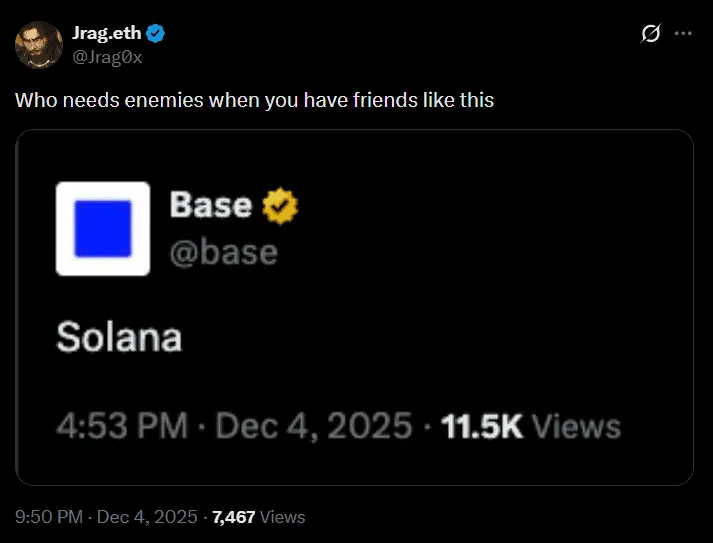
Base has released the Base-Solana Bridge on mainnet. The bridge lets builders on Base support Solana assets in their apps.
Aave is discussing the scaling down of multichain activities. Revenue generated from many of these chains isn’t enough to offset the costs and risks.
MetaMask introduced Transaction Shield. For any transaction they deem safe, subscribers are guaranteed against loss up to $10,000 per month.
Drift Protocol introduced Drift v3. It promises 10x faster fills, 10x improved liquidity, and a cleaner, more intuitive interface than v2.
Uniswap has integrated Revolut for a faster, seamless onramp. Revolut is Europe’s largest finance app with over 65M customers.
Chainlink is getting a Grayscale Chainlink Trust ETF. It’ll launch on NYSE Arca as a new spot ETP. The ticker will be $GLINK.
Ethena has expanded its partnership with Anchorage to offer in-platform rewards to USDtb and USDe holders.
Terminal Finance has shut down its operations. It was designed to launch on Ethena’s converge chain, but there’s no sign of the chain launching.
USDe is now available as a quote asset on both Hyperliquid spot and HIP-3 perpetual markets. With adoption, it can increase demand for USDe.
📰 Industry News
Bank of America will reportedly allow Merrill, Private Bank, and Merrill Edge clients to allocate 1%–4% of their portfolios to crypto.
Astria Network shut down. It was a Celestia-backed shared sequencer network for L2s. They’d raised ~$18 million.
Anthropic and MATS researchers found out that AI can hack smart contracts. Agents found $4.6M in blockchain smart contract exploits.
Kraken will acquire Backed, the company behind xStocks. With it, Kraken will be able to accelerate in the RWA vertical.
Binance introduced Binance Junior, a new account for kids. This will be a sub-account of the parent’s master account.
🐦⬛ X Hits
- History (& future) of DeFi innovation.
- Principles for growing a chain ecosystem.
- What happened to the restaking sector?
- Can L1s compete against BTC as cryptomoney?
- Limitations of prediction markets.
😂 Meme
Until next time,
Edgy
Today’s email was written by Edgy and Yayya.
DISCLAIMER: I’m NOT a financial advisor. This content is for education and information purposes only. Crypto and DeFi are risky and speculative. Please do your research before investing.
Whenever you’re ready, here’s how we can help you:
- 🚀 The DeFi Edge Ventures – We identify, invest, and help amplify DeFi Protocols that positively impact the Crypto space.
EdgyWrites The DeFi Edge every Thursday
Next issue ·
Get the next issue in your inbox
One short email a week: what happened in DeFi, what it means, and what Edgy is watching next. Free, about 7 minutes, no shilling.
Your inbox, every Thursday

15,000+ readers, including people at
“Very well curated, non chaotic.”
Reader survey