
Did wall street declare war on onchain stocks?

Polymarket reportedly fired its CMO this week.
Back in June, the WSJ found the company paid creators to film themselves winning trades that never happened. Now they seem to be cleaning house before a rumoured IPO.
The truth machine faked its own receipts.
Here’s what we got today:
- Companies are objecting to tokenization. Here's the reason behind it.
- Top projects by net holder revenue. And the clear leader among them.
- Around the web. NYSE and trade.xyz are launching a HIP-3 market; Starknet voted to research an exit from Ethereum L1, and more.
Here's your Edge 🗡️!
News
Is Wall St. Starting a War on Onchain Tokens?
33 companies just told crypto: hands off our stock.
Microsoft. Alphabet. Goldman. Coca-Cola. This week, JPMorgan joined them. That's 30 of the 62 names on OKXICE's original list.
Looks like a war. It isn't.
In the same week, DTCC's tokenization service went live with 20 banks and brokers signed up, including JPMorgan. The fight isn't about whether stocks go on-chain. It's about who runs the rails.
What does "OKX and ICE tokenizing" actually mean?
OKXICE is a 50/50 joint venture between OKX and ICE, the company that owns the NYSE.
What's the token? A broker-dealer buys real Microsoft shares, holds them, and mints one token per share. Each token is a legal claim on one actual share. You also get dividends, votes, and proxy materials.
It's supposed to trade on XLayer, OKX's chain. Uniswap v4 pools against USDC, 24/7, with KYC'd wallets only.
By default, the companies themselves don't have to agree. Under the SEC's new Innovation Exemption, the venue sends a notice. Object within 30 days, and your stock can't list. Stay silent, and it lists, with no take-backs.
That's why 33 companies object. And to be fair, they have reasons.
- Silence is permanent. When saying no is free and saying nothing means consent, lawyers say no.
- A second price for your stock. AMM pools will be a second-pricing venue that the company would have no control over. And many of them would have low liquidity. Companies wouldn't want degens to manipulate their stock markets during off-hours.
- Other technical risks. Admin keys can upgrade contracts and pull LP liquidity "without a timelock." SIPC coverage for tokens in your wallet is "uncertain." Etc.
Fair points. Now let's look at the other side.
- Public means public. Toly put it best: If companies don't want their public stocks to be freely traded by the public, "they should go private then."
- The objection only covers one venue. It doesn't touch other venues, offshore products, or synthetics. Ondo's MSFTon gives holders no voting rights at all, and it keeps trading. Blocking this gives more market share for those lower-quality options.
- The registered market is tokenizing anyway, with no veto. The SEC approved Nasdaq's plan to trade Russell 1000 stocks in tokenized form on its normal order book. On DTCC's service, "the consent of issuers is not required".
My take
Companies aren't fighting tokenization per se. They're just objecting because it's the safer strategy, at least from their perspective.
The real fight is between the venue operators: the registered system (Nasdaq, DTC) vs. new exempt on-chain venues. And it isn't simply TradFi vs. crypto either. The NYSE's parent is partnered with OKX for tokenization.
Analysis
Net Holder Yield: Which Revenue Tokens Actually Pay You After Unlocks?

It's "revenue meta". So all we need is tokens that generate high revenue relative to market cap, right?
Well, no.
Pump.fun has spent $25.3M buying back PUMP so far in October. Its buybacks run at a 15.5% yield on market cap. Still, PUMP is down >12% over 30 days.
Why? Unlocks. Every month, 6.875B new PUMP (about $30M at today's price) hits the market. The buyback absorbs about 5.7B. Holders are still getting diluted: −2.4% a year, net.
So what actually matters? Net holder yield.
Net holder yield = holder yield − dilution from new supply.
The leaderboard after the unlocks
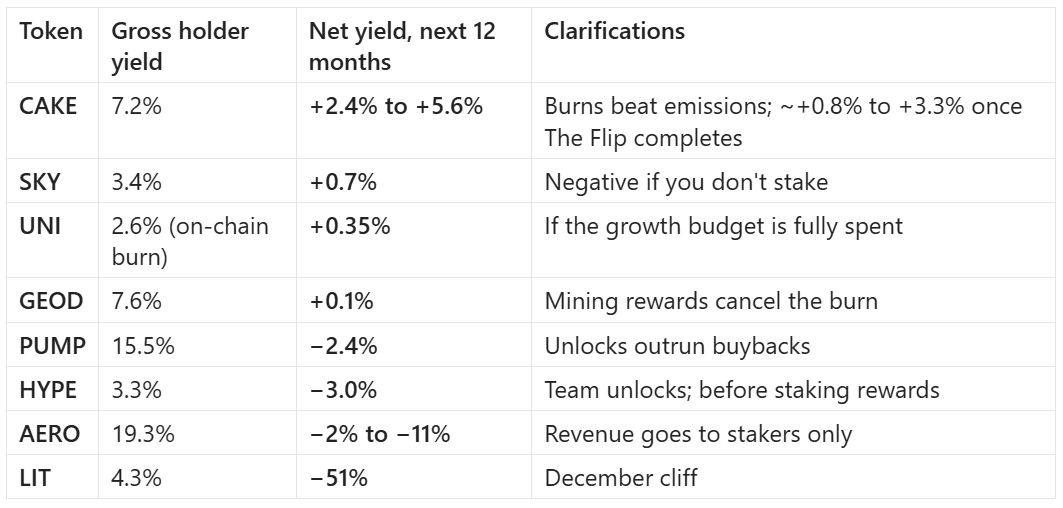
Quick 80/20 on the method: I took every token over $50M market cap that DeFiLlama tracks holder revenue for (no stablecoins, no L1 gas burns) 62 tokens in all, and ran the same math on every one. Gross yield = the last 89 days of holder revenue, annualized, ÷ CoinGecko market cap. I assume revenue stays flat (if it falls 30%, every gross yield falls 30% with it). Net yield subtracts scheduled unlocks from DeFiLlama's unlock tracker, current emission rates, and any rule changes already voted in. Sources are linked inline.
None of these tokens are printing money once you count the unlocks.
One comes close.


This issue
Did wall street declare war on onchain stocks?
33 companies just told OKX and ICE: don't tokenize our stock. We thought tokenization was awesome for everyone. What's happening?
- Companies are objecting to tokenization. Here's the reason behind it.
- Top projects by net holder revenue. And the clear leader among them.
Next issue:
Free · every Thursday
Enjoying this issue? Get the next one by email.
Each Thursday Edgy explains what happened in DeFi and what it means for you. About 7 minutes. No shilling.
“No BS, solid analysis, not pressing me to buy.”
Reader survey
Written by Edgy · 15,000+ readers



CAKE: burning more than it prints
PancakeSwap burned more CAKE than it minted in 146 of the last 161 weeks. In the four weeks to September 27 alone, net burns removed 2.25M CAKE.
And it's about to print less. CAKE holders passed "The Flip". Over the next three months, daily emissions drop from 22,500 to 11,000 CAKE. That takes new supply from about 675k CAKE a month to 330k, against roughly 2M CAKE a month bought back and burned. Later, emissions settle at 7,000 a day.
The catch? The same vote cuts the protocol's share of v3 and Infinity swap fees from about 33% to 12%. Less fee share means less to burn.
The rollout protects the burns for now. The chains that burn the least switch first. BNB Chain, where about 63% of CAKE's holder revenue comes from, switches last, and only once supply is down 20%.
So the next 12 months still look good: about +2.4% to +5.6% net, depending on whether you use the last 7 or 89 days of revenue. After the final switch, it's closer to +0.8% to +3.3%.
Seven tokens, one problem: supply
- SKY (+0.7%): 55% of buybacks are burned and 45% are paid to stakers in USDS. Stakers also get about 100M SKY every 90 days from the treasury. Negative if you don't stake, and governance already cut buybacks 87% once this year.
- UNI (+0.35%): the fee burn can't be switched off, but it burns about 1.9M UNI a month while the growth budget releases about 1.7M.
- GEOD (+0.1%): real revenue from drones, robots and farms. But the ~2.9M GEOD a month burned is matched by ~2.9M minted as mining rewards.
- PUMP (−2.4%): and the buyback commitment expires around April 2027.
- HYPE (−3.0%): the best business on the board (41% of perp DEX fees). But team unlocks of about 1.58M HYPE a month run close to double the 0.83M bought back. That's before staking rewards.
- AERO (−2% to −11%): the merger didn't stop emissions. Aero now mints rewards as LPs claim them, capped at 20% inflation a year, and its own estimate puts issuance at about 8–11% of supply. Revenue goes only to sAERO stakers.
- LIT (−51%): Lighter has burned 18.09M LIT. But from January, about 13.8M LIT a month unlocks after the December 27 cliff, against about 0.9M bought back.
The excluded: big numbers that won't last
Some tokens beat CAKE on paper. I left them out of the table because the revenue behind them is a one-off, someone else's money, or doesn't reach holders. I won't clutter the article by listing all of them here.
Every buyback has a seller on the other side. Too often, it's the team's unlock.
🚀 DeFi Catalysts
trade.XYZ is teaming up with ICE, the owner of the NYSE, to launch a dedicated US market for 24/7 perps built on Hyperliquid, subject to CFTC approval.
Pendle launched PendleLoop for leveraged longs and shorts on any token, tokenized stocks included. You can also loop yield, including PTs and sUSDe.
BNB Chain is building a second, parallel L1 with ~200ms blocks that runs alongside BSC and uses BNB for gas. Public testnet is planned for end of 2026 and mainnet for early 2027.
Starknet voters backed researching a move off Ethereum to become an independent post-quantum L1, with 93.5% of voting power in favor.
Morpho now accepts Robinhood Stock Tokens as collateral to borrow stablecoins. Any app can plug into those credit markets.
Sentora launched the first externally curated markets on Aave V4. You can borrow RLUSD, PYUSD and OUSD against yield-bearing and bluechip collateral on Ethereum.
Uniswap launched Aggregator Hooks, so trades can route through rival DEXs without leaving Uniswap. It's live on Ethereum, Base, and Robinhood Chain.
Soneium, Sony's L2, is launching a token and rebranding itself as an "onchain entertainment economy" built on tokenized IP.
Aave says Aavenomics 3.0 will bring AAVE buybacks, staking, and burns. On the same Q3 call, it reported ~$33.6B in deposits, up 41%.
Akash Network picked Solana as its new home and plans to leave its own Cosmos chain. A separate governance vote will set the cutover date once audits pass.
Osmosis proposes burning 55.5M OSMO from its community pool, nearly half of what it holds. That cuts supply by about 7%, with Oct 30 as the target date.
Travala launched an AVA buyback multiplier. Its match of the AVA Foundation's monthly buyback now scales from 1x to 3x with member givebacks, so total buybacks can reach 4x givebacks.
🧰 The Toolkit
Artemis now publishes income statements for crypto protocols.
Ethena Pay users can now earn up to 12% on their dollars in a single click with Earn+.
TxFlow farmers can use a free points and wallet analytics tool from Atoms Research. It estimates the value of your points and compares fees and volume across epochs.
Arkham launched Arkham Enterprise and moved key free features behind it, including Tracer 2.0, full transaction history, and counterparty views.
🪂 Airdrop Alpha
GenLayer published GEN tokenomics. It has a 4.2B genesis supply, with 25% to the community and 13.29% to investors.
Extended confirmed its $XTEN token for November, and tokenomics start dropping on Oct 31.
🚨 Rekt Report
Swell's swETH and rswETH admin keys appear compromised. Attackers are inflating NAV and have deployed upgrades that could steal ~2,500 ETH.
CoinDCX confirmed a ~$16M loss from retired wallets, days after its CEO called the reports a "false alarm." It says it absorbed the loss and customer funds are safe.
Initia halted its L1 and rollups after an attacker used a MoveVM caching bug to credit itself unbacked WETH, iUSD and USDC. About $2.7M was bridged out before the halt.
Fearless Wallet's browser extension was stealing keys for ~20 months, according to SlowMist. If you used it since Feb 2025, treat that wallet as compromised and move to fresh keys.
📉 Down Bad
Keystone says a website breach exposed 25,964 customer records and a device authentication key. Recovery phrases and private keys weren't touched.
Coinbase says analytics vendor Amplitude was breached, exposing some customers' contact data. No funds were hit, and Coinbase denies its own systems were breached.
Predict.fun says ~$400K USDT was drained from a small number of user wallets, likely via its compromised API docs site. It will fully reimburse affected users.
Allium, the onchain data provider, had a security breach on Oct 25. The core platform is back online, but some features are still down.
Foundation says compromised Cloudflare API keys let spam emails go out from its official domains. Passport funds and hardware are safe.
SlowMist found malicious code in the Udesk support widget that swaps deposit addresses on exchange sites and steals session data. The attacker never touches the exchange itself.
📰 Industry News
Kraken's parent Payward plans to become the first CFTC-regulated deployer on Hyperliquid, offering perps to US clients.
33 companies, including JPMorgan, AMD and Coca-Cola, now object to OKX and ICE tokenizing their shares. That's more than half of the 62 originally named.
DTCC's tokenization service is live, creating tokenized versions of DTC-held securities. 20 firms have signed on, including J.P. Morgan, Citadel Securities and State Street.
SoFi launched SoFi Earn (SOFIE), a tokenized deposit paying 4.40% APY with FDIC coverage. It converts 1:1 into the SoFiUSD stablecoin.
RLUSD now has a federally chartered trust bank holding its reserves. The charter doesn't allow deposits or lending.
🤑 Money Moves
Visa is reportedly in talks to buy Fireblocks for ~$2.5B, which would give it institutional crypto custody infrastructure.
S&P Global completed its acquisition of OpenZeppelin. OpenZeppelin Contracts stay open source, and audits continue under the same team.
Pearl's lab reportedly raised $130M from Lightspeed, Ribbit and Square Peg, $55M in equity and $75M for GPUs. That undercuts PEARL's "no VCs" fair-launch pitch.
🐦⬛ X Hits
- Isolated exposure tokens.
- The bullish case for onchain options.
- Argument for buybacks. And its counter.
- Which DeFi tokens capture their business?
- What it takes for a $100M+ ENA buyback a year.
😂 Meme
Until next time,
Edgy
Today's email was written by Edgy and Yayya.
DISCLAIMER: I'm NOT a financial advisor. This content is for education and information purposes only. Crypto and DeFi are risky and speculative. Please do your research before investing.
Whenever you're ready, here's how we can help you:
- 🚀 The DeFi Edge Ventures - We identify, invest, and help amplify DeFi Protocols that positively impact the Crypto space.
EdgyWrites The DeFi Edge every Thursday
Next issue ·
Get the next issue in your inbox
One short email a week: what happened in DeFi, what it means, and what Edgy is watching next. Free, about 7 minutes, no shilling.
Your inbox, every Thursday

15,000+ readers, including people at
“Very well curated, non chaotic.”
Reader survey